
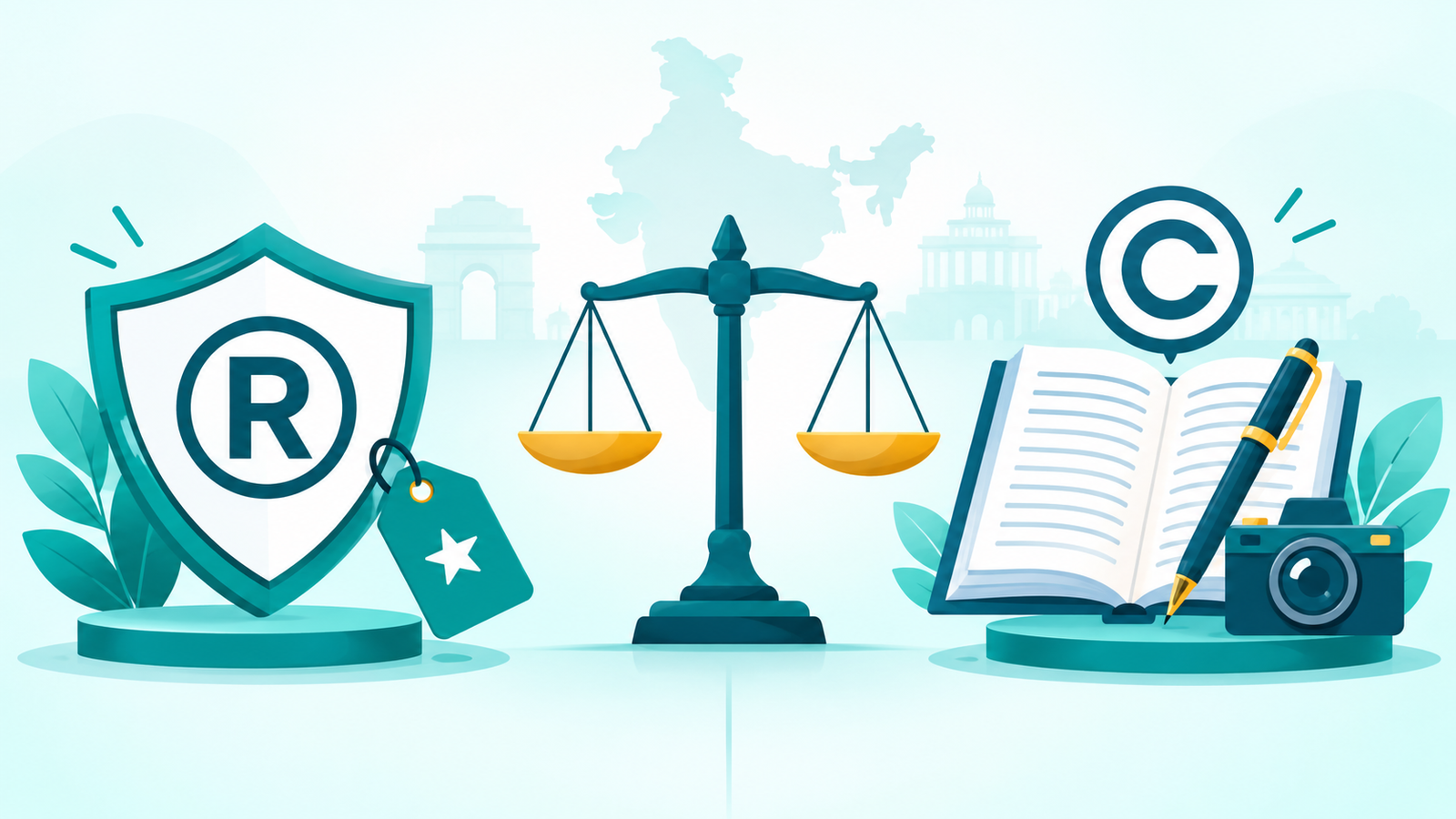
Founders often confuse trademarks and copyrights, and then protect the wrong thing. Both are forms of intellectual property, but they protect different assets and work in different ways. This guide explains the difference under Indian law and tells you which one your business needs.
What is a trademark?
A trademark is a sign that identifies the source of goods or services: a brand name, logo, tagline, label or a distinctive combination of colours or shapes. It is governed by the Trade Marks Act, 1999 and registered with the Trade Marks Registry. A registered trademark lets you stop others from using a confusingly similar mark for similar goods or services, and gives you the right to use the ® symbol.
What is copyright?
Copyright protects original creative expression: books, articles, website content, software code, photographs, music, films, drawings and design artwork. It is governed by the Copyright Act, 1957. Copyright arises automatically when the work is created, and registration with the Copyright Office is optional but gives useful evidence of ownership.
Trademark vs copyright: key differences
| Trademark | Copyright | |
|---|---|---|
| What it protects | Brand identifiers: names, logos, slogans | Original creative works |
| Main law | Trade Marks Act, 1999 | Copyright Act, 1957 |
| How protection begins | Strongest after registration; some rights arise from use | Automatically on creation |
| Registration | Strongly recommended | Optional |
| Duration | 10 years, renewable indefinitely | Generally the author’s life plus 60 years for literary and artistic works |
| Purpose | Prevent confusion in the market | Prevent copying of the work |
Which one does your business need?
- Your company or product name: trademark.
- Your logo: usually both. The artwork is protected by copyright, and the logo as a brand identifier is protected by trademark.
- Website text, blogs, videos and course material: copyright.
- Software and mobile app code: copyright, with other protections possible for specific inventions.
- A tagline or slogan: trademark, if it is distinctive.
Most startups should register a trademark early, because a brand name that someone else registers first can force a rebrand.
Trademark registration process in India
- Search: check the trademark database for identical or similar marks in your class.
- Choose the class: goods and services are divided into 45 classes, and a separate application fee applies per class.
- File the application: submit it online with the applicant details, mark and class. You can use ™ from the day you file.
- Examination and objections: the Registry examines the application and may raise objections that you need to answer.
- Publication and opposition: the mark is published in the Trade Marks Journal so others can oppose it.
- Registration: if there is no unresolved objection or opposition, the certificate is issued.
The official online filing fee is currently ₹4,500 per class for individuals, startups and small enterprises and ₹9,000 per class for other applicants. Fees can change, so check the official fee schedule before filing. The whole process commonly takes many months depending on objections and oppositions.
Copyright registration in brief
You apply through the Copyright Office with details of the work and the author, and the Registrar examines it. A separate application is filed for each work, and a registration certificate is useful evidence in disputes and licensing deals.
Common mistakes
- Assuming company registration also protects your brand name. It does not.
- Using the ® symbol before the mark is registered.
- Letting a freelance designer keep the rights to your logo. Get a written assignment of copyright.
- Filing in the wrong class, which leaves your actual products unprotected.
Frequently asked questions
Can I get both a trademark and a copyright for my logo?
Yes. They protect different aspects of the same logo.
Is a copyright registration enough to stop someone using my brand name?
No. Names and short phrases are generally protected through trademark law, not copyright.
Does MSME or startup status reduce trademark fees?
Yes, small enterprises and startups pay the lower official filing fee. See our MSME registration guide.
Protect your brand with JiStartup
We run the search, select the right class, file the application and handle objections. Explore our trademark registration, expedited trademark filing and copyright registration services, or contact us for advice.
This article is general information, not legal advice. Confirm current fees and procedures with the official IP India portals or a professional.
