
NGO Darpan Registration in India
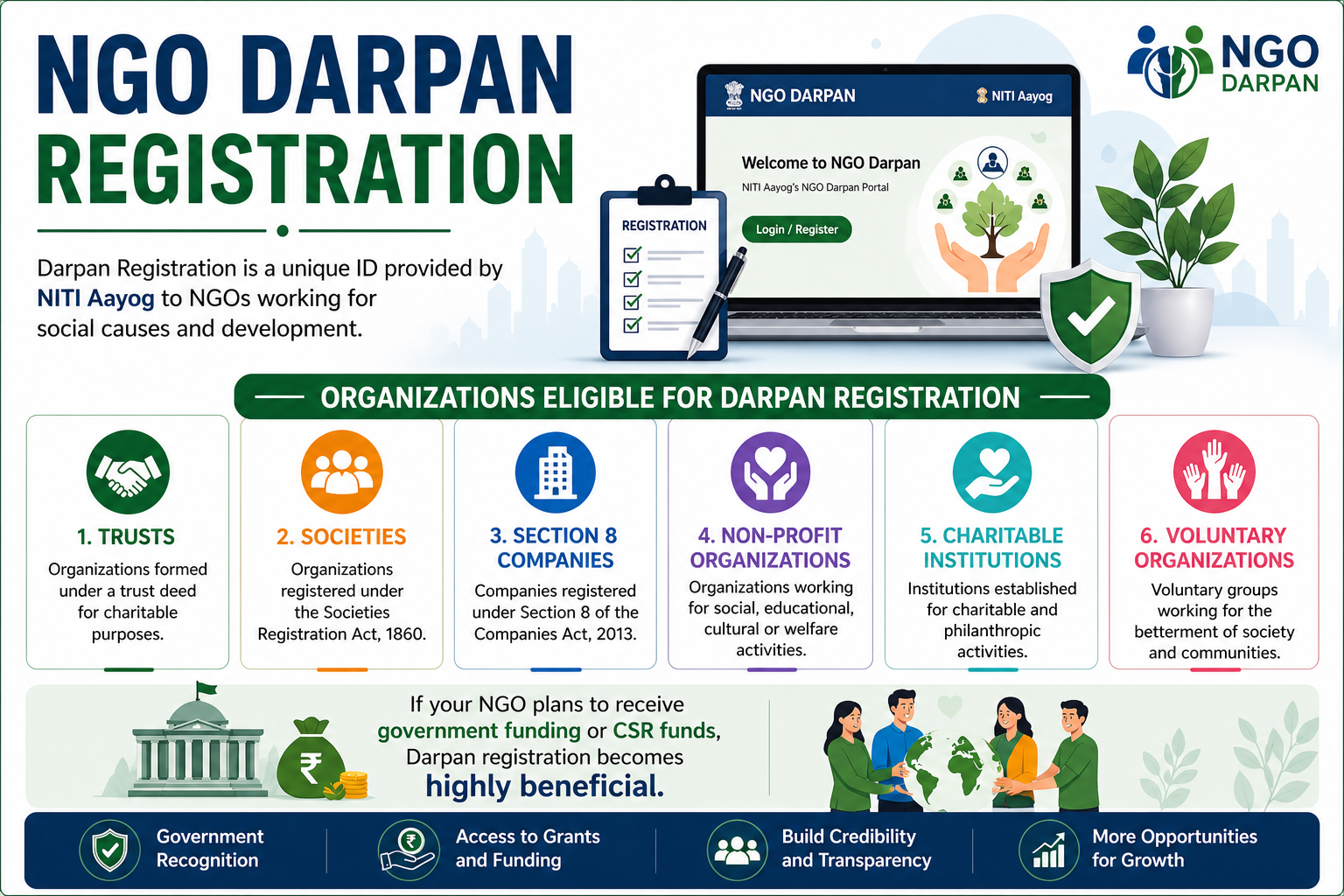
NGO Darpan Registration is an online registration process available through the NGO Darpan Portal managed by the NITI Aayog. It is mandatory for NGOs, Trusts, and Societies that wish to receive government grants, funding, or participate in government schemes.
After successful registration, the organization receives a Unique Darpan ID, which is required for applying to various ministries and government departments in India.
If your NGO wants to work with government bodies or apply for funding, completing Darpan Registration is an important step.
What is NGO Darpan?
NGO Darpan is an online platform created by the Government of India to maintain a centralized database of NGOs and voluntary organizations across the country.
The portal helps government departments verify NGO details before granting financial assistance or partnerships.
Through this portal, NGOs can:
Benefits of NGO Darpan Registration
Registering on the NGO Darpan portal provides several advantages:
1. Eligibility for Government Grants
Organizations can apply for grants from various ministries once they obtain a Darpan ID.
2. Improved Transparency
Registration improves credibility and transparency of NGOs.
3. Access to Government Schemes
NGOs can participate in development programs and welfare schemes.
4. Centralized Database
Government departments can easily verify the authenticity of NGOs.
5. Better Funding Opportunities
It increases chances of receiving support from government bodies and institutions.

Types of Organizations Eligible for Darpan Registration
The NGO Darpan portal, managed by NITI Aayog, allows different types of non-profit entities to register. Each type has its own legal structure but can apply for a Darpan ID.
1. Trust
A Trust is formed under the Indian Trusts Act or relevant state laws for charitable purposes such as education, healthcare, and social welfare.
- Managed by trustees
- Common for family or community-based charities
- Requires a Trust Deed
2. Society
A Society is registered under the Societies Registration Act, 1860. It is typically formed for promoting literature, science, arts, or charitable activities.
- Requires minimum members (usually 7)
- Governed by a managing committee
- Needs Memorandum of Association (MOA)
3. Section 8 Company
A Section 8 Company is registered under the Companies Act, 2013 for non-profit objectives.
- More structured and compliant
- Preferred for larger NGOs
- Requires Board of Directors and ROC compliance
4. Other Voluntary Organizations
Includes NGOs, charitable associations, and non-profit groups working in social development sectors such as rural development, women empowerment, education, etc.

Who Should Apply for Darpan Registration?
The following organizations should apply for NGO Darpan Registration:
Trusts
Societies
Section 8 Companies
Non-Profit Organizations
Charitable Institutions
Voluntary Organizations
If your NGO plans to receive government funding or CSR funds, Darpan registration becomes highly beneficial.
Eligibility Criteria for Darpan Registration
To apply for NGO Darpan Registration, organizations must meet the following eligibility conditions:
1. Legal Registration
The organization must be legally registered as:
- Trust
- Society
- Section 8 Company
Unregistered entities cannot apply.
2. Valid PAN Card
The NGO must have a valid PAN card in the name of the organization.
3. Active Governing Body
Details of all board members, trustees, or directors must be available and valid.
4. Aadhaar of Key Members
At least one key member (President/Secretary/Director) must provide Aadhaar details for verification.
5. Functional Organization
The NGO should be operational and involved in genuine charitable or social activities.
6. Valid Contact Details
A working mobile number and email ID are required for OTP verification and communication.
Requirements for NGO Darpan Registration
To ensure smooth registration on the portal of NITI Aayog, the following requirements must be fulfilled:
1. Accurate Organization Details
- Name of NGO (as per registration certificate)
- Registration number and date
- Type of organization (Trust/Society/Section 8 Company)
2. Registered Office Address
- Complete address with PIN code
- Should match official records
3. Details of Governing Members
- Name, designation, and contact details
- PAN and Aadhaar (for key members)
4. Digital Readiness
- Scanned copies of documents
- Access to registered mobile/email for OTP
5. Proper Documentation Format
Documents must be:
- Clear and readable
- In accepted formats (PDF/JPEG)
- Matching the details entered in the application
6. No Duplicate Registration
An NGO should not already be registered on the portal. Duplicate entries may lead to rejection.
Documents Required for Darpan Registration
Below is a comprehensive list of documents required to complete the registration process:
1. NGO PAN Card
- Mandatory for all organizations
- Must match the registered name
2. Registration Certificate
Depending on the type:
- Trust Deed (for Trust)
- Society Registration Certificate (for Society)
- Certificate of Incorporation (for Section 8 Company)
3. Governing Body Details
- List of members/trustees/directors
- Their designation and roles
4. Aadhaar Card of Members
- Required for identity verification
- Mandatory for key office bearers
5. PAN of Office Bearers
- For financial transparency and validation
6. Address Proof of Organization
- Utility bill / rent agreement / ownership proof
7. Email ID and Mobile Number
- Must be active for OTP verification
8. Memorandum of Association / Bye-laws
- Defines objectives and structure of NGO
9. Digital Signature (Optional)
- Useful for authentication but not always mandatory
Who Issues the Darpan ID?
The Darpan ID is issued through the NGO Darpan portal maintained by the NITI Aayog under the Government of India.
This ID acts as a unique identification number for NGOs when interacting with government departments.
A virtual office address is legally accepted for company registration and GST purposes.
How We Help You Build a Strong Legal Foundation
Expert Documentation Support
We prepare and verify all required documents to ensure error-free Darpan registration.
Accurate Application Filing
Our team handles the complete filing process on the NITI Aayog portal with precision.
Faster Approval Process
We minimize delays by avoiding common mistakes and ensuring compliance from day one.
End-to-End Assistance
From registration to Darpan ID generation, we provide complete support at every step.
Darpan Registration Process
The registration process involves the following steps:
Step 1 – Visit the NGO Darpan Portal
Create an account on the official portal managed by NITI Aayog.
Step 2 – Provide Organization Details
Enter details such as NGO name, address, registration type, and objectives.
Step 3 – Enter Governing Body Details
Provide information about trustees, directors, or society members.
Step 4 – Upload Documents
Submit necessary documents for verification.
Step 5 – Submit Application
After verification, the NGO will receive a Unique Darpan ID.
Common Mistakes to Avoid in Darpan Registration
Many NGOs face rejection or delays due to simple errors while applying on the NITI Aayog portal. Avoid these common mistakes:
How Long Does Darpan Registration Take?
The timeline for Darpan Registration is usually quick if all details are accurate:
Delays may occur if there are errors or document mismatches.
Is Darpan Registration Mandatory?
Darpan Registration is not compulsory for all NGOs, but it becomes mandatory in the following cases:
Without a Darpan ID, NGOs may miss out on key opportunities.
Difference Between Darpan Registration and NGO Registration
Many people confuse Darpan Registration with NGO formation. Here’s the difference:
Both are important but serve different purposes.
Advantages of Darpan Registration
Registering your NGO on the portal managed by NITI Aayog offers several long-term benefits:
1. Access to Government Grants and Funding
A valid Darpan ID is often mandatory to apply for grants from central ministries and departments. It opens doors to financial support for social and development projects.
2. Government Recognition and Credibility
Darpan Registration gives your NGO official recognition, making it more trustworthy in the eyes of government authorities, donors, and partners.
3. Increased Transparency
The portal maintains a centralized database of NGOs, ensuring transparency in operations and governance. This improves accountability and public trust.
4. Eligibility for Government Schemes
NGOs can participate in various welfare programs and schemes launched by the Government of India once registered.
5. Better Chances of CSR Funding
Many companies prefer NGOs with a Darpan ID for Corporate Social Responsibility (CSR) funding, as it ensures authenticity and compliance.
6. Easy Verification by Authorities
Government departments can quickly verify your NGO’s details, speeding up approvals for projects and collaborations.
7. Centralized Digital Profile
All key information about your NGO is stored in one place, making it easy to manage and update organizational details.
8. Enhances Professional Image
A registered NGO appears more structured and compliant, which helps in building partnerships with institutions and stakeholders.
Disadvantages of Darpan Registration
While beneficial, there are certain limitations and challenges to consider:
1. Mandatory for Government Funding
If your NGO wants to apply for government grants, Darpan Registration becomes compulsory, adding an extra compliance step.
2. Detailed Information Disclosure
You are required to provide complete details of governing members and operations, which may feel extensive for small NGOs.
3. Risk of Application Rejection
Incorrect details, document mismatch, or incomplete information can lead to rejection or delays.
4. Regular Updates Required
NGOs must keep their profile updated on the NITI Aayog portal to remain eligible for schemes and funding.
5. Dependency on Portal Functionality
Technical issues or portal downtime can sometimes delay the registration or update process.
6. Limited Use Without Government Interaction
If your NGO does not plan to apply for government schemes or funding, the immediate utility of Darpan Registration may be limited.
Register Your Darpan ID with Jistartup
Getting your NGO listed on the Darpan portal is more than just filling a form—it’s about positioning your organization for future funding, recognition, and growth. At Jistartup, we don’t just process your application; we ensure your NGO is fully prepared to meet government standards from day one.
Why Jistartup is Different
Strategic Registration Approach
We don’t treat Darpan registration as a routine task. Our experts review your NGO structure, documents, and details to align them with government expectations.
Zero-Error Filing System
Even small mistakes can delay your Darpan ID. We follow a strict verification process to ensure every detail is accurate before submission.
Guidance Beyond Registration
We help you understand how to use your Darpan ID effectively—for grants, schemes, and future compliance.
Quick Turnaround with Dedicated Support
No waiting, no confusion. Our team stays connected with you until your registration is successfully completed.
Built for NGOs That Want to Grow
Whether you are a newly formed Trust or an established NGO, registering through Jistartup ensures that your organization is:
With Jistartup, you can focus on building your business while we handle the legal formalities.
🚀 Start your entrepreneurial journey today with Jistartup!
See What Our Clients Are Saying
“The team at Jistartup handled our registration and compliance work very efficiently. Their clear guidance made the process quick and stress-free. A great partner for new entrepreneurs.”
“We opted for Virtual Office services from Office Space Provider along with company registration through Jistartup. The documentation was handled perfectly and got approved without any hassle. Very professional experience.”
Frequently Asked Questions (FAQs)
1. Can an NGO apply for Darpan Registration without 12A or 80G certification?
Yes, Darpan Registration can be obtained independently. Having 12A or 80G is not mandatory for applying on the portal managed by NITI Aayog.
2. Is there any government fee for Darpan Registration?
No, Darpan Registration is completely free of cost on the official portal. However, professional service providers may charge for assistance.
3. Can a single person register multiple NGOs on the Darpan portal?
Yes, but each NGO must have separate legal registration, PAN, and governing body details. Duplicate or fake entries may lead to rejection.
4. What should I do if I forget my Darpan login credentials?
You can reset your login details using the “Forgot Password” option available on the portal by verifying your registered email or mobile number.
5. Is Aadhaar mandatory for all members of the NGO?
No, Aadhaar is usually required only for key office bearers such as President, Secretary, or Director for verification purposes.
6. Can foreign nationals be part of an NGO registered on the Darpan portal?
Yes, foreign nationals can be members of an NGO, but proper documentation and compliance with Indian laws must be ensured.
7. Does Darpan Registration expire or require renewal?
No, the Darpan ID does not expire. However, NGOs must keep their information updated on the portal managed by NITI Aayog to remain active and eligible.
8. Can I apply for Darpan Registration if my NGO address changes?
Yes, you can register and later update the new address on the portal. It’s important to keep the information current to avoid issues.
9. Is it possible to track the status of my Darpan application?
Yes, applicants can log in to the portal and check the status of their application in real time.
10. Can Darpan Registration be cancelled or deleted?
There is no direct cancellation process, but NGOs can stop using the portal. In case of errors or duplication, you may need to contact support for resolution.
