
Register a Trust in India Easily & Legally
Building a charitable organization starts with a strong legal foundation. Trust Registration is one of the most reliable and widely used ways to establish a non-profit organization in India.
Whether your goal is to support education, provide healthcare, empower communities, or run social initiatives, a registered trust gives your organization legal identity, credibility, and long-term sustainability.
With professional support, the process becomes smooth, fast, and compliant with all legal requirements.
What is Trust Registration?
A Trust is a legal arrangement where a person (Settlor) transfers property or assets to Trustees for the benefit of the public or specific individuals.
The entire structure is governed by a legal document called the Trust Deed, which clearly defines:
Trusts are commonly used for:
Benefits of Trust Registration
Legal Identity
Your organization becomes a recognized legal entity.
Build Donor Trust
Increases credibility among donors, partners, and government authorities.
Open Bank Account
A registered trust can operate a dedicated bank account.
Eligibility for Tax Benefits
Apply for 12A and 80G registration to get tax exemptions.
Fundraising Opportunities
Eligible to receive donations, CSR funds, and grants.
Structured Governance
Clear rules ensure transparency and proper management.
Types of Trusts in India
Public Charitable Trust
Formed for the benefit of the general public such as education, healthcare, and welfare.
Private Trust
Created for specific individuals or families, mainly for asset management.
Religious Trust
Established to promote religious purposes or manage temples and institutions.
Who Should Register a Trust?
-
Individuals planning to start an NGO
-
Social workers and activists
-
Charitable groups and communities
-
Religious organizations
-
Families managing charitable assets

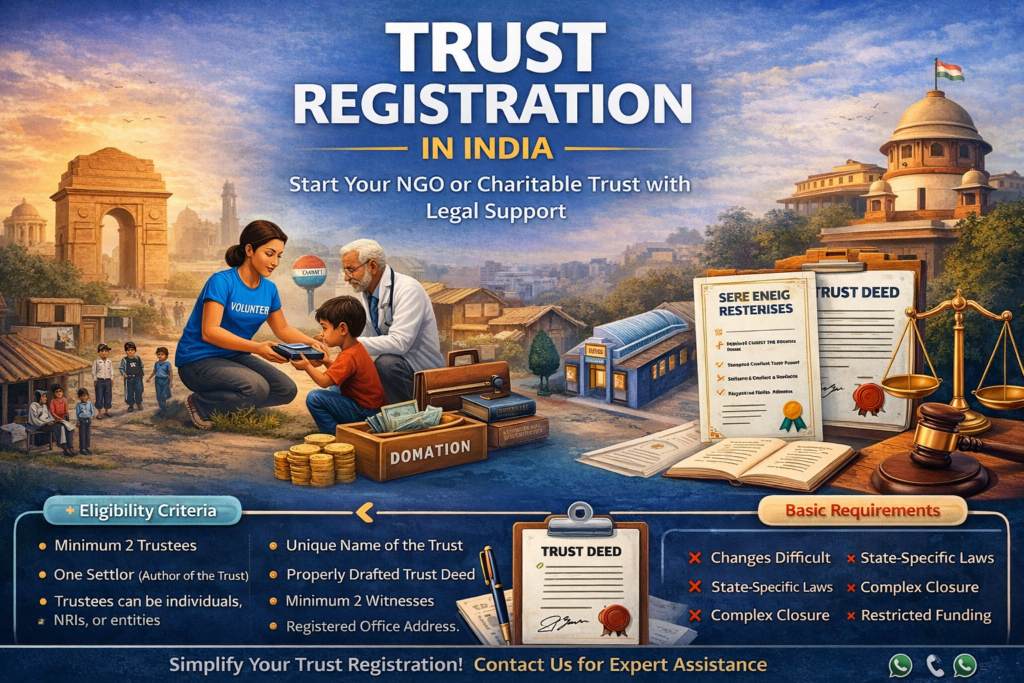
Eligibility & Requirements for Trust Registration in India
Eligibility Criteria
Basic Requirements
Legal Requirements
- Trust Deed must be executed on appropriate stamp paper as per state law
- Registration must be done at the local Sub-Registrar Office
- Trust must comply with the Indian Trusts Act (for private trusts) and relevant state laws (for public trusts)
Documents Required
Additional (Post-Registration Requirements)
A virtual office address is legally accepted for company registration and GST purposes.
How We Help You Build a Strong Legal Foundation
Expert Legal Guidance
Clear advice to choose the right structure and avoid mistakes
Customized Documentation
Professionally drafted trust deed tailored to your goals
Hassle-Free Registration
End-to-end support for smooth and quick approval
Complete Compliance Support
Assistance with legal, tax, and post-registration requirements
Step-by-Step Trust Registration Process
Step 1: Choose Trust Name
Select a unique and meaningful name for your trust.
Step 2: Draft Trust Deed
Prepare a legally valid trust deed defining objectives and rules.
Step 3: Stamp Paper Execution
Print the trust deed on stamp paper as per state rules.
Step 4: Signing of Trust Deed
Signed by settlor and trustees in presence of witnesses.
Step 5: Registration with Sub-Registrar
Submit documents to register the trust legally.
Step 6: Get Registration Certificate
Receive official trust registration confirmation.
Timeline for Trust Registration
7–15 working days, subject to:
Advantages of Trust Registration
- Legal Recognition
Registering a trust provides a formal legal identity, allowing it to operate as a recognized non-profit entity. - Easy Formation & Simple Process
Trust registration is relatively simple compared to other structures, with fewer formalities and quick setup. - Tax Benefits
Registered trusts can apply for tax exemptions such as 12A and 80G, helping reduce tax liability and attract donors. - Enhanced Credibility
A registered trust builds confidence among donors, government bodies, and stakeholders, making fundraising easier. - Asset Protection
Assets are held in the name of the trust and used only for its objectives, ensuring proper utilization. - Continuity & Stability
The trust continues to exist even if trustees change, ensuring long-term sustainability.
Disadvantages of Trust Registration
- Limited Flexibility in Changes
Once the trust deed is registered, making changes or amendments can be difficult and time-consuming. - Less Regulatory Control
Compared to other structures, trusts may have less strict regulatory oversight, which can sometimes affect transparency. - State-Specific Laws
Trust registration rules vary from state to state, making the process slightly complex depending on location. - No Personal Ownership
Trustees do not have personal ownership over trust assets, as they are meant solely for charitable purposes. - Difficult Dissolution Process
Closing or dissolving a trust is not easy and involves legal procedures. - Limited Fundraising Scope
Compared to corporate structures like Section 8 companies, trusts may face limitations in certain funding opportunities.
Why Choose JiStartup for Trust Registration?
We simplify the entire process and ensure 100% compliance.
Expert Guidance
Professional support at every stage.
Customized Trust Deed
Tailored as per your objectives.
Fast Processing
Quick documentation and filing.
Affordable Pricing
Transparent and cost-effective packages.
End-to-End Support
From consultation to registration certificate.
With Jistartup, you can focus on building your business while we handle the legal formalities.
🚀 Start your entrepreneurial journey today with Jistartup!
See What Our Clients Are Saying
“The team at Jistartup handled our registration and compliance work very efficiently. Their clear guidance made the process quick and stress-free. A great partner for new entrepreneurs.”
“We opted for Virtual Office services from Office Space Provider along with company registration through Jistartup. The documentation was handled perfectly and got approved without any hassle. Very professional experience.”
FAQs – Trust Registration in India (Advanced)
1. Can a trust own property in its name?
Yes, a registered trust can legally own, acquire, and manage property in its own name for its objectives.
2. Is it mandatory to register a trust deed?
For public charitable trusts, registration is highly recommended to gain legal recognition and avoid future disputes.
3. Can one person create a trust?
A trust requires at least one settlor and two trustees, so a single person alone cannot fully constitute a trust.
4. Can a trust operate in multiple states?
Yes, a trust registered in one state can operate across India, but may need additional local compliance in other states.
5. Is there any minimum capital requirement to start a trust?
No, there is no minimum capital requirement. The settlor can start with a nominal amount.
6. Can trustees receive salary or remuneration?
Yes, trustees can receive reasonable compensation if it is clearly mentioned in the trust deed.
7. Can a trust be converted into another entity?
No, a trust cannot be directly converted into a company or society. A new entity must be formed separately.
8. What happens if a trustee resigns or dies?
The trust continues to exist, and new trustees can be appointed as per the trust deed provisions.
9. Can foreigners or NRIs be part of a trust?
Yes, NRIs and foreign nationals can be trustees, subject to certain regulatory compliances.
10. Is audit mandatory for a trust?
Yes, if the trust exceeds specified income limits, it must maintain accounts and undergo audit as per tax laws.
