
MOA Amendment Services by JiStartup
Modify Your Memorandum of Association with Complete Legal Compliance
A company’s growth often requires changes to its business activities, capital structure, registered office, or even its corporate identity. Whenever such changes impact the contents of the Memorandum of Association (MOA), the company must legally amend its MOA and obtain the necessary approvals under the Companies Act, 2013.
JiStartup provides professional MOA Amendment Services to help businesses make these changes smoothly, accurately, and in full compliance with MCA regulations. Our experts handle documentation, drafting, filing, and follow-up processes, allowing you to focus on growing your business while we manage the legal formalities.
What is a Memorandum of Association (MOA)?
The Memorandum of Association (MOA) is one of the most important constitutional documents of a company. It defines the company’s scope of operations, objectives, powers, and relationship with shareholders and external parties.
The MOA serves as the foundation upon which a company operates and contains essential clauses such as:
Any modification to these clauses requires a formal amendment process and approval from the concerned authorities.
What is MOA Amendment?
MOA Amendment refers to the legal process of altering one or more clauses contained in the Memorandum of Association of a company.
As businesses evolve, they may need to:
Such changes cannot be implemented unless the MOA is amended and approved according to legal requirements.
Situations Where MOA Amendment Becomes Necessary
Change in Business Objectives
Many companies expand into new markets, products, or services. If the proposed activity is not covered under the existing Object Clause, an amendment becomes mandatory.
Increase in Authorized Share Capital
Companies planning to raise additional investment or issue more shares may need to increase their authorized capital, requiring modification of the Capital Clause.
Company Name Change
When a business undergoes rebranding or strategic restructuring, the Name Clause of the MOA must be amended.
Registered Office Shift to Another State
Moving the registered office from one state to another requires changes to the Registered Office Clause and approval from the relevant authorities.
Business Restructuring
Mergers, acquisitions, diversification, and strategic business transformations often require amendments to the MOA.
Compliance Requirements
Certain regulatory or legal requirements may necessitate updating the MOA to reflect the current operational structure of the company.
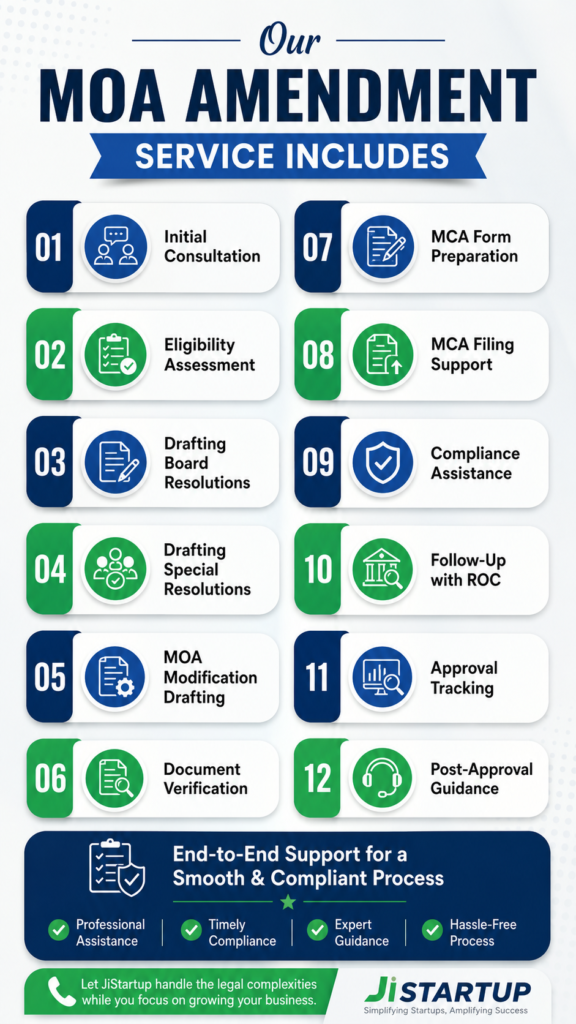
Our MOA Amendment Service Includes
Initial Consultation
Eligibility Assessment
Drafting Board Resolutions
Drafting Special Resolutions
MOA Modification Drafting
Document Verification
MCA Form Preparation
MCA Filing Support
Compliance Assistance
Follow-Up with ROC
Approval Tracking
Post-Approval Guidance
Types of MOA Amendments
Object Clause Amendment
This amendment allows a company to:
Name Clause Amendment
Required when a company intends to:
Capital Clause Amendment
Necessary for:
Registered Office Clause Amendment
Applicable when:
Liability Clause Amendment
In specific cases, companies may need to modify shareholder liability provisions.
Documents Required for MOA Amendment
The following documents may be required:
Additional documents may be required depending on the type of amendment.
A virtual office address is legally accepted for company registration and GST purposes.
How We Help You Build a Strong Legal Foundation
Expert Legal Guidance
Professional support from compliance experts throughout the process.
Accurate Documentation
Preparation and verification of all legal documents.
Seamless MCA Filing
Error-free filing with the Ministry of Corporate Affairs.
End-to-End Compliance Support
Complete assistance from consultation to final approval.
MOA Amendment Process
Step 1: Preliminary Consultation
Our experts review your requirements and determine the applicable amendment procedure.
Step 2: Drafting Board Resolution
We prepare the necessary board resolutions authorizing the amendment process.
Step 3: Board Meeting
The Board of Directors approves the proposed amendment and authorizes further actions.
Step 4: Shareholders’ Approval
A Special Resolution is passed by shareholders during an Extraordinary General Meeting (EGM) or Annual General Meeting (AGM).
Step 5: Preparation of Altered MOA
The revised MOA is drafted according to the proposed changes.
Step 6: MCA Filing
Required forms and supporting documents are filed with the Ministry of Corporate Affairs.
Step 7: Regulatory Review
The Registrar of Companies reviews the application and supporting documents.
Step 8: Approval and Completion
Upon approval, the amended MOA becomes legally effective.
Why Timely MOA Amendment is Important
Many businesses evolve over time. A startup that initially focused on one service may expand into multiple industries, introduce new products, or seek external funding. If these changes are not reflected in the Memorandum of Association, the company may face compliance issues and operational limitations.
Timely amendment of the MOA ensures that the company operates within the legal framework prescribed under the Companies Act, 2013. It also demonstrates transparency and accountability to investors, customers, financial institutions, and regulatory authorities.
Updating the MOA at the right time helps businesses avoid legal complications while creating a strong foundation for future growth and expansion.
Common Mistakes Companies Make During MOA Amendment
Many companies experience delays or rejections due to avoidable errors during the amendment process. Some common mistakes include:
Professional assistance can significantly reduce these risks and ensure successful approval.
Legal Provisions Governing MOA Amendment
The amendment of a company’s Memorandum of Association is governed by various provisions of the Companies Act, 2013. Depending on the nature of the amendment, specific sections and rules become applicable.
Certain amendments may require:
Following the prescribed legal procedures is essential to ensure the validity of the amendment.
Benefits of Professional MOA Amendment Services
Handling MOA amendments without professional guidance can be complex and time-consuming. Professional assistance provides several advantages:
Reduced Compliance Risks
Experts ensure that all filings meet legal requirements.
Faster Approval Process
Proper documentation minimizes the chances of rejection.
Accurate Documentation
All resolutions and forms are prepared correctly.
Expert Consultation
Receive guidance on the most suitable amendment structure.
Complete Peace of Mind
Focus on business growth while professionals manage compliance.
Advantages of MOA Amendment
1. Enables Business Expansion and Diversification
One of the biggest advantages of amending the Memorandum of Association is the ability to legally expand business operations. As market conditions change, companies often wish to introduce new products, services, or business activities. If these activities are not covered under the existing Object Clause, the company cannot legally undertake them. An MOA amendment allows the company to diversify into new sectors and explore additional revenue opportunities without compliance concerns.
2. Facilitates Fund Raising and Investment
Investors, venture capitalists, and financial institutions prefer investing in companies with clear and updated constitutional documents. If a company plans to increase its authorized share capital or issue additional shares, the MOA must be amended accordingly. This amendment creates opportunities for raising funds and attracting strategic investments for business growth.
3. Supports Business Restructuring
Companies may undergo mergers, acquisitions, partnerships, or operational restructuring during their lifecycle. MOA amendments help businesses align their legal structure with changing business requirements. This flexibility ensures smooth transitions and better corporate management.
4. Enhances Legal Compliance
Operating beyond the scope defined in the MOA can result in regulatory issues and penalties. Amending the MOA ensures that all company activities remain legally compliant with the provisions of the Companies Act, 2013. Proper compliance also reduces the risk of disputes with regulators and stakeholders.
5. Improves Corporate Governance
An updated MOA accurately reflects the current objectives and structure of the company. This improves transparency, strengthens corporate governance, and helps shareholders, investors, creditors, and regulatory authorities understand the company’s operations clearly.
6. Supports Company Rebranding
Businesses often rebrand themselves to enter new markets, improve brand perception, or align with changing strategies. A name change requires an amendment to the Name Clause of the MOA. This allows companies to legally adopt a new identity and strengthen their market presence.
7. Facilitates Increase in Authorized Capital
Growing companies frequently require additional capital to support expansion plans. By amending the Capital Clause, businesses can increase their authorized share capital and issue more shares when needed. This helps in securing future investments and financing.
8. Increases Operational Flexibility
Business environments change rapidly. Companies that maintain an updated MOA can quickly adapt to emerging opportunities, technological advancements, and market demands. This flexibility provides a competitive advantage and supports long-term growth.
9. Builds Credibility Among Stakeholders
Customers, investors, lenders, and government authorities view compliant businesses more favorably. An amended MOA demonstrates that the company follows proper legal procedures and maintains accurate corporate records, thereby enhancing trust and credibility.
10. Reduces Future Legal Complications
Keeping the MOA aligned with actual business activities minimizes the chances of legal disputes, compliance notices, and operational restrictions. It also simplifies future corporate actions such as mergers, acquisitions, funding rounds, and regulatory approvals.
Disadvantages of MOA Amendment
1. Involves Complex Legal Procedures
The MOA amendment process requires compliance with various legal provisions under the Companies Act, 2013. Companies must follow specific procedures, obtain approvals, and file prescribed forms with the Ministry of Corporate Affairs (MCA). For businesses unfamiliar with corporate compliance, the process can be complicated.
2. Requires Shareholder Approval
Most MOA amendments require a Special Resolution approved by shareholders. Organizing meetings, preparing notices, obtaining approvals, and maintaining records can be time-consuming, especially for companies with multiple stakeholders.
3. Documentation Intensive Process
Several documents are required for a successful amendment, including board resolutions, shareholder resolutions, revised MOA drafts, meeting notices, and MCA forms. Any errors or omissions in these documents can lead to delays or rejection of the application.
4. Additional Compliance Costs
MOA amendments may involve government filing fees, professional fees, documentation expenses, and compliance-related costs. Depending on the nature of the amendment, these costs can vary and may impact smaller businesses.
5. Approval Delays Can Occur
The amendment becomes effective only after approval from the Registrar of Companies (ROC) and other authorities where applicable. Delays in approvals or requests for additional information can extend the timeline and affect planned business activities.
6. Risk of Rejection
Incorrect filings, incomplete documentation, or non-compliance with legal requirements can result in rejection of the amendment application. Companies may then need to rectify errors and refile documents, causing additional expenses and delays.
7. Temporary Administrative Burden
During the amendment process, management must dedicate time and resources to meetings, documentation, approvals, and coordination with professionals. This may temporarily divert attention from core business operations.
8. Potential Impact on Existing Agreements
Certain amendments, particularly those involving company name changes, business objectives, or capital restructuring, may require updates to contracts, licenses, bank records, GST registrations, and other statutory documents. This can increase administrative workload.
9. Regulatory Scrutiny
Major amendments such as interstate office shifting, capital restructuring, or significant object clause changes may attract additional scrutiny from regulatory authorities. Companies must ensure complete compliance to avoid complications.
10. Time-Consuming for Large Organizations
For companies with a large shareholder base or complex corporate structures, obtaining approvals and coordinating legal formalities can take considerable time. This may delay the implementation of strategic business decisions.
JiStartup's Commitment to Compliance Excellence
At JiStartup, we understand that every company has unique compliance requirements. Our dedicated team works closely with clients to understand their business objectives and ensure that every amendment aligns with legal regulations and future growth plans.
From the initial consultation to final approval, we provide transparent communication, professional support, and timely updates throughout the process.
Our mission is to simplify corporate compliance and help businesses build a strong legal foundation for sustainable growth.
See What Our Clients Are Saying
“The team at Jistartup handled our registration and compliance work very efficiently. Their clear guidance made the process quick and stress-free. A great partner for new entrepreneurs.”
“We opted for Virtual Office services from Office Space Provider along with company registration through Jistartup. The documentation was handled perfectly and got approved without any hassle. Very professional experience.”
Frequently Asked Questions (FAQs) on MOA Amendment
1. What is an MOA Amendment?
An MOA Amendment is the process of making changes to the Memorandum of Association of a company. These changes may relate to the company’s name, business objectives, registered office, authorized capital, or other key clauses contained in the MOA.
2. Is MOA Amendment mandatory for adding a new business activity?
Yes. If the proposed business activity is not covered under the existing Object Clause of the MOA, the company must amend the Object Clause before legally undertaking the new activity.
3. Can a company amend multiple clauses of the MOA at the same time?
Yes. A company can amend multiple clauses, such as the Name Clause, Object Clause, and Capital Clause, through the same amendment process, subject to applicable approvals and compliance requirements.
4. Who approves the MOA Amendment?
The amendment generally requires approval from the Board of Directors and shareholders through a Special Resolution. Certain amendments may also require approval from the Registrar of Companies (ROC) or other regulatory authorities.
5. How long does the MOA Amendment process take?
The timeline depends on the type of amendment and regulatory approvals involved. In most cases, the process may take anywhere between 7 to 30 working days after submission of all required documents.
6. Can a Private Limited Company amend its MOA?
Yes. Private Limited Companies, Public Limited Companies, and other eligible companies registered under the Companies Act can amend their MOA by following the prescribed legal procedures.
7. What happens if a company operates outside the scope of its MOA?
Operating beyond the activities specified in the MOA may lead to compliance issues, legal complications, penalties, and regulatory action. Therefore, it is important to amend the MOA before undertaking activities not covered by the existing Object Clause.
8. Does MOA Amendment affect the company's GST registration or bank account?
In some cases, such as a company name change or registered office change, related records including GST registration, bank accounts, licenses, and other statutory registrations may need to be updated after the amendment is approved.
9. Can shareholders reject a proposed MOA Amendment?
Yes. Since most amendments require approval through a Special Resolution, shareholders have the right to vote for or against the proposed amendment. The amendment can proceed only if the required majority approves it.
10. What happens after Private Limited Company registration is completed?
JiStartup provides end-to-end assistance including consultation, document preparation, drafting of resolutions, MCA filing, compliance support, and follow-up with authorities. Our experts ensure a smooth, accurate, and hassle-free amendment process at an affordable cost.
