

GSTR–10 Final Return Filing Online in India
Cancelling your GST registration is not the final step in GST compliance. Businesses whose GST registration has been cancelled or surrendered are required to file GSTR–10, also known as the Final Return. This return helps the government confirm that all pending tax liabilities have been cleared before the GST registration is officially closed.
At JiStartup, we provide professional and hassle-free GSTR–10 filing services for businesses across India. Whether your business has closed, merged, discontinued operations, or voluntarily surrendered GST registration, our experts help you complete the filing process accurately and on time.
Our goal is to ensure complete compliance while helping businesses avoid penalties, notices, and unnecessary legal complications.
What is GSTR–10?
GSTR–10 is a final GST return filed by taxpayers whose GST registration has been cancelled. This return contains information about:
The purpose of GSTR–10 is to ensure that taxpayers pay any pending GST liability before exiting the GST system.
Why is GSTR–10 Important?
Many businesses assume that GST compliance ends immediately after cancellation of GST registration. However, GST law requires taxpayers to file a final return to formally conclude their tax obligations.
Filing GSTR–10 is important because it:
Failure to file GSTR–10 may result in late fees, notices from GST authorities, and difficulties in future registrations.
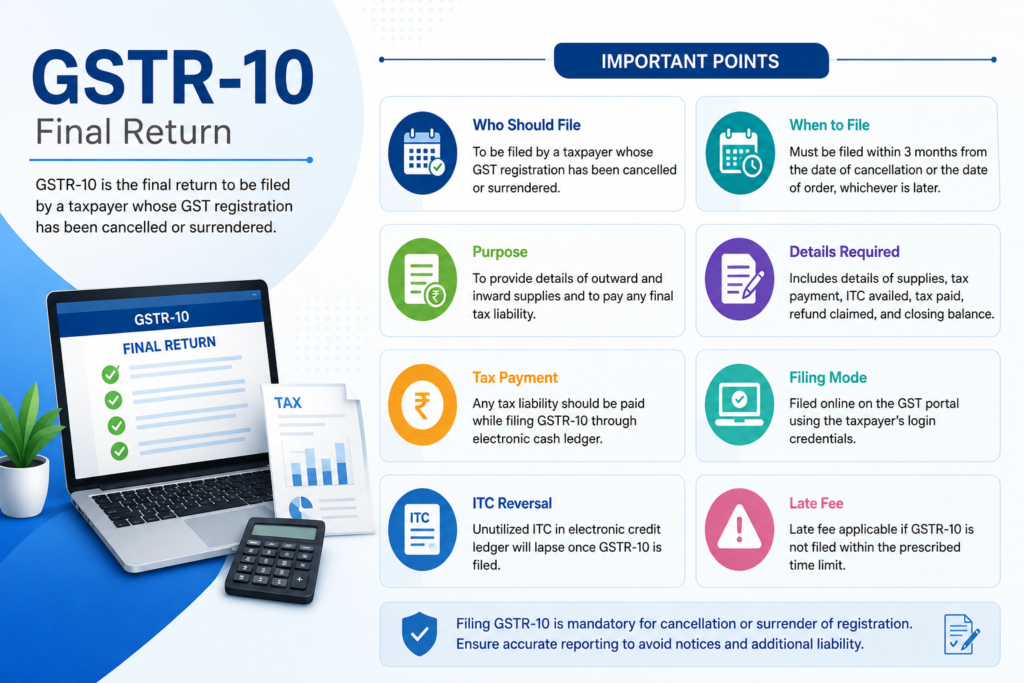
Who Should File GSTR–10?
GSTR–10 must be filed by taxpayers whose GST registration has been cancelled or surrendered.
This includes:
Who is Not Required to File GSTR–10?
The following taxpayers are not required to file GSTR–10:
When Should GSTR–10 Be Filed?
GSTR–10 must be filed within 3 months from:
Whichever is later.
Timely filing is essential to avoid penalties and compliance issues.
Documents Required for GSTR–10 Filing
To file GSTR–10, businesses generally need:
Our experts help organize and verify all documents before filing.
How We Help You Build a Strong Legal Foundation
Expert GST Compliance Support
Professional assistance for accurate and error-free GSTR–10 filing.
Timely Filing & Penalty Prevention
We ensure your final return is filed within the due date.
Complete Documentation Assistance
Support in organizing and verifying all required GST documents.
Hassle-Free Online Process
Smooth end-to-end filing process with dedicated expert guidance.
Our Step-by-Step GSTR–10 Filing Process
Step 1 – Initial Consultation
We understand your business status and GST cancellation details.
Step 2 – Document Collection
Required documents and stock details are collected and verified.
Step 3 – Liability Calculation
Our experts calculate applicable tax liabilities accurately.
Step 4 – Return Preparation
We prepare GSTR–10 carefully according to GST regulations.
Step 5 – Filing on GST Portal
The return is submitted online through the GST portal.
Step 6 – Acknowledgement & Completion
You receive filing confirmation and compliance support.
Penalty for Late Filing of GSTR–10
Failure to file GSTR–10 within the due date may lead to:
JiStartup helps you avoid these penalties through timely and accurate filing support.
Details Included in GSTR–10
The following information is generally included in GSTR–10:
Basic Taxpayer Details
Cancellation Information
Stock Details
Tax Liability
Payment Information
Common Reasons for GST Cancellation
Businesses may file GSTR–10 after GST cancellation due to several reasons such as:
Challenges Faced While Filing GSTR–10
Many businesses face difficulties while filing the final GST return because of:
JiStartup’s expert team handles the entire process professionally to reduce errors and delays.
Advantages of Filing GSTR–10
1. Ensures Proper GST Compliance
Filing GSTR–10 completes your GST obligations legally after cancellation of registration. It confirms that your business has fulfilled all pending tax responsibilities before exiting the GST system.
2. Avoids Heavy Penalties and Notices
Timely filing helps businesses avoid late fees, GST notices, and legal actions from tax authorities. This reduces unnecessary compliance stress and financial burden.
3. Smooth Closure of GST Registration
GSTR–10 helps complete the GST cancellation process properly. Without filing the final return, the cancellation process may remain incomplete.
4. Maintains Good Compliance History
A clean GST compliance record can help businesses in future registrations, loan approvals, government tenders, and legal verifications.
5. Prevents Future Legal Complications
Filing the final return reduces the chances of future disputes related to pending taxes or unclosed GST liabilities.
6. Proper Reporting of Closing Stock
GSTR–10 ensures that details of remaining stock, capital goods, and input tax credit are properly disclosed and settled.
7. Peace of Mind for Business Owners
Businesses can close operations or surrender GST registration confidently after completing all legal formalities.
8. Helps in Business Restructuring
Companies undergoing mergers, closures, transfers, or restructuring can maintain proper legal compliance through final return filing.
Disadvantages of Not Filing GSTR–10
1. Daily Late Fees and Penalties
Failure to file GSTR–10 can result in late fees of ₹200 per day until the return is filed, subject to prescribed limits.
2. GST Department Notices
Non-filing may trigger notices and reminders from GST authorities, leading to additional compliance pressure.
3. Legal and Compliance Issues
Businesses may face legal complications if GST liabilities remain unresolved after cancellation.
4. Difficulty in Future GST Registration
Past non-compliance can create problems while applying for new GST registrations in the future.
5. Increased Risk of Tax Disputes
Incorrect or incomplete closure of GST registration may lead to disputes regarding stock valuation or unpaid taxes.
6. Negative Impact on Business Reputation
Poor compliance records may affect credibility with banks, investors, vendors, and government authorities.
7. Delay in Complete Business Closure
Without filing the final return, the GST cancellation process may remain incomplete, causing administrative delays.
8. Additional Financial Burden
Penalties, interest, and professional rectification costs may increase if the filing is delayed for a long period.
How JiStartup Helps You with GSTR–10 Filing
Expert GST Consultation
Our professionals understand your cancellation status and guide you through the complete process.
Accurate Tax Computation
We calculate tax liabilities on closing stock correctly to avoid future disputes.
Complete Documentation Support
Our team helps organize and verify all necessary documents.
Error-Free Filing
We ensure proper return preparation and accurate submission.
Timely Filing Assistance
We help you meet due dates and avoid penalties.
Dedicated Customer Support
Get assistance at every stage of your filing process.
See What Our Clients Are Saying
“The team at Jistartup handled our registration and compliance work very efficiently. Their clear guidance made the process quick and stress-free. A great partner for new entrepreneurs.”
“We opted for Virtual Office services from Office Space Provider along with company registration through Jistartup. The documentation was handled perfectly and got approved without any hassle. Very professional experience.”
Frequently Asked Questions (FAQs)
1. Can I file GSTR–10 myself on the GST portal?
Yes, GSTR–10 can be filed directly on the GST portal. However, professional assistance helps avoid mistakes in stock valuation, tax calculation, and compliance reporting.
2. Is GSTR–10 required if there was no business activity?
Yes, even if there was no business activity after GST cancellation, eligible taxpayers may still need to file the final return.
3. Do I need to file pending GST returns before GSTR–10?
Yes, all regular GST returns should generally be filed before submitting GSTR–10.
4. Can GSTR–10 be filed after voluntary GST cancellation?
Yes, taxpayers who voluntarily surrender their GST registration are required to file GSTR–10.
5. Is there any government fee for filing GSTR–10?
There is no separate government filing fee for GSTR–10, but late fees may apply if filed after the due date.
6. What details of stock are required in GSTR–10?
Businesses need to provide details of inputs, semi-finished goods, finished goods, and capital goods available on the cancellation date.
7. Can a cancelled GST registration be reactivated after filing GSTR–10?
In some cases, GST registration may be restored through revocation procedures, depending on eligibility and GST department approval.
8. What if my GST registration was cancelled by the department?
Even if the GST department cancels the registration, eligible taxpayers are still required to file GSTR–10.
9. Does GSTR–10 apply to businesses operating in multiple states?
Yes, GSTR–10 must be filed for each GST registration that has been cancelled in different states.
10. Why should I choose professional help for GSTR–10 filing?
Professional experts help ensure accurate filing, proper tax calculation, timely submission, and reduced chances of penalties or notices.
