
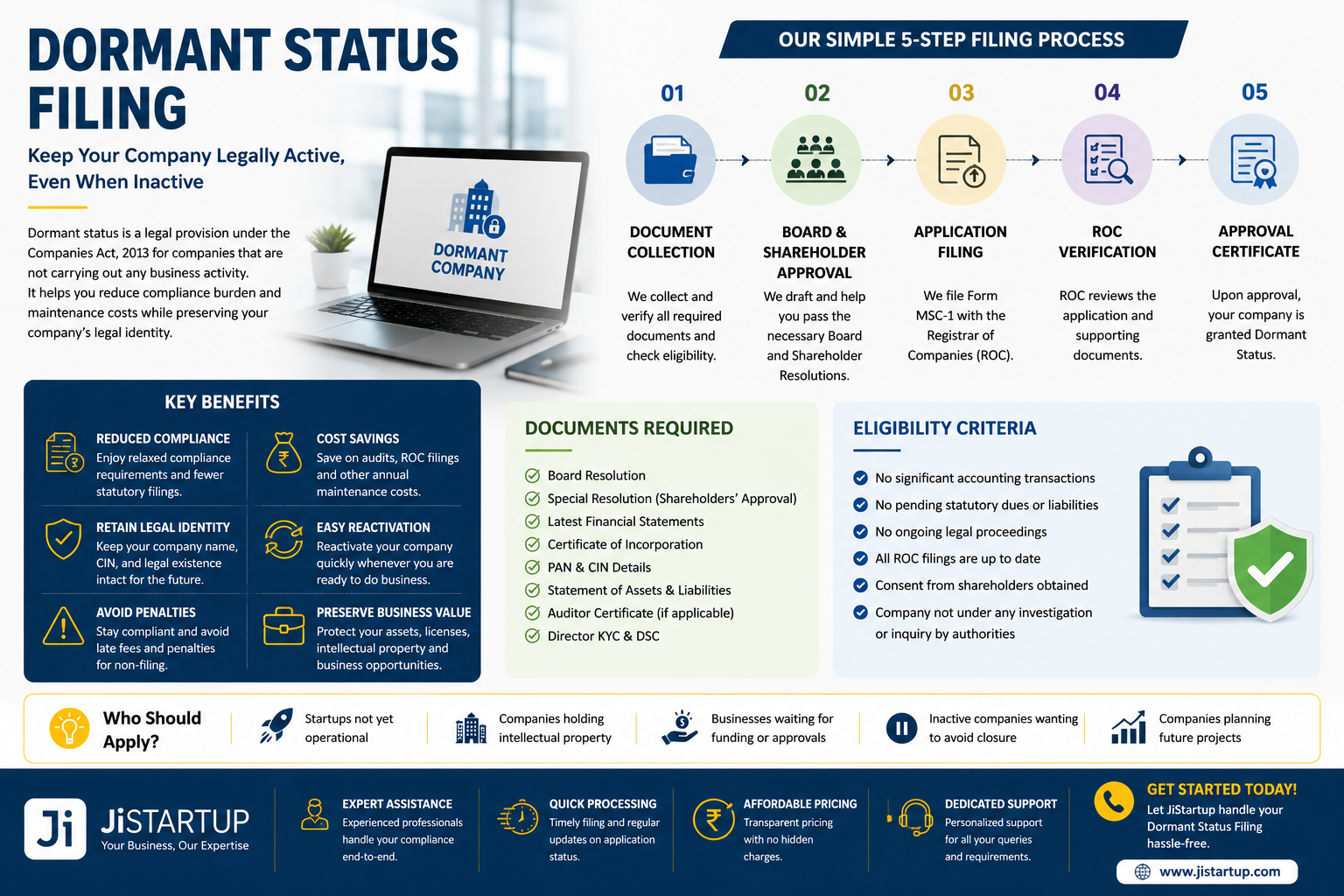
Dormant Status Filing Preserve Your Company While Reducing Compliance Costs
Has your company temporarily stopped business operations? Are you planning to restart your business in the future but don’t want to face unnecessary compliance expenses every year?
A dormant company status is the perfect solution for businesses that are inactive but wish to retain their legal identity. Instead of keeping an inactive company under regular compliance obligations, you can apply for Dormant Status under the Companies Act, 2013 and significantly reduce your annual compliance burden.
JiStartup provides complete Dormant Status Filing services across India. From checking eligibility to preparing documents, filing applications with the Registrar of Companies (ROC), and obtaining approval, our experienced professionals handle everything on your behalf.
Whether you own a startup, private limited company, subsidiary, or a company established for a future project, we ensure a smooth and hassle-free filing process.
What is Dormant Company Status?
Dormant Company Status is a legal provision introduced under Section 455 of the Companies Act, 2013. It allows inactive companies to obtain a special status from the Registrar of Companies (ROC), enabling them to remain legally registered while enjoying reduced compliance obligations.
A company that has no significant accounting transactions or is not carrying out any business activity may apply for dormant status.
Many entrepreneurs register companies for future business plans, investment opportunities, intellectual property ownership, or project development. Instead of closing such companies, dormant status allows them to preserve their corporate existence at a much lower maintenance cost.
Dormant status does not dissolve the company. It simply changes its operational status until the business is ready to become active again.
Why Should You Apply for Dormant Status?
Keeping an inactive company under normal compliance requirements can become expensive and time-consuming. Every financial year, active companies must file annual returns, financial statements, conduct audits, maintain statutory registers, and comply with various legal requirements.
If your company is not conducting any business, these recurring obligations may become unnecessary.
Dormant status offers an ideal alternative by reducing compliance requirements while preserving your company’s legal identity.
Key Benefits of Dormant Company Status
Reduced Annual Compliance
Dormant companies enjoy significantly fewer compliance obligations compared to active companies, making administration much easier.
Lower Maintenance Cost
Since filing requirements are minimal, companies save considerable money on professional fees, audits, accounting, and annual ROC compliance.
Preserve Company Name
Your registered company name remains protected and cannot be used by another business.
Retain Corporate Identity
Your Certificate of Incorporation, Corporate Identity Number (CIN), and legal existence remain valid.
Easy Reactivation
Whenever you’re ready to resume operations, your company can easily apply for active status.
Better Than Company Closure
Dormant status allows businesses to preserve their legal structure without going through the lengthy process of striking off and re-incorporating later.
Suitable for Future Business Plans
Many startups register companies before securing funding or launching products. Dormant status helps preserve these companies until operations begin.
Holds Valuable Assets
Companies that own trademarks, copyrights, patents, domain names, or intellectual property can retain these assets while remaining dormant.
Who Can Apply for Dormant Status?
A company may apply for dormant status if it meets the prescribed conditions under the Companies Act.
Generally, the company should:
Companies That Benefit from Dormant Status
Dormant company status is suitable for:
Documents Required for Dormant Status Filing
Our team assists in preparing and verifying all required documents.
Typically, the following documents are required:
Additional documents may be required depending on the company’s compliance history.
How We Help You Build a Strong Legal Foundation
Clear Eligibility Review
We check whether your company qualifies for dormant status before filing.
Accurate Documentation
We prepare all resolutions, declarations, and supporting papers correctly.
Smooth ROC Filing
We handle the complete application process with the Registrar of Companies.
Ongoing Compliance Support
We help you stay compliant even after your company becomes dormant.
Step-by-Step Dormant Status Filing Process
Step 1 – Initial Consultation
Our experts understand your business status and evaluate whether your company qualifies for dormant status.
Step 2 – Eligibility Verification
We review previous ROC filings, financial records, statutory compliance, and other legal requirements.
Step 3 – Documentation
Our professionals prepare all board resolutions, shareholder resolutions, declarations, and supporting documents.
Step 4 – Filing Application
We file the prescribed Dormant Status application with the Registrar of Companies along with all necessary documents.
Step 5 – ROC Verification
The Registrar examines your application and may request additional clarification if required.
Step 6 – Approval
Upon successful verification, the ROC grants Dormant Company Status and updates the company’s records.
Compliance After Obtaining Dormant Status
Although compliance requirements are reduced, dormant companies must still fulfill certain obligations.
These include:
How Can a Dormant Company Become Active Again?
Business opportunities may arise at any time. Whenever you’re ready to restart operations, your dormant company can be reactivated.
The process generally includes:
JiStartup also provides complete Dormant Company Reactivation services.
Common Reasons Businesses Choose Dormant Status
Many businesses choose dormant status because:
Dormant status allows businesses to remain legally protected without unnecessary annual expenses.
Advantages of Dormant Company Status
1. Significant Reduction in Annual Compliance
One of the biggest advantages of obtaining dormant company status is the reduction in statutory compliance requirements. Active companies are required to file annual financial statements, annual returns, conduct board meetings, maintain various statutory registers, and comply with several provisions under the Companies Act, 2013. A dormant company enjoys relaxed compliance obligations, making it much easier to maintain the company while it remains inactive.
2. Lower Business Maintenance Costs
Maintaining an active company involves expenses such as accounting fees, audit charges, ROC filing fees, professional consultation costs, and administrative expenses. By obtaining dormant status, these recurring costs are considerably reduced, helping business owners save money while preserving their company’s legal existence.
3. Retains the Company’s Legal Identity
Dormant status allows a company to continue existing as a legally registered entity. Its Corporate Identity Number (CIN), Certificate of Incorporation, and legal status remain intact. This means the company does not need to undergo the lengthy incorporation process again when business activities resume.
4. Protects the Company Name
A registered company name is an important business asset. By obtaining dormant status, the company retains exclusive rights over its registered name, preventing others from registering or using an identical name during the dormant period.
5. Easy Reactivation for Future Business
If business operations need to restart in the future, the company can apply for reactivation by following the prescribed legal procedure. This is much faster and more convenient than forming a completely new company from scratch.
6. Ideal for Future Projects and Investments
Many entrepreneurs incorporate companies for future expansion, investment opportunities, or upcoming projects. If the project is delayed due to funding, market conditions, or regulatory approvals, dormant status allows the company to remain legally registered until operations begin.
7. Suitable for Holding Intellectual Property
Companies that own valuable assets such as trademarks, copyrights, patents, software, domain names, or other intellectual property can retain ownership without actively carrying on business. Dormant status provides legal continuity while minimizing compliance costs.
8. Prevents Unnecessary Penalties
Inactive companies that fail to comply with mandatory ROC filings may face penalties, additional fees, and legal consequences. Applying for dormant status helps companies remain compliant with reduced obligations and lowers the risk of non-compliance penalties.
9. Better Alternative to Company Closure
Closing or striking off a company is often a permanent decision. If the promoters wish to restart business later, they may need to incorporate a new company, obtain fresh registrations, and rebuild their corporate identity. Dormant status allows businesses to pause operations without losing their legal existence.
10. Maintains Business Credibility
Even though the company is inactive, it continues to exist as a registered corporate entity. This can be beneficial when dealing with investors, financial institutions, government authorities, or future business partners who value an established corporate structure.
11. Preserves Corporate History
The company’s incorporation date, statutory records, and compliance history remain intact. This continuity can add credibility and may be advantageous when seeking investments, partnerships, or contracts in the future.
12. Provides Operational Flexibility
Business conditions can change unexpectedly. Dormant status gives promoters the flexibility to pause operations during uncertain times and resume business whenever market conditions become favorable without losing the benefits of an existing company.
Disadvantages of Dormant Company Status
1. Limited Business Operations
A dormant company cannot actively conduct business or undertake significant commercial transactions. If the company starts regular business activities without restoring active status, it may violate the applicable legal provisions.
2. Annual Compliance Still Exists
Although compliance requirements are reduced, they are not completely eliminated. Dormant companies must continue filing prescribed annual returns, maintain the minimum number of directors, and comply with other applicable legal requirements. Failure to do so may result in penalties or cancellation of dormant status.
3. Restrictions on Significant Accounting Transactions
Dormant companies are not permitted to undertake significant accounting transactions except those specifically allowed under the Companies Act, such as payment of government fees or statutory compliance expenses. Business-related financial transactions may require reactivation of the company.
4. Reactivation Process is Required Before Business Operations
Before resuming normal business activities, a dormant company must apply to restore its active status with the Registrar of Companies. This involves additional documentation, filing procedures, and approval, which may require time and professional assistance.
5. Existing Liabilities Must Be Cleared
Companies with unresolved liabilities, pending statutory dues, or certain legal issues may not qualify for dormant status until such matters are resolved. This can delay the application process for some businesses.
6. Ongoing Regulatory Oversight
Dormant companies remain under the jurisdiction of the Registrar of Companies. They may still receive notices, inspections, or requests for clarification regarding statutory compliance if required by law.
7. Not Suitable for Frequently Changing Businesses
Businesses that expect to start and stop operations frequently may find dormant status inconvenient because every transition back to active operations requires legal formalities and regulatory approval.
8. Additional Professional Assistance May Be Needed
Although compliance is reduced, companies often require professional support for annual filings, documentation, and maintaining dormant status. This can involve recurring professional service costs.
9. Risk of Losing Dormant Status
If a dormant company fails to comply with the prescribed annual filing requirements or engages in unauthorized business transactions, the Registrar of Companies may remove its dormant status and restore it to active status or initiate further legal action, depending on the circumstances.
10. No Revenue Generation During Dormant Period
Since a dormant company is intended for inactive businesses, it cannot operate as a regular commercial entity or generate business income until it is reactivated. This makes dormant status unsuitable for companies that intend to continue trading or providing services.
Why Choose JiStartup?
Experienced Legal Professionals
Our compliance experts have extensive experience in ROC filings and corporate legal services.
End-to-End Assistance
From documentation to final approval, everything is handled by our team.
Affordable Pricing
Transparent pricing with no hidden charges.
Fast Processing
Quick documentation and timely filing reduce delays.
Dedicated Relationship Manager
Get one point of contact throughout your filing process.
Pan India Service
We serve startups, MSMEs, entrepreneurs, and companies across India through completely online services.
Regular Compliance Support
Even after approval, we help maintain your dormant company status through annual compliance services.
Data Security
Your company information remains confidential and securely managed.
See What Our Clients Are Saying
“The team at Jistartup handled our registration and compliance work very efficiently. Their clear guidance made the process quick and stress-free. A great partner for new entrepreneurs.”
“We opted for Virtual Office services from Office Space Provider along with company registration through Jistartup. The documentation was handled perfectly and got approved without any hassle. Very professional experience.”
Frequently Asked Questions (FAQs)
1. Can a company with bank accounts apply for dormant status?
Yes. A company may retain its bank account while applying for dormant status, provided it meets the eligibility conditions and does not carry out significant business transactions through the account. It is advisable to maintain only transactions permitted under the Companies Act.
2. Can a dormant company own movable or immovable property?
Yes. A dormant company can legally own assets such as land, buildings, vehicles, machinery, trademarks, patents, copyrights, or other intellectual property. Dormant status does not affect the ownership rights of the company.
3. Is GST registration automatically cancelled after obtaining dormant status?
No. Dormant company status under the Companies Act does not automatically cancel GST registration. If the company has an active GST registration but is no longer conducting business, a separate application may be required to surrender or deactivate the GST registration, depending on the circumstances.
4. Can foreign shareholders be part of a dormant company?
Yes. A company with foreign shareholders or foreign investment can apply for dormant status, provided it satisfies the applicable legal requirements and there are no regulatory restrictions preventing the application.
5. Can a dormant company change its registered office?
Yes. A dormant company can change its registered office by following the prescribed legal procedure and filing the necessary forms with the Registrar of Companies.
6. Can directors or shareholders be changed while the company is dormant?
Yes. Changes in directors or shareholders can generally be made even if the company has dormant status, subject to compliance with the Companies Act, 2013, and filing the required forms with the Registrar of Companies.
7. Does dormant status affect the company's Permanent Account Number (PAN)?
No. The company’s PAN remains active even after obtaining dormant status. The company continues to exist as a separate legal entity, and its PAN remains valid unless otherwise cancelled by the concerned authorities.
8. Can a dormant company receive investments or loans?
Generally, a dormant company should avoid significant financial transactions. If the company intends to receive investments, loans, or undertake business-related financial activities, it is advisable to first restore the company to active status.
9. What happens if the Registrar finds that a dormant company has resumed business without reactivation?
If a dormant company begins commercial operations without restoring its active status, the Registrar of Companies may initiate appropriate action under the Companies Act, including changing the company’s status and requiring compliance with applicable legal provisions.
10. What happens after Private Limited Company registration is completed?
Yes. JiStartup provides end-to-end assistance, including eligibility assessment, document preparation, application filing, ROC coordination, annual dormant compliance, and reactivation services whenever you decide to restart your business operations.
