
Director Removal Services in India – Fast, Legal & Hassle-Free | JiStartup
Remove a Director from Your Company with Complete Legal Compliance
A company’s board of directors plays a vital role in managing business operations, strategic planning, and regulatory compliance. However, there are situations where a director may need to be removed due to resignation, disqualification, business restructuring, disagreements among management, non-performance, or other legal reasons.
Removing a director is not as simple as deleting their name from company records. The process must be carried out in accordance with the Companies Act, 2013, and appropriate filings must be submitted to the Ministry of Corporate Affairs (MCA). Failure to follow the prescribed procedure can lead to penalties, compliance issues, and future legal complications.
At JiStartup, we provide end-to-end Director Removal Services for Private Limited Companies, Public Limited Companies, and other eligible entities across India. Our experts handle documentation, board resolutions, shareholder resolutions, MCA filings, and compliance requirements, ensuring a smooth and legally valid transition.
What is Director Removal?
Director removal refers to the legal process of terminating the position of a director from a company. Once removed, the individual ceases to hold powers, responsibilities, and obligations associated with the directorship.
The removal may occur voluntarily through resignation or involuntarily through a decision of shareholders or due to statutory disqualification under applicable laws.
The company must update its records and file necessary forms with the Ministry of Corporate Affairs to ensure the director’s name is officially removed from government records.
Why Might a Company Need to Remove a Director?
Several circumstances may require the removal of a director from a company.
Voluntary Resignation
A director may choose to resign due to personal reasons, retirement, relocation, health concerns, or pursuing other business opportunities.
Business Restructuring
Companies often restructure management teams to align with new business goals, investor requirements, mergers, acquisitions, or expansion strategies.
Non-Performance
A director who is unable to fulfill their duties effectively may be removed to improve governance and operational efficiency.
Disputes Among Management
Differences in vision, management conflicts, or governance disputes may necessitate the removal of a director.
Legal Disqualification
Directors may become disqualified under provisions of the Companies Act due to non-compliance, insolvency, criminal convictions, or other statutory grounds.
Change in Ownership
When ownership changes due to investment, acquisition, or partnership restructuring, directors may be replaced as part of the transition.
Legal Provisions Governing Director Removal
Director removal in India is primarily governed by:
The company must ensure that all procedures are carried out strictly as per legal requirements to avoid future disputes and penalties.
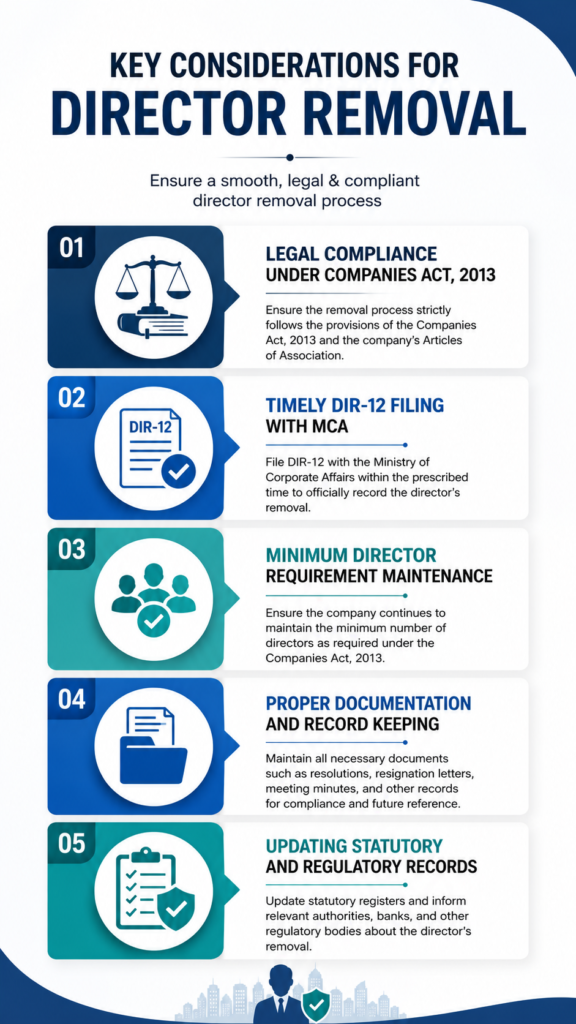
Key Considerations for Director Removal
-
Legal Compliance Under Companies Act, 2013
-
Timely DIR-12 Filing with MCA
-
Minimum Director Requirement Maintenance
-
Proper Documentation and Record Keeping
-
Updating Statutory and Regulatory Records
Types of Director Removal
Director Resignation
The most common type of removal occurs when a director voluntarily resigns by submitting a resignation letter to the company.
Removal by Shareholders
Shareholders can remove a director before the expiry of their term through an ordinary resolution after following due process.
Removal Due to Disqualification
A director may automatically cease to hold office if they become disqualified under the Companies Act.
Removal Pursuant to Regulatory Orders
Courts, tribunals, or regulatory authorities may direct the removal of a director in specific circumstances.
Documents Required for Director Removal
The exact documents may vary depending on the circumstances of removal. Generally, the following documents are required:
How We Help You Build a Strong Legal Foundation
📋 Expert Compliance Guidance
Our professionals ensure every legal requirement is fulfilled accurately and in accordance with the Companies Act and MCA regulations.
📑 End-to-End Documentation
We prepare, review, and manage all necessary resolutions, forms, and supporting documents to ensure a seamless process.
⚡ Timely MCA Filings
We handle statutory filings promptly, helping your company avoid penalties, delays, and compliance risks.
🤝 Dedicated Professional Support
Receive personalized assistance from experienced compliance experts throughout the entire director removal process.
Director Removal Process at JiStartup
Step 1: Consultation and Assessment
Our compliance experts understand your situation and determine the appropriate legal route for removal.
Step 2: Documentation Review
We collect and verify all necessary documents, resolutions, and supporting records.
Step 3: Drafting of Resolutions
We prepare board resolutions, shareholder notices, explanatory statements, and meeting documentation.
Step 4: Conducting Required Meetings
Where applicable, we assist in conducting board meetings and shareholder meetings as required by law.
Step 5: MCA Filing
We prepare and file the necessary forms, including DIR-12 and related documents with the MCA.
Step 6: Compliance Verification
Our team verifies filing acknowledgments and updates company records accordingly.
Step 7: Completion and Confirmation
Once approved, the director’s removal is officially reflected in MCA records.
Benefits of Professional Director Removal Services
Complete Legal Compliance
Avoid mistakes that could result in penalties or future legal complications.
Accurate Documentation
Professionally drafted resolutions and filings minimize rejection risks.
Faster Processing
Our experts ensure timely preparation and filing of forms.
Reduced Administrative Burden
Focus on your business while we handle the compliance process.
Expert Guidance
Receive personalized advice based on your company’s structure and circumstances.
Consequences of Improper Director Removal
Failure to follow the prescribed legal process can result in:
Proper compliance protects both the company and its stakeholders.
Common Challenges Faced During Director Removal
Many businesses encounter issues such as:
Advantages of Director Removal
1. Improved Corporate Governance
Removing an inactive, non-performing, or non-compliant director can significantly improve the overall governance structure of a company. A well-functioning board ensures better decision-making, transparency, accountability, and adherence to legal requirements. By replacing ineffective leadership, the company can strengthen its management practices and build greater confidence among stakeholders.
2. Better Business Decision-Making
Directors play a critical role in shaping business strategies and operational decisions. If a director’s vision no longer aligns with the company’s goals, their removal can help eliminate obstacles to growth. A more aligned and proactive board can make faster, more effective decisions that support long-term business success.
3. Reduced Legal and Compliance Risks
A director who fails to comply with statutory obligations or engages in activities that expose the company to legal liabilities can pose significant risks. Removing such a director helps safeguard the company from potential penalties, regulatory scrutiny, and legal disputes while ensuring compliance with applicable laws and regulations.
4. Enhanced Operational Efficiency
Conflicts among directors can slow down business operations and delay important decisions. Director removal can help eliminate internal disruptions, allowing management to focus on achieving organizational objectives. A streamlined leadership structure often results in smoother business operations and improved productivity.
5. Increased Investor Confidence
Investors prefer companies with strong governance and competent leadership. Removing a director whose actions negatively affect the company’s reputation or performance can improve investor confidence. This can be particularly beneficial when seeking funding, attracting strategic partners, or preparing for expansion.
6. Opportunity for New Leadership
Director removal creates an opportunity to bring in fresh talent, expertise, and perspectives. New directors may contribute innovative ideas, industry experience, and strategic insights that can help the company adapt to changing market conditions and achieve its growth objectives.
7. Resolution of Management Conflicts
Persistent disagreements among board members can hinder company progress. Removing a director involved in ongoing conflicts can help restore harmony within the leadership team and facilitate more productive discussions and collaboration.
8. Protection of Company Reputation
The actions and conduct of directors can significantly impact a company’s reputation. If a director is associated with misconduct, unethical behavior, or poor performance, their removal can help protect the company’s image and maintain trust among customers, investors, employees, and business partners.
Disadvantages of Director Removal
1. Potential Internal Conflicts
Director removal can create tensions among shareholders, board members, and management. Disagreements regarding the removal process may lead to disputes, strained relationships, and a less collaborative work environment.
2. Risk of Legal Challenges
If the removal process is not conducted in accordance with the Companies Act, 2013, or the company’s Articles of Association, the removed director may challenge the decision legally. Such disputes can result in additional costs, delays, and reputational concerns.
3. Loss of Valuable Experience
A director often possesses extensive knowledge of the company’s operations, industry trends, and strategic plans. Their removal may lead to a loss of valuable expertise and institutional knowledge, which can impact business continuity and decision-making.
4. Temporary Business Disruptions
The transition period following a director’s removal may create uncertainty within the organization. Important projects, strategic initiatives, and management functions may experience delays until a replacement director is appointed and integrated into the board.
5. Additional Compliance Requirements
Director removal involves various legal and regulatory procedures, including board meetings, shareholder resolutions, and MCA filings. Failure to manage these requirements properly can increase administrative burdens and consume valuable time and resources.
6. Impact on Stakeholder Perception
Frequent changes in leadership may create concerns among investors, lenders, customers, and employees regarding the stability of the company. Stakeholders may view director removal as a sign of internal issues, particularly if the circumstances are not communicated effectively.
7. Cost of Replacement and Transition
After removing a director, the company may need to appoint a replacement. Recruitment, onboarding, training, and compliance-related expenses can increase operational costs, especially if the company seeks highly qualified professionals.
8. Possibility of Shareholder Disputes
In companies with multiple shareholders, director removal can become a sensitive issue. Differences in opinion regarding the necessity or fairness of the removal may lead to shareholder disagreements and governance challenges.
Get Professional Director Removal Support Today
Whether your company is undergoing restructuring, facing management changes, or processing a director’s resignation, JiStartup is here to simplify the entire process.
Our experienced compliance professionals ensure that every step is handled accurately, efficiently, and in accordance with applicable laws.
Contact JiStartup today to remove a director from your company quickly, legally, and without hassle.
See What Our Clients Are Saying
“The team at Jistartup handled our registration and compliance work very efficiently. Their clear guidance made the process quick and stress-free. A great partner for new entrepreneurs.”
“We opted for Virtual Office services from Office Space Provider along with company registration through Jistartup. The documentation was handled perfectly and got approved without any hassle. Very professional experience.”
Additional FAQs for Director Removal Services
1. Can a company function after removing one of its directors?
Yes, a company can continue its operations after removing a director, provided it maintains the minimum number of directors required under the Companies Act, 2013 and its Articles of Association.
2. Does removing a director affect the company's ownership structure?
No. Director removal only affects management and governance. Shareholding ownership remains unchanged unless the director separately transfers or sells their shares.
3. Can a director be removed during the middle of their term?
Yes, a director can be removed before the completion of their term by following the prescribed legal procedure and obtaining necessary approvals.
4. Is the consent of all directors required to remove a director?
No. Depending on the circumstances, removal may require board approval, shareholder approval, or compliance with statutory provisions. Unanimous consent of all directors is generally not mandatory.
5. What happens to contracts signed by a removed director?
Contracts executed by the director while legally holding office generally remain valid. Their removal does not automatically invalidate previous agreements entered into on behalf of the company.
6. Can a removed director be reappointed in the future?
Yes, unless the individual is legally disqualified, a removed director may be reappointed in the future subject to shareholder approval and compliance with applicable regulations.
7. Will banks and government departments need to be informed after director removal?
In many cases, yes. Companies may need to update banking authorities, tax departments, licensing authorities, vendors, and other stakeholders regarding changes in authorized signatories or management.
8. Can a foreign director be removed from an Indian company?
Yes. The removal process for a foreign director follows the same legal framework applicable to directors of Indian companies, subject to regulatory compliance and documentation requirements.
9. What records should a company maintain after removing a director?
Companies should preserve board resolutions, shareholder resolutions, meeting minutes, resignation letters, MCA acknowledgments, and other related records for future reference and compliance purposes.
10. How can professional assistance help during director removal?
Professional experts ensure proper documentation, timely filings, legal compliance, and accurate execution of the removal process, reducing the risk of errors, penalties, and future disputes.
