

Barcode Registration in India
Barcode Registration is an essential requirement for businesses that sell products through retail stores, supermarkets, or e-commerce platforms. A barcode helps identify a product uniquely and simplifies inventory management, billing, and product tracking.
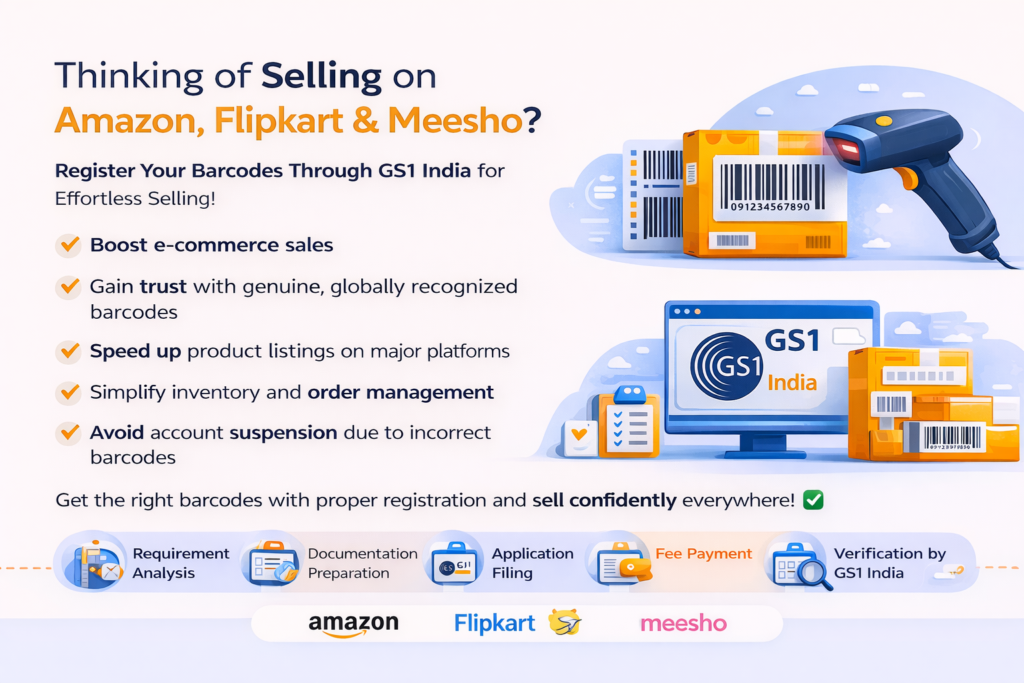
In India, barcodes are issued by GS1 India, which is the official authority responsible for providing globally recognized barcodes. Businesses must obtain a GS1 Barcode Registration to sell their products through platforms like Amazon, Flipkart, supermarkets, and retail chains.
With professional assistance, businesses can obtain barcode registration quickly with proper documentation and guidance.
What is a Barcode?
A barcode is a machine-readable representation of product information in the form of parallel lines and numbers. Each barcode represents a unique identification number that helps retailers and warehouses track products efficiently.
Barcodes are widely used for:
Why Barcode Registration is Important
Barcode registration offers several advantages for businesses dealing with physical products.
1. Required for E-commerce Platforms
Online marketplaces like Amazon, Flipkart, and Meesho often require valid barcodes for listing products.
2. Global Product Identification
GS1 barcodes are globally recognized and accepted in international markets.
3. Easy Inventory Management
Barcodes help businesses manage stock levels efficiently using scanning systems.
4. Faster Billing Process
Retail stores can quickly scan products during checkout.
5. Improves Business Credibility
Registered barcodes increase trust among distributors, retailers, and customers.
Types of Barcodes
Businesses can obtain different types of barcodes depending on their product requirements.
EAN-13 Barcode
The most commonly used barcode for retail products.
UPC Barcode
Mainly used in North America for retail goods.
ITF-14 Barcode
Used for packaging and logistics.
QR Codes
Used for digital information and marketing purposes.
Barcode Registration in India
Get your products retail-ready with GS1 Barcode Registration.
Ensure unique product identification, easy inventory management, and seamless selling on e-commerce platforms.
✔ Quick Registration
✔ Globally Accepted
✔ Easy Product Tracking
✔ E-commerce Ready
Start your barcode registration today and grow your business effortlessly 🚀
Eligibility for Barcode Registration in India
Any business involved in manufacturing, trading, or selling products can apply for barcode registration through GS1 India.
Who is Eligible?
The following entities are eligible to apply for a GS1 Barcode:
Basic Eligibility Criteria
To apply for barcode registration, businesses must meet the following criteria:
1. Legal Business Entity
The applicant must have a registered business such as:
- Sole Proprietorship
- Company or LLP
- Registered Partnership
2. Product-Based Business
Barcode registration is applicable only if you:
- Manufacture products
- Sell packaged goods
- Trade physical products
(Service-based businesses do not require barcodes.)
3. Unique Product Listing
Each product must have:
- A unique name
- Distinct packaging or variation
- Separate barcode for each variant (size, color, etc.)
4. Business Turnover Declaration
Applicants must declare their:
- Annual turnover
- Expected number of barcodes required
(This helps determine the barcode package and fees.)
Requirements for Barcode Registration
To successfully obtain barcode registration from GS1 India, you need to fulfill the following requirements:
1. Business Registration Proof
Any one of the following:
- Certificate of Incorporation
- Partnership Deed
- MSME Certificate
- Shop & Establishment Certificate
2. PAN Card
- PAN of the business or proprietor is mandatory
3. GST Registration (if applicable)
- GST certificate is required for most product-based businesses
- Optional for small businesses below GST threshold
4. Identity & Address Proof
- Aadhaar Card / Passport / Voter ID of applicant
- Address proof of business location
5. Product Details
- List of products
- Product categories
- Number of barcode requirements
6. Brand Name Details
- Registered brand name (if available)
- Trademark (optional but recommended)
7. Digital Requirements
- Active email ID
- Mobile number
- Letterhead of the company
Who Needs Barcode Registration?
Barcode registration is required for businesses that manufacture, trade, or sell packaged goods.
Businesses that need barcodes include:
Providing accurate documents ensures faster approval of your barcode registration.
How We Help You Build a Strong Legal Foundation
Expert Guidance
We simplify barcode registration with step-by-step support through GS1 India guidelines.
Accurate Documentation
We ensure error-free application with proper verification of all required documents.
Quick Processing
Fast-track your barcode approval so you can start selling on platforms like Amazon and Flipkart without delays.
End-to-End Support
From application to renewal, we handle everything for complete compliance.
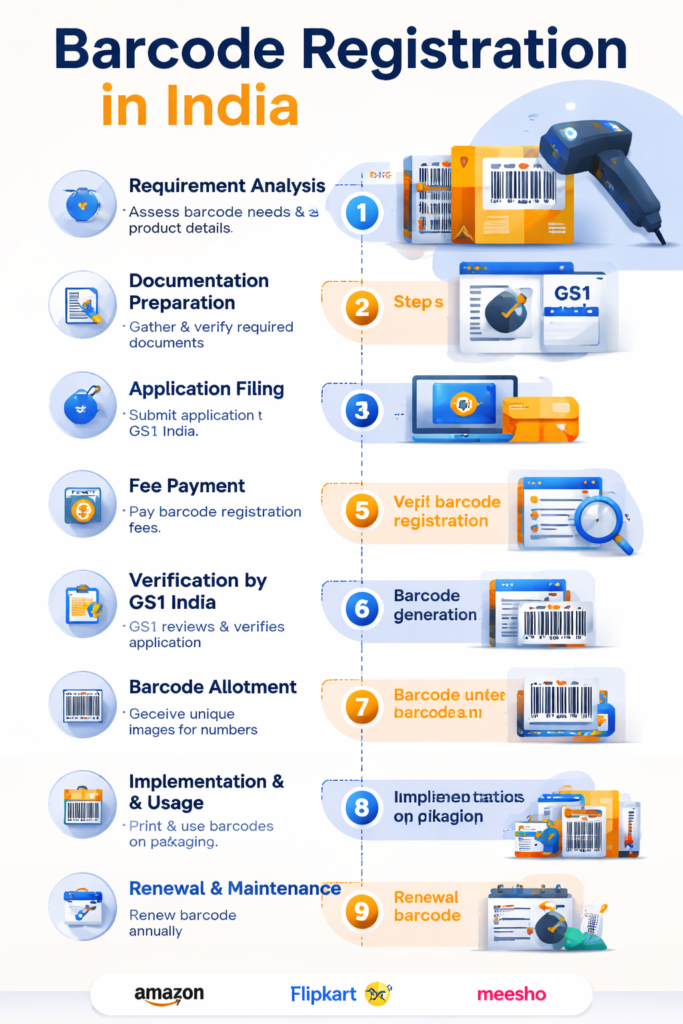
Barcode Registration Process in India
Obtaining a barcode in India is a structured process regulated by GS1 India, the only authorized body to issue globally accepted barcodes. The process involves proper documentation, application submission, and approval based on your business requirements.
Below is the step-by-step process:
Step 1 – Requirement Analysis
The first step is to understand your business needs:
- Number of products you sell
- Product variations (size, color, packaging)
- Future expansion plans
- Turnover of the business
👉 Each product and its variant requires a unique barcode, so proper planning is important before applying.
Step 2 – Documentation Preparation
Once requirements are identified, all necessary documents are collected and verified:
- Business registration proof
- PAN card
- GST certificate (if applicable)
- Identity and address proof
- Product details
Accurate documentation ensures a smooth approval process without delays.
Step 3 – Application Filing with GS1 India
The barcode registration application is then submitted to GS1 India through the official portal.
This step includes:
- Filling business details
- Selecting barcode capacity
- Uploading required documents
- Declaring turnover
👉 Any errors at this stage may lead to rejection or delay, so professional assistance is recommended.
Step 4 – Fee Payment
After submitting the application, the applicable fees must be paid.
The fee structure depends on:
- Company turnover
- Number of barcodes required
- Type of subscription plan
Fees generally include:
- One-time registration fee
- Annual renewal charges
Step 5 – Verification by GS1 India
Once the application and payment are completed, GS1 India reviews the submitted details.
Verification includes:
- Document validation
- Business authenticity check
- Compliance with GS1 standards
If everything is correct, the application moves to approval.
Step 6 – Barcode Allotment
After successful verification, GS1 India issues:
- Company Prefix Number
- Unique barcode numbers for your products
This prefix becomes your business identity in the global barcode system.
Step 7 – Barcode Generation & Design
Using the allotted numbers, barcodes are generated and converted into:
- EAN-13 barcode images
- Printable barcode formats
These barcodes can then be added to your:
- Product packaging
- Labels
- Boxes
Step 8 – Implementation & Usage
Once generated, you can start using barcodes for:
- Retail store sales
- Inventory management
- Warehouse tracking
- Listing products on platforms like Amazon, Flipkart, and Meesho
👉 Proper placement and printing quality are important for scanning accuracy.
Step 9 – Renewal & Maintenance
Barcode registration is not a one-time process. Businesses must:
- Renew their barcode license annually
- Update product details if required
- Maintain compliance with GS1 standards
Failure to renew may lead to barcode deactivation.
Timeline for Barcode Registration
The overall time required for barcode registration is:
Key Tips for Smooth Barcode Registration
Get Started Today
Barcode registration is a crucial step for businesses aiming to sell products in retail stores and online marketplaces. With proper registration through GS1 India, your products gain global recognition and seamless market access.
Start your barcode registration today and take your business to the next level.
Advantages of Barcode Registration
1. Global Recognition
Barcodes issued by GS1 India are accepted worldwide, making it easier to sell products in international markets.
2. Mandatory for E-commerce
Most online marketplaces like Amazon, Flipkart, and Meesho require valid barcodes for product listings.
3. Efficient Inventory Management
Barcodes help track stock levels, reduce manual errors, and improve warehouse management.
4. Faster Billing & Checkout
Retailers can scan products instantly, reducing billing time and improving customer experience.
5. Improved Business Credibility
Having a registered barcode increases trust among distributors, retailers, and customers.
6. Unique Product Identification
Each product and its variants get a unique identity, avoiding confusion and duplication.
7. Supply Chain Optimization
Barcodes streamline logistics, tracking, and product movement across the supply chain.
Disadvantages of Barcode Registration
1. Cost Involved
Barcode registration with GS1 India includes initial fees and annual renewal charges, which may be a burden for small businesses.
2. Annual Renewal Requirement
Businesses must renew their barcode license regularly to continue using it legally.
3. Separate Barcode for Each Product
Each product variation (size, color, etc.) requires a different barcode, increasing the total cost.
4. Documentation Process
The application requires proper documentation and verification, which may take time if not handled correctly.
5. Not Required for Service Businesses
Service-based businesses cannot benefit from barcode registration since it applies only to physical products.
Register Your Barcode Registration with Jistartup
Take your product business to the next level with fast and reliable barcode registration through Jistartup. Whether you are a startup, manufacturer, or growing brand, we help you obtain authentic and globally accepted barcodes from GS1 India with complete ease and accuracy.
Barcode registration is not just a compliance requirement—it is a crucial step for entering modern retail and e-commerce markets. With the right guidance and support, you can avoid delays, errors, and rejections while ensuring your products are ready for nationwide and international distribution.
See What Our Clients Are Saying
“The team at Jistartup handled our registration and compliance work very efficiently. Their clear guidance made the process quick and stress-free. A great partner for new entrepreneurs.”
“We opted for Virtual Office services from Office Space Provider along with company registration through Jistartup. The documentation was handled perfectly and got approved without any hassle. Very professional experience.”
Frequently Asked Questions (FAQs) – Barcode Registration
1. Can I use the same barcode for multiple products?
No, each product must have a unique barcode. Even slight variations like size, color, or packaging require separate barcodes to avoid confusion in inventory and sales tracking.
2. What happens if I use a fake or unofficial barcode?
Using unauthorized barcodes not issued by GS1 India can lead to product rejection on platforms like Amazon and may damage your business credibility.
3. Is barcode registration required for selling in local shops?
While not always mandatory for small local shops, barcodes are highly recommended for better inventory management and for expanding into supermarkets and large retail chains.
4. Can I upgrade my barcode capacity later?
Yes, businesses can upgrade their barcode package if they need more barcodes in the future. This allows flexibility as your product range grows.
5. Do barcodes contain product price or details?
No, barcodes only store a unique identification number. Product details like price and description are linked through software systems, not stored in the barcode itself.
6. Can I transfer my barcode to another company?
No, barcodes issued by GS1 India are registered to a specific business entity and cannot be transferred to another company.
7. Is barcode registration a one-time process?
No, barcode registration requires annual renewal. Failure to renew may lead to deactivation of your barcode numbers.
8. Do I need separate barcodes for combo or bundled products?
Yes, bundled or combo products must have a separate unique barcode, different from individual product barcodes.
9. Can I sell products internationally with Indian barcodes?
Yes, barcodes issued by GS1 India are globally recognized and can be used for exporting products worldwide.
10. What is the difference between EAN and UPC barcodes?
EAN (European Article Number) is commonly used internationally, while UPC (Universal Product Code) is mainly used in North America. Both serve the same purpose but differ in format and region usage.
