
FDI Filing With RBI – Complete FEMA Compliance Services by JiStartup
Foreign Direct Investment (FDI) is one of the most powerful ways to bring global capital into an Indian business. However, receiving foreign investment is not just about getting funds into your bank account. Every Indian company that receives investment from a non-resident investor must report the transaction to the Reserve Bank of India (RBI) under the Foreign Exchange Management Act (FEMA) through the FIRMS portal. Missing timelines, submitting incomplete documents, or filing incorrect forms can lead to penalties, delays in future investments, and regulatory complications.
JiStartup provides end-to-end assistance for FDI filing with RBI, including FC-GPR filing, FC-TRS filing, LLP-related filings, FLA return filing, documentation support, valuation coordination, and FEMA compliance advisory. Our experts handle the entire process so founders, finance teams, and investors can focus on business growth while remaining fully compliant with RBI regulations.
Why Businesses Choose JiStartup for RBI FDI Filing
Complete filing support from document collection to FIRMS portal submission, handled by specialists who work with startups, private companies, LLPs, and foreign investors.
FC-GPR Filing
Reporting of shares issued to foreign investors within RBI timelines.
FLA Return Filing
Annual foreign liabilities and assets reporting support.
FC-TRS Filing
Reporting of share transfers between residents and non-residents.
Valuation & Documentation
CA/merchant banker coordination and complete paperwork review.
What Is FDI Filing With RBI?
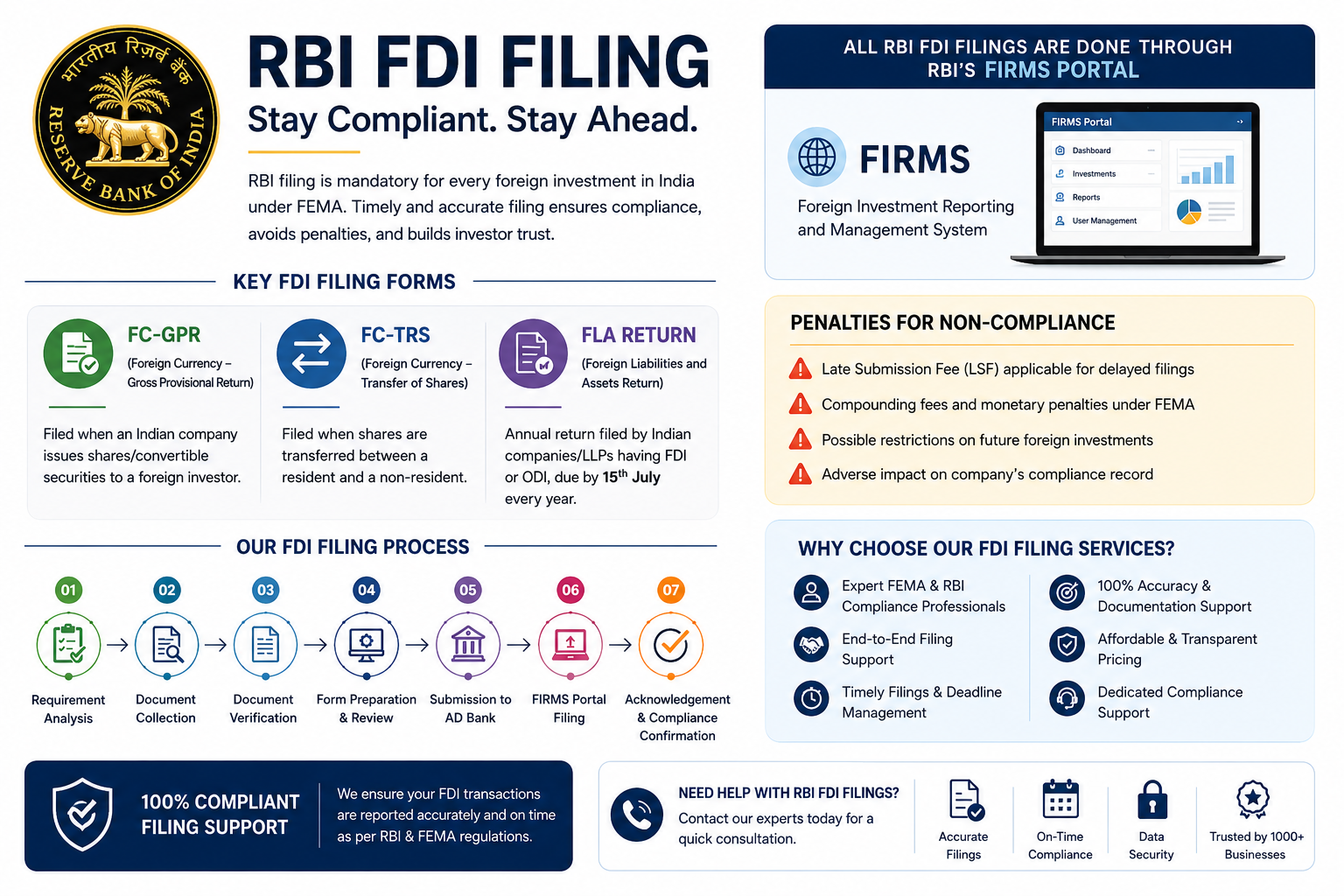
FDI filing is the process of reporting foreign investment transactions to the RBI through the Foreign Investment Reporting and Management System (FIRMS) portal. Whenever an Indian company receives money from a foreign investor and issues shares, or when shares are transferred between a resident and a non-resident, specific forms must be filed within prescribed timelines.
These filings are mandatory under FEMA and apply even if the investment is received through approved routes. RBI reporting is separate from company law compliances under the Companies Act, 2013, and both must be completed correctly.
Key Principle
Receiving foreign funds is only the first step. RBI reporting is mandatory, and non-reporting can attract late submission fees and FEMA penalties.
Who Needs RBI FDI Filing?

FDI Filing with RBI
Secure Your Foreign Investment. Stay Fully Compliant.
Key Highlights
- ✅ RBI & FEMA Compliant Filing
- 🌍 Smooth Foreign Investment Reporting
- 📋 Complete Documentation Assistance
- ⏱️ Timely Filing Within Statutory Deadlines
- 💼 Expert Guidance for Startups & Companies
Our FDI Filing Services
FC-GPR Filing
When a company issues shares, compulsorily convertible debentures (CCDs), or compulsorily convertible preference shares (CCPS) to a foreign investor, Form FC-GPR must be filed within 30 days from the date of allotment.
JiStartup handles:
FC-TRS Filing
When shares are transferred between a resident and a non-resident, Form FC-TRS must be filed within 60 days of transfer or receipt of consideration.
We assist with:
LLP Foreign Investment Filing
Limited Liability Partnerships receiving foreign investment have separate reporting requirements. We help LLPs complete all FEMA-related filings accurately and on time.
Annual FLA Return
Every company or LLP that has received foreign investment or made overseas investment must file the Foreign Liabilities and Assets (FLA) Return annually, generally by 15 July.
JiStartup prepares and files the return based on your audited or provisional financial statements.
FDI Filing Timelines You Must Track
Missing these deadlines can trigger Late Submission Fees (LSF).
The fee increases based on the amount involved and the period of delay. Timely filing is always cheaper than delayed regularization.
Documents Required for FDI Filing
For FC-GP
For FC-TRS
Don’t worry if you don’t have all documents ready. JiStartup helps you identify, collect, and prepare the missing paperwork.
A virtual office address is legally accepted for company registration and GST purposes.
How We Help You Build a Strong Legal Foundation
Accurate RBI & FEMA Compliance
We ensure every FDI filing is completed in accordance with RBI and FEMA regulations.
Complete Documentation Support
Our experts verify and prepare all required documents for error-free filing.
Timely Filing & Submission
We help you meet statutory deadlines and avoid penalties or late submission fees.
End-to-End Expert Assistance
From consultation to RBI acknowledgment, we manage the entire filing process seamlessly.
Our Step-by-Step Filing Process
1. Initial Consultation
We assess your foreign investment transaction, understand your business structure, and identify the applicable RBI and FEMA filing requirements.
2. Document Collection
Our experts provide a comprehensive document checklist, verify all records, and ensure every required document is complete and compliant.
3. Valuation & Certification
We coordinate the preparation of valuation reports and obtain the necessary certificates required for accurate RBI reporting.
4. RBI FIRMS Portal Filing
We prepare, review, and submit the applicable forms through the RBI FIRMS Portal, ensuring timely and error-free filing.
5. Filing Acknowledgment & Compliance Support
After successful submission, we provide the filing acknowledgment and assist with maintaining compliance records for future audits, due diligence, and fundraising activities.
Why Accurate Valuation Matters
Under FEMA rules, shares issued to foreign investors cannot be issued below the fair value determined by an eligible valuer. Incorrect valuation is one of the most common reasons for RBI queries and delayed approvals.
Common Mistakes We Help You Avoid
Penalties for Delayed or Non-Filing
RBI allows delayed filings through the Late Submission Fee (LSF) mechanism, but the cost can be substantial depending on the transaction value and delay period.
Potential consequences include:
Late Submission Fees (LSF)
FEMA penalties for non-compliance
Difficulty in future fundraising rounds
Investor due diligence concerns
Regulatory notices from authorities
Advantages of FDI Filing with RBI
1. Ensures Legal Compliance
Timely FDI filing ensures your company complies with RBI and FEMA regulations, reducing the risk of legal issues and regulatory action.
2. Avoids Penalties and Late Fees
Filing within the prescribed timelines helps avoid Late Submission Fees (LSF), penalties, and unnecessary financial liabilities.
3. Enhances Investor Confidence
Proper compliance demonstrates transparency and strengthens the confidence of foreign investors, venture capital firms, and financial institutions.
4. Facilitates Future Fundraising
A clean compliance record makes it easier to raise additional foreign investments and complete future funding rounds without regulatory hurdles.
5. Improves Corporate Credibility
Companies that maintain timely RBI filings are viewed as professionally managed and legally compliant by stakeholders and business partners.
6. Supports Smooth Regulatory Audits
Proper documentation and timely filings simplify audits, due diligence, and inspections by regulatory authorities.
7. Ensures Accurate Investment Records
FDI filings maintain official records of foreign investments, share allotments, and ownership changes with the RBI.
8. Reduces Compliance Risks
Professional filing minimizes the chances of errors, omissions, or incorrect reporting that could lead to future complications.
Disadvantages of FDI Filing with RBI
1. Strict Compliance Timelines
FDI filings must be completed within specific deadlines, leaving little room for delays in documentation or approvals.
2. Extensive Documentation
The filing process requires several supporting documents, including valuation reports, KYC, board resolutions, and banking certificates.
3. Complex Regulatory Requirements
Understanding FEMA regulations and RBI reporting norms can be challenging without professional assistance.
4. Additional Compliance Costs
Businesses may incur expenses for valuation certificates, professional consultation, and compliance management.
5. Risk of Penalties for Delays
Failure to file within the prescribed timelines may result in Late Submission Fees (LSF) and other regulatory consequences.
6. Dependency on Multiple Stakeholders
The filing process often requires coordination with banks, Chartered Accountants, Company Secretaries, and foreign investors, which may cause delays.
7. Frequent Regulatory Updates
RBI and FEMA guidelines may change periodically, requiring businesses to stay updated with the latest compliance requirements.
8. Time-Consuming Process
Collecting documents, obtaining certifications, and completing portal filings can take considerable time, especially for first-time applicants.
Ready to Complete Your RBI FDI Filing?
Whether you are closing your first international funding round or managing an ongoing foreign investment structure, JiStartup ensures your RBI filings are completed accurately, on time, and in full compliance with FEMA.
With Jistartup, you can focus on building your business while we handle the legal formalities.
🚀 Start your entrepreneurial journey today with Jistartup!
See What Our Clients Are Saying
“The team at Jistartup handled our registration and compliance work very efficiently. Their clear guidance made the process quick and stress-free. A great partner for new entrepreneurs.”
“We opted for Virtual Office services from Office Space Provider along with company registration through Jistartup. The documentation was handled perfectly and got approved without any hassle. Very professional experience.”
Frequently Asked Questions (FAQs) – FDI Filing with RBI
1. What is FDI filing with RBI?
FDI filing with RBI is the mandatory reporting of foreign investments made in an Indian company under the Foreign Exchange Management Act (FEMA). The reporting is completed through the RBI’s FIRMS portal using prescribed forms such as FC-GPR, FC-TRS, and FLA Return.
2. Is RBI FDI filing mandatory for every foreign investment?
Yes. Every eligible foreign investment in an Indian company must be reported to the RBI within the prescribed timelines. Failure to report may result in late submission fees and penalties under FEMA.
3. What is the difference between FC-GPR and FC-TRS?
FC-GPR is filed when an Indian company issues new shares or convertible securities to a foreign investor. FC-TRS is filed when existing shares are transferred between a resident and a non-resident.
4. What happens if I miss the RBI filing deadline?
If the filing deadline is missed, the company may be required to pay a Late Submission Fee (LSF) before the delayed filing can be regularized. Continued non-compliance may also attract penalties under FEMA.
5. Can a startup receive foreign investment without RBI filing?
No. Even if the company is a startup, it must comply with FEMA regulations and complete the applicable RBI filings after receiving foreign investment.
6. Is a valuation report mandatory for FDI filing?
Yes. In most cases, a valuation report from a Chartered Accountant or a SEBI-registered Merchant Banker is required to ensure that the shares are issued or transferred at a price compliant with FEMA regulations.
7. Which authority verifies FDI filings before submission to RBI?
The Authorized Dealer (AD) Bank reviews the documents and verifies the filing before it is processed through the RBI’s FIRMS portal. The bank may seek additional documents or clarifications if required.
8. Can one company receive investments from multiple foreign investors?
Yes. An Indian company can receive investments from multiple foreign investors, provided the investment complies with the applicable FDI policy, sectoral caps, pricing guidelines, and RBI reporting requirements.
9. Do LLPs also have RBI reporting obligations for foreign investment?
Yes. LLPs receiving foreign investment are also required to comply with FEMA regulations and complete the applicable RBI reporting through the prescribed forms and timelines.
10. Why should I choose JiStartup for RBI FDI filing services?
JiStartup offers end-to-end assistance for RBI FDI compliance, including document verification, valuation coordination, FEMA advisory, preparation of forms, FIRMS portal filing, and continuous support until the filing is successfully completed, ensuring a smooth and hassle-free experience.
