
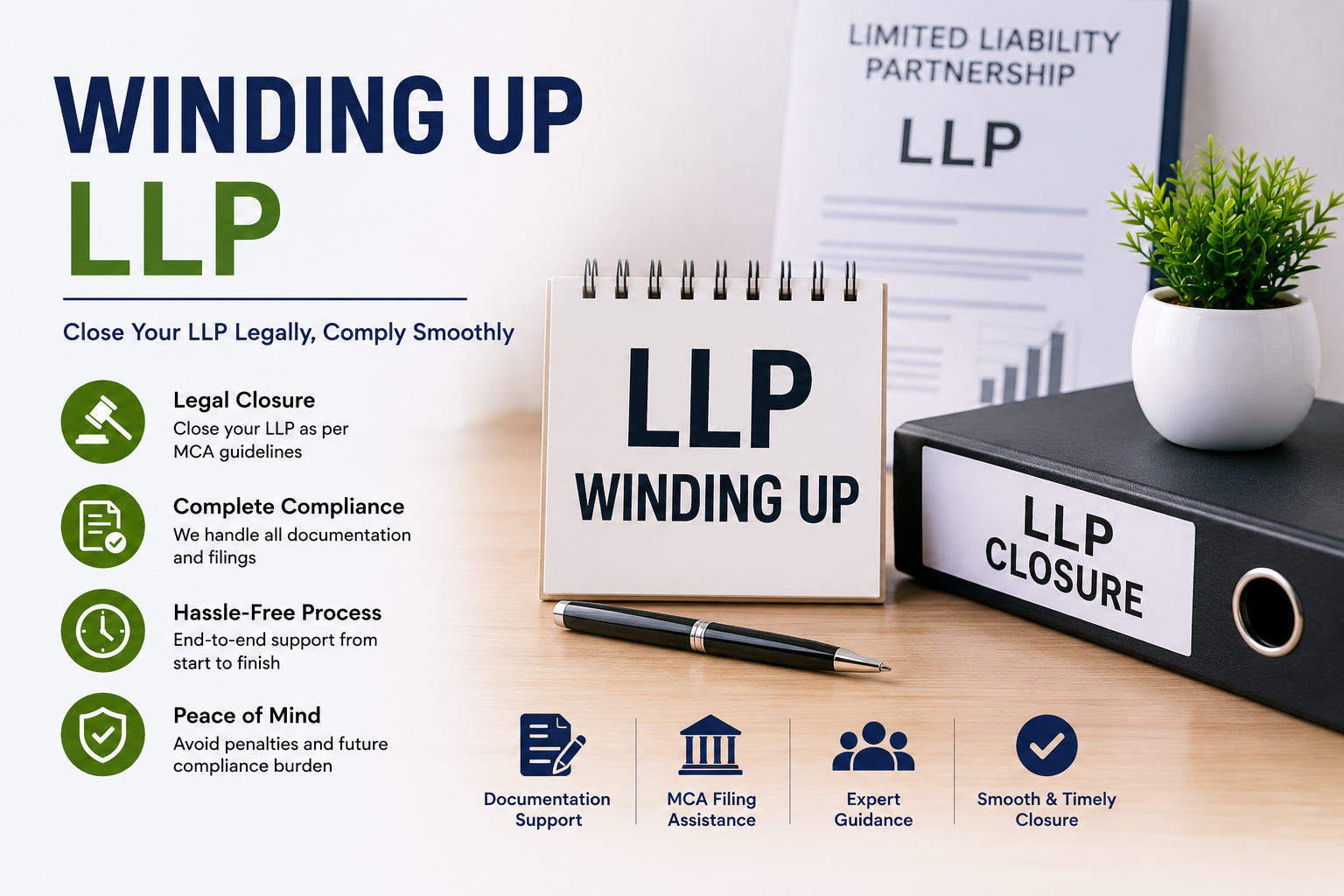
Winding Up LLP & Company Services by JiStartup
Close Your Business Legally, Smoothly & Hassle-Free
Every business journey has a beginning and, sometimes, a planned ending. If your LLP or Company is no longer operational, generating revenue, or serving its intended purpose, it is important to close it legally through the proper winding-up process.
Many business owners mistakenly believe that simply stopping operations is enough. However, inactive LLPs and companies continue to attract compliance obligations, annual filing requirements, penalties, and legal notices. Proper closure ensures that you are protected from future liabilities and unnecessary compliance burdens.
JiStartup provides complete assistance for LLP and Company Winding Up services across India. Our experts handle documentation, compliance verification, regulatory filings, and coordination with authorities to ensure a smooth and legally compliant closure process.
What is Winding Up?
Winding Up is the legal process of closing a business entity and removing its name from government records. During this process, the business settles outstanding liabilities, closes bank accounts, completes pending statutory requirements, and applies for official closure.
After successful completion of the winding-up process, the LLP or Company ceases to exist as a legal entity.
The primary objective of winding up is to ensure that all stakeholders, creditors, partners, shareholders, employees, and regulatory authorities are properly addressed before closure.
Why is Proper Business Closure Important?
Many entrepreneurs discontinue operations but fail to complete the legal closure process. This can lead to:

Types of Winding Up in India
1. Voluntary Winding Up
Voluntary winding up occurs when the owners decide to close the business willingly.
Common reasons include:
This is the most common and cost-effective method of business closure.
2. Compulsory Winding Up
Compulsory winding up is ordered by legal authorities under specific circumstances.
Reasons may include:
Challenges Faced During Winding Up
Many business owners encounter difficulties such as:
Missing documents
Unfiled annual returns
Pending taxes
Inactive directors
Compliance defaults
Unresolved liabilities
Complex MCA procedures
JiStartup helps resolve these issues before initiating closure.

Our Winding Up Service Includes
Eligibility Assessment
Compliance Review
Document Preparation
Affidavit Drafting
Indemnity Bond Preparation
Statement of Accounts Preparation
MCA Filing Support
Follow-up with Authorities
Closure Confirmation
Post-Closure GuidanceIncludes
Eligibility Assessment
Compliance Review
Document Preparation
Affidavit Drafting
Indemnity Bond Preparation
Statement of Accounts Preparation
MCA Filing Support
Follow-up with Authorities
Closure Confirmation
Post-Closure Guidance
Winding Up of LLP
Limited Liability Partnerships (LLPs) that are inactive or no longer required should be formally closed to avoid future compliance issues.
When Should You Close an LLP?
You may consider LLP closure if:
LLP Winding Up Process
Step 1: Obtain Partner Approval
All designated partners must mutually agree to wind up the LLP.
Step 2: Clear Liabilities
Outstanding debts, statutory dues, taxes, and vendor payments must be settled.
Step 3: Close Bank Accounts
Business bank accounts should be closed and closure certificates obtained.
Step 4: Prepare Statement of Accounts
Financial statements showing nil liabilities are prepared.
Step 5: File Closure Documents
Required forms and declarations are filed with authorities.
Step 6: MCA Approval
Upon successful verification, the LLP is removed from official records.
Documents Required for LLP Winding Up
Winding Up of Private Limited Company
A Private Limited Company can apply for strike-off if it is no longer carrying on business and meets eligibility conditions.
Eligibility for Company Closure
A company may apply for closure if:
Company Winding Up Process
Board Resolution
The directors approve the proposal for closure.
Shareholder Approval
Shareholders pass the necessary resolution.
Settlement of Liabilities
All debts and obligations are cleared.
Closure of Bank Accounts
Corporate bank accounts are closed.
Documentation Preparation
Affidavits, indemnity bonds, and declarations are prepared.
Filing Application
The strike-off application is submitted to MCA.
Government Review
Authorities review the application and supporting documents.
Final Closure
The company name is struck off from official records.
Documents Required for Company Winding Up
Common Reasons Businesses Choose to Wind Up
Business Inactivity
The company or LLP has stopped operations.
Financial Losses
The business is no longer financially sustainable.
Change in Business Strategy
Owners wish to pursue a different business model.
Partnership Issues
Differences among partners make continuation difficult.
Merger or Acquisition
The entity is no longer required after restructuring.
Dormant Entity
The business was incorporated but never actively used.
A virtual office address is legally accepted for company registration and GST purposes.
How We Help You Build a Strong Legal Foundation
✅ Compliance Assessment
We review your LLP or company’s compliance status before initiating closure.
✅ Accurate Documentation
Preparation of all required forms, declarations, and supporting documents.
✅ Expert Filing Support
Professional assistance with MCA filings and regulatory procedures.
✅ Hassle-Free Closure
End-to-end support to ensure a smooth and legally compliant winding-up process.
How JiStartup Simplifies the Process
Free Initial Consultation
We assess your eligibility for winding up.
Compliance Review
We identify pending filings and liabilities.
Documentation Support
Our experts prepare all required documents.
Filing Assistance
We manage the complete filing process.
Regulatory Coordination
We coordinate with authorities on your behalf.
End-to-End Support
From consultation to closure certificate, we remain with you throughout the process.
Timeline for Winding Up
LLP Closure
Typically 3–6 months depending on compliance status.
Company Strike-Off
Generally 3–6 months subject to documentation and approvals.
Timelines may vary based on government processing and pending compliances.
Industries We Serve
⚠ Non-compliance attracts heavy penalties.
Advantages of Winding Up an LLP or Company
1. Eliminates Compliance Burden
Once the LLP or company is legally closed, you no longer need to file annual returns, financial statements, or other statutory documents.
2. Avoids Future Penalties
Inactive businesses can attract heavy late filing fees and penalties. Winding up prevents the accumulation of such liabilities.
3. Reduces Administrative Costs
You can save money spent on accountants, auditors, compliance professionals, and annual government filing fees.
4. Provides a Clean Legal Exit
A formal winding-up process ensures the business is closed according to legal requirements, protecting directors and partners from future obligations.
5. Prevents Legal Complications
Proper closure minimizes the risk of notices, inspections, or regulatory actions from government authorities.
6. Improves Financial Planning
Business owners can focus their resources and investments on new ventures instead of maintaining an inactive entity.
7. Protects Directors and Partners
Closing the entity legally helps reduce personal exposure to compliance-related issues arising from an inactive business.
8. Better Business Reputation
A properly closed business reflects responsible corporate governance and professionalism.
9. Peace of Mind
Owners can move on to new opportunities without worrying about pending compliance requirements.
10. Removes Dormant Entities from Records
Winding up helps maintain a clean and organized corporate structure by removing unnecessary entities.
Disadvantages of Winding Up an LLP or Company
1. Closure Process Can Be Time-Consuming
The winding-up process involves documentation, approvals, and regulatory procedures that may take several months.
2. Compliance Must Be Completed First
Any pending annual filings, tax returns, or statutory obligations generally need to be cleared before closure.
3. Outstanding Liabilities Must Be Settled
Businesses with unpaid debts, taxes, or obligations cannot easily proceed with closure until liabilities are resolved.
4. Professional Assistance May Be Required
The process often requires expert guidance to ensure proper documentation and compliance with legal requirements.
5. Business Name May Become Unavailable
After closure, the business name may not always remain reserved for future use.
6. Loss of Existing Business Identity
Brand value, registrations, licenses, and goodwill associated with the entity may be lost upon closure.
7. Difficult to Revive Later
If you decide to restart the same entity after closure, restoration can involve legal procedures and additional costs.
8. Documentation Requirements
Multiple declarations, affidavits, financial statements, and approvals may be required during the winding-up process.
9. Possible Delays Due to Non-Compliance
Missing records, unresolved filings, or incomplete documentation can delay approval from authorities.
10. Closure Costs
Although winding up eliminates future expenses, there may be professional and government-related costs involved in completing the closure process.
Why Choose JiStartup?
Experienced Compliance Professionals
Years of expertise in corporate compliance and regulatory matters.
Transparent Pricing
No hidden costs or surprise charges.
Fast Processing
Efficient handling of documentation and filings.
Dedicated Support
Expert guidance throughout the closure journey.
Pan-India Service
Support available across all states and cities in India.
Complete Compliance Assistance
One-stop solution for LLP and Company closure.
See What Our Clients Are Saying
“The team at Jistartup handled our registration and compliance work very efficiently. Their clear guidance made the process quick and stress-free. A great partner for new entrepreneurs.”
“We opted for Virtual Office services from Office Space Provider along with company registration through Jistartup. The documentation was handled perfectly and got approved without any hassle. Very professional experience.”
Frequently Asked Questions (FAQs)
1. Can I close an LLP that has not been operational for years?
Yes. Subject to compliance completion and eligibility requirements.
2. Can a company with liabilities be closed?
No. Outstanding liabilities generally need to be settled before closure.
3. Is winding up mandatory for inactive entities?
3. Is winding up mandatory for inactive entities?
4. Can pending ROC filings affect closure?
Yes. Pending filings may need to be completed before closure approval.
5. How long does the process take?
Usually between 3 and 6 months depending on the entity’s compliance status.
6. Can JiStartup handle old inactive companies?
Yes. We assist in regularizing compliance and processing closure applications.
7. What happens after winding up?
The entity is removed from government records and ceases to exist legally.
8. Can I reopen a company after closure?
Generally, a struck-off company cannot continue operations unless restored through legal procedures.
9. Is director presence required?
Most of the process can be handled remotely with document support.
10. Why should I choose JiStartup?
We provide complete, transparent, affordable, and expert-driven winding-up services across India.
