
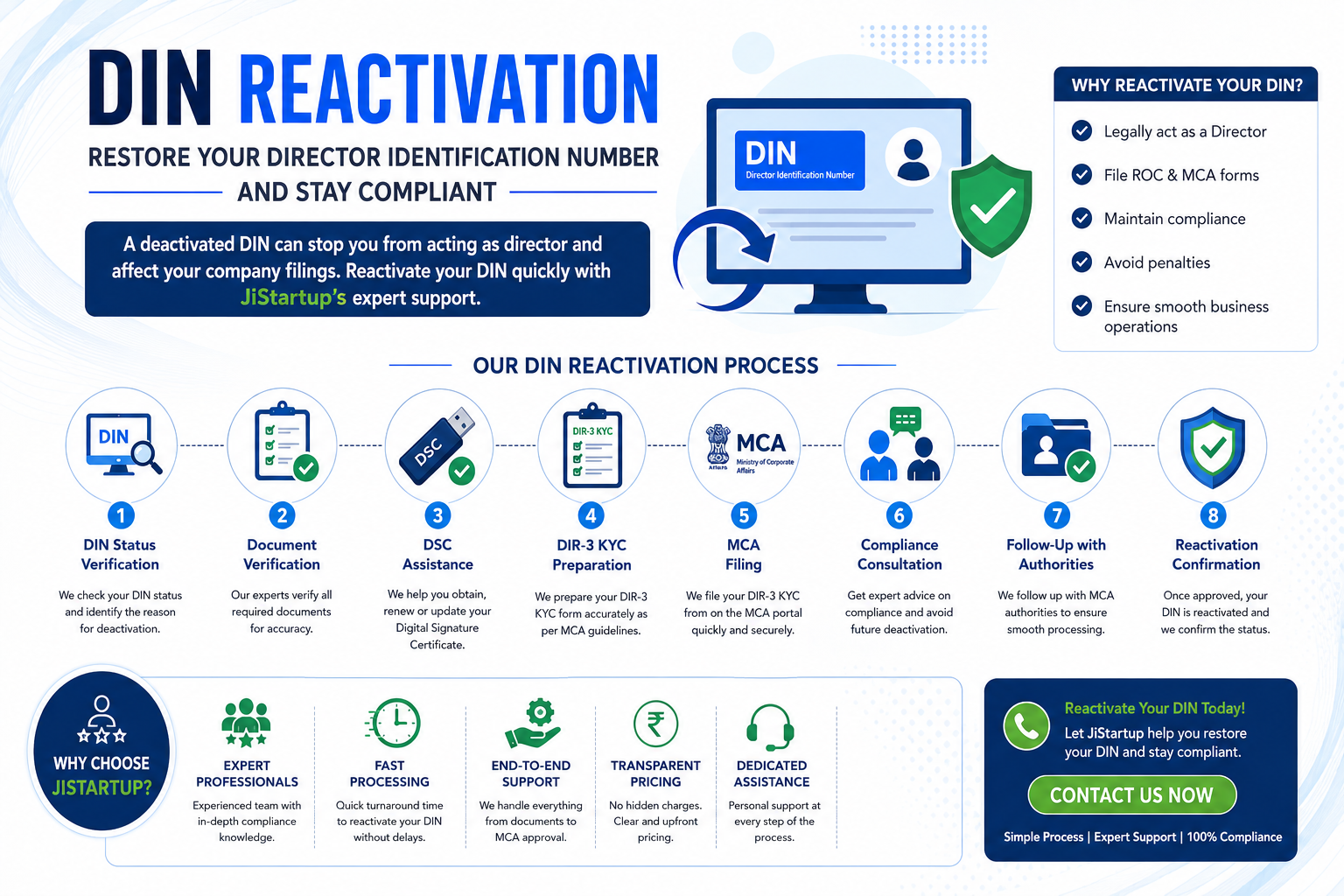
DIN Reactivation Services by JiStartup
Restore Your Director Identification Number Quickly and Stay Compliant
A Director Identification Number (DIN) is a unique identification number allotted to individuals who wish to serve as directors of companies in India. Issued by the Ministry of Corporate Affairs (MCA), the DIN remains valid for a lifetime. However, failure to comply with annual KYC requirements can result in DIN deactivation, preventing an individual from functioning as a director.
If your DIN has been deactivated due to non-filing of DIR-3 KYC or other compliance issues, JiStartup offers complete DIN Reactivation Services to help you restore your DIN quickly and legally. Our experienced compliance professionals handle the entire process from document verification to MCA filing, ensuring a smooth and hassle-free experience.
What is DIN Reactivation?
DIN Reactivation is the process of restoring a Director Identification Number that has been deactivated by the Ministry of Corporate Affairs. Once reactivated, the director can resume all legal responsibilities and company-related filings.
The MCA generally deactivates DINs when directors fail to submit their annual DIR-3 KYC filing within the prescribed deadline. To reactivate the DIN, the director must complete the pending compliance requirements and pay the applicable government fees.
Understanding Director Identification Number (DIN)
The Director Identification Number serves as a permanent identity for directors across all companies in which they hold directorship positions. It helps maintain transparency and track directors’ activities under corporate regulations.
Every director is required to keep their DIN details updated and comply with annual KYC requirements. Failure to do so can result in deactivation and restrictions on performing director-related functions.

Why Does DIN Get Deactivated?
Several reasons can lead to DIN deactivation:
Non-Filing of DIR-3 KYC
The most common reason is failure to file DIR-3 KYC before the MCA deadline.
Incorrect Personal Information
Mismatch in PAN, Aadhaar, name, date of birth, or contact details can create compliance issues.
Failure to Update Contact Details
Directors must maintain updated mobile numbers and email addresses linked to their DIN records.
Regulatory Non-Compliance
Any non-compliance with MCA directives can lead to restrictions on DIN usage.
Rejected KYC Filing
Improper documentation or incorrect filing may result in rejection and subsequent deactivation.

Our DIN Reactivation Service Includes
-
DIN Status Verification
-
Document Verification
-
DSC Assistance
-
DIR-3 KYC Preparation
-
MCA Filing
-
Compliance Consultation
-
Follow-Up with Authorities
-
Reactivation Confirmation
Consequences of DIN Deactivation
A deactivated DIN can significantly affect a director’s ability to manage corporate affairs.
Inability to Act as Director
The individual cannot legally function as a director in any company.
Restriction on MCA Filings
Company forms requiring director authentication cannot be filed.
Compliance Issues
Companies may face delays in statutory filings due to inactive DINs.
Legal Risks
Continued non-compliance may attract regulatory scrutiny and penalties.
Business Disruptions
Corporate decisions and transactions may get delayed due to inactive director credentials.
Benefits of Reactivating Your DIN
Resume Directorship Activities
Continue managing company affairs without restrictions.
Maintain Regulatory Compliance
Ensure adherence to MCA requirements.
Avoid Future Penalties
Timely reactivation helps prevent additional compliance issues.
Smooth Company Operations
Enable uninterrupted filing of ROC forms and statutory documents.
Strengthen Corporate Governance
Maintain transparent and compliant business practices.
Documents Required for DIN Reactivation
To reactivate a DIN, the following documents are generally required:
For Indian Nationals
For Foreign Nationals
A virtual office address is legally accepted for company registration and GST purposes.
How We Help You Build a Strong Legal Foundation
✅ Expert Compliance Review
We assess your DIN status and identify all pending compliance requirements.
✅ Accurate Documentation
Our team prepares and verifies all documents to ensure error-free filing.
✅ Hassle-Free MCA Filing
We handle the complete DIR-3 KYC filing and DIN reactivation process on your behalf.
✅ Ongoing Compliance Support
Get expert guidance to maintain compliance and avoid future DIN deactivation.
Step-by-Step DIN Reactivation Process
Step 1: Consultation and Verification
Our compliance experts review your DIN status and identify the reason for deactivation.
Step 2: Document Collection
Required documents are collected and verified for accuracy.
Step 3: DSC Validation
Digital Signature Certificate validity is checked. If expired, renewal assistance is provided.
Step 4: Preparation of DIR-3 KYC
The KYC form is prepared carefully to ensure compliance with MCA requirements.
Step 5: Filing with MCA
The completed application is filed electronically with the MCA portal.
Step 6: Payment of Applicable Fees
Government fees and penalties are paid as prescribed.
Step 7: DIN Reactivation
After successful processing, the DIN status is restored to active.
Who Needs DIN Reactivation?
DIN reactivation is required for:
Why DIR-3 KYC Filing is Important
DIR-3 KYC is an annual compliance requirement for every DIN holder. It helps the MCA maintain accurate records of directors.
The filing verifies:
Failure to file the form within the prescribed timeline can lead to automatic DIN deactivation.
Common Challenges During DIN Reactivation
Many directors face difficulties such as:
JiStartup helps overcome these challenges through expert guidance and professional support.
Advantages of DIN Reactivation
1. Restores Your Legal Authority as a Director
A deactivated DIN prevents an individual from legally functioning as a director in any company. Once the DIN is reactivated, the director regains the legal authority to participate in company management, sign documents, approve filings, and carry out statutory responsibilities. This ensures uninterrupted involvement in corporate decision-making and governance.
2. Enables MCA and ROC Filings
Many company filings submitted to the Ministry of Corporate Affairs (MCA) require the authentication and approval of directors with active DINs. Reactivating the DIN allows companies to continue filing annual returns, financial statements, director-related forms, and other statutory documents without delays or compliance issues.
3. Prevents Business Disruptions
An inactive DIN can create obstacles in routine business operations. Companies may face delays in regulatory filings, director appointments, and other important corporate actions. DIN reactivation helps ensure smooth business functioning and prevents interruptions caused by compliance restrictions.
4. Maintains Regulatory Compliance
Corporate compliance is essential for every business operating in India. Reactivating a DIN demonstrates adherence to MCA regulations and helps directors maintain a clean compliance record. It also reduces the risk of regulatory scrutiny and future complications.
5. Enhances Professional Credibility
Directors are expected to comply with statutory requirements. Having an active DIN reflects professionalism, responsibility, and commitment to legal compliance. Investors, lenders, stakeholders, and business partners often view compliant directors more favorably.
6. Allows Appointment in New Companies
A valid DIN is mandatory for becoming a director in any company. Individuals with reactivated DINs can accept directorship positions in existing or newly incorporated companies without legal restrictions.
7. Facilitates Corporate Transactions
Many corporate transactions require the involvement of directors with active DINs. Reactivation ensures smooth execution of mergers, acquisitions, share transfers, board resolutions, and other important business activities.
8. Supports Long-Term Business Growth
Businesses grow when their leadership can operate without compliance barriers. Reactivating a DIN removes obstacles that may hinder expansion plans, investments, partnerships, or restructuring activities.
9. Avoids Additional Compliance Complications
Prompt DIN reactivation helps prevent future compliance issues that may arise from prolonged inactivity. Early action often simplifies the process and reduces administrative challenges.
10. Protects the Company’s Compliance Status
Companies depend on their directors for statutory compliance. An active DIN helps ensure timely filings and regulatory adherence, contributing to the overall legal health of the organization
Disadvantages of DIN Reactivation
1. Late Filing Penalties
One of the primary disadvantages is the financial penalty associated with delayed compliance. Directors who fail to file DIR-3 KYC within the prescribed timeline must pay additional government fees to reactivate their DIN.
2. Additional Documentation Requirements
DIN reactivation requires submission and verification of various documents such as PAN, Aadhaar, email address, mobile number, and Digital Signature Certificate (DSC). Collecting and validating these documents may take time.
3. Dependence on Accurate Information
Any mismatch in personal details such as name, PAN, date of birth, or address can lead to filing issues, delays, or rejection of the application. Directors may need to correct records before proceeding.
4. Digital Signature Certificate Requirements
A valid DSC is mandatory for DIN reactivation. If the DSC has expired or is unavailable, directors must first obtain or renew it, adding an extra compliance step.
5. Temporary Operational Restrictions
Until the DIN is successfully reactivated, the director cannot legally perform director-related functions. This temporary restriction can affect company operations and decision-making processes.
6. Risk of Filing Errors
Incorrect filing of DIR-3 KYC or submission of incomplete information can lead to rejection of the application. This may result in further delays and additional efforts to rectify errors.
7. Time-Consuming for Non-Professionals
Individuals unfamiliar with MCA procedures may find the reactivation process complicated. Understanding compliance requirements, preparing documents, and completing filings can be challenging without professional assistance.
8. Possible Delays Due to Verification Issues
OTP verification failures, document mismatches, technical portal issues, or regulatory reviews can occasionally delay the reactivation process.
9. Cost of Professional Assistance
Many directors choose professional services to ensure accurate filing and avoid rejection. While beneficial, this adds an additional cost to the reactivation process.
10. Ongoing Annual Compliance Responsibility
After reactivation, directors must continue filing DIR-3 KYC every year within the prescribed deadline. Failure to maintain compliance can result in repeated deactivation and penalties.
Reactivate Your DIN Today with JiStartup
Don’t let a deactivated DIN affect your business operations. Restore your DIN quickly with JiStartup’s professional DIN Reactivation Services. Our experts ensure a smooth, compliant, and hassle-free process so you can focus on growing your business.
Contact JiStartup today and get your DIN reactivated with confidence.
See What Our Clients Are Saying
“The team at Jistartup handled our registration and compliance work very efficiently. Their clear guidance made the process quick and stress-free. A great partner for new entrepreneurs.”
“We opted for Virtual Office services from Office Space Provider along with company registration through Jistartup. The documentation was handled perfectly and got approved without any hassle. Very professional experience.”
Frequently Asked Questions (FAQs)
1. What is DIN Reactivation?
DIN Reactivation is the process of restoring a deactivated Director Identification Number by completing pending compliance requirements.
2. Why was my DIN deactivated?
Most commonly due to non-filing of DIR-3 KYC with the MCA.
3. How much is the government fee for DIN reactivation?
The MCA generally charges a late filing fee as prescribed under current regulations.
4. How long does DIN reactivation take?
Usually between 1 and 3 working days after successful filing and verification.
5. Is DSC mandatory for DIN reactivation?
Yes. A valid Digital Signature Certificate is required for filing DIR-3 KYC.
6. Can I become a director with a deactivated DIN?
No. A deactivated DIN cannot be used for director-related activities.
7. Can foreign directors reactivate their DIN?
Yes. Foreign nationals can reactivate their DIN by submitting the required documents.
8. Do I need to file DIR-3 KYC every year?
Yes. Annual filing is mandatory for all DIN holders.
9. What happens if I continue to ignore DIN reactivation?
You will remain unable to act as a director and may face ongoing compliance difficulties.
10. Why should I choose JiStartup?
JiStartup provides expert guidance, accurate filing, transparent pricing, and dedicated support throughout the DIN reactivation process.
