
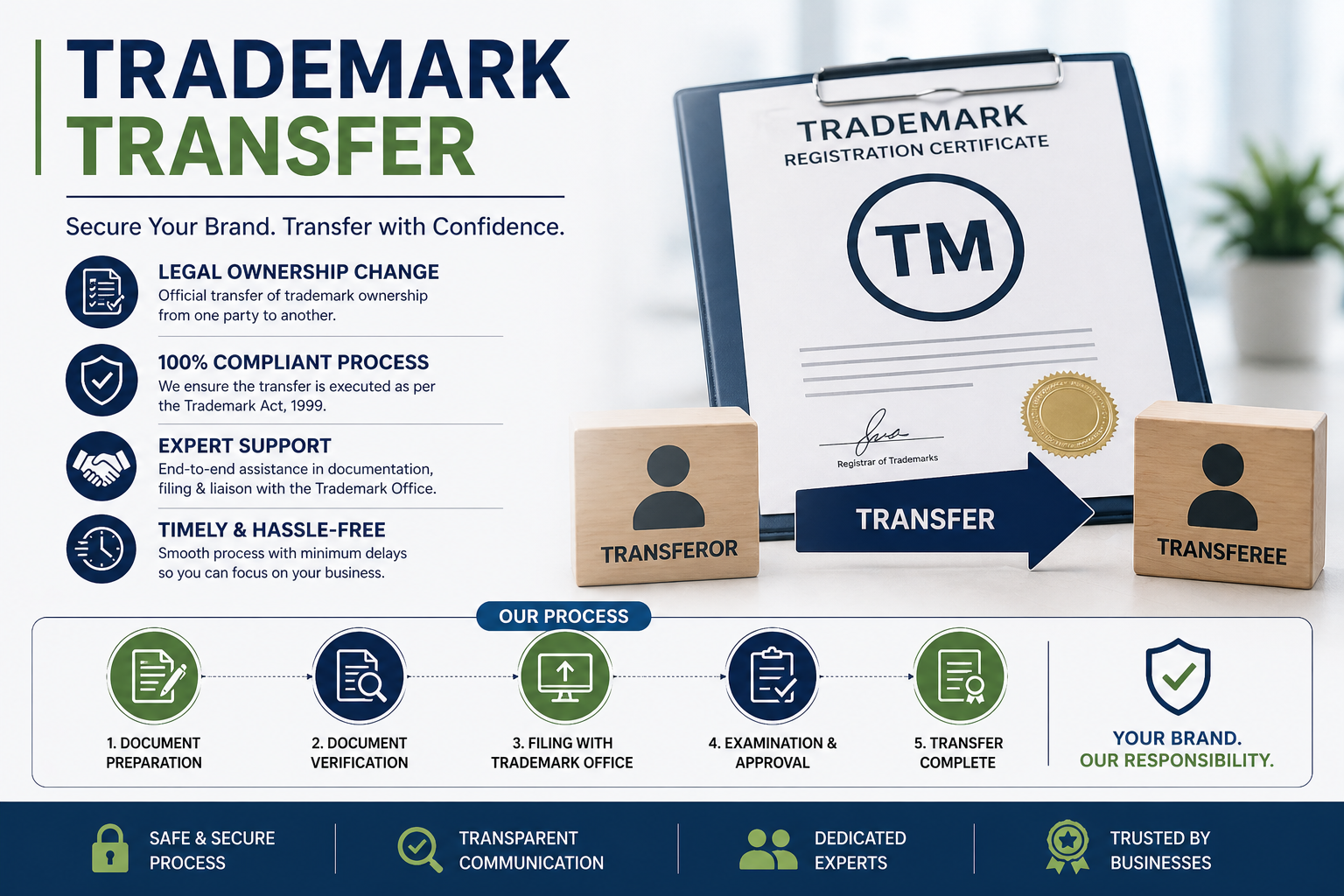
Trademark Transfer / Assignment in India
A Trademark Transfer, also known as Trademark Assignment, is the legal process of transferring ownership of a registered or pending trademark from one person or company to another. The transfer can occur due to business sale, merger, inheritance, partnership change, or brand ownership restructuring.
Registering the transfer with the Office of the Controller General of Patents, Designs & Trade Marks ensures that the new owner becomes the official legal holder of the trademark rights.
Trademark transfer is an important step to protect intellectual property rights and avoid future legal disputes regarding brand ownership.
What is Trademark Assignment?
Trademark Assignment refers to the legal transfer of trademark rights from the original owner (assignor) to a new owner (assignee). After the assignment is registered, the new owner gains full legal rights to use, sell, license, or modify the trademark.
The assignment must be recorded with the Controller General of Patents Designs and Trade Marks to make the ownership change legally valid.
Benefits of Trademark Transfer
Registering a trademark transfer offers several advantages.
Legal Ownership
The new owner becomes the official trademark holder under Indian law.
Brand Protection
It protects the brand identity and prevents unauthorized usage.
Business Expansion
Transferred trademarks can be used for franchising, licensing, and brand development.
Avoids Legal Disputes
Official transfer eliminates confusion regarding ownership.
Improves Brand Value
A registered trademark becomes a valuable business asset.

Types of Trademark Transfer
There are different types of trademark assignment depending on the ownership transfer structure.
1. Complete Assignment
In this case, the trademark owner transfers all rights of the trademark to another entity. The new owner gets full control over the trademark including usage, licensing, and resale.
2. Partial Assignment
Here, the trademark rights are transferred only for specific goods or services instead of the entire trademark.
3. Assignment with Goodwill
The trademark is transferred along with the brand reputation, business value, and customer recognition associated with it.
4. Assignment without Goodwill
The trademark is transferred without transferring the existing brand reputation or business goodwill.
Eligibility for Trademark Transfer
The following individuals or entities are eligible to apply for trademark assignment in India:
Requirements for Trademark Transfer
To successfully complete a trademark transfer, the following requirements must be fulfilled:
1. Valid Trademark
The trademark must be either:
- Registered, or
- Pending (applied but not yet registered)
2. Assignment Agreement
A legally binding agreement must be executed between the assignor and assignee clearly stating:
- Details of both parties
- Trademark details
- Type of assignment (with or without goodwill)
- Terms and conditions of transfer
3. Consent of Both Parties
Both the current owner and the new owner must agree to the transfer and sign the required documents.
4. Filing with Trademark Authority
The assignment must be filed with the Office of the Controller General of Patents, Designs & Trade Marks using the prescribed form (TM-P).
5. Stamp Duty Compliance
The assignment agreement must be properly stamped as per applicable state laws.
6. Proper Classification
The trademark must clearly specify the goods/services for which the transfer is being made (especially in partial assignment cases).
Documents Required for Trademark Transfer
The following documents are required to process trademark assignment:
Mandatory Documents
Additional Documents (if applicable)
How We Help You Build a Strong Legal Foundation
Expert Documentation
We draft accurate trademark assignment agreements to ensure complete legal clarity and compliance.
Hassle-Free Filing
Our team handles end-to-end filing with the Office of the Controller General of Patents, Designs & Trade Marks for a smooth process
Compliance Assurance
We ensure all legal requirements, stamp duty, and documentation are properly met to avoid rejection.
End-to-End Support
From consultation to final approval, we guide you at every step for a secure trademark transfer.
Trademark Transfer Process in India
The trademark transfer process involves several steps.
Step 1: Drafting the Assignment Agreement
A legal agreement is prepared between the assignor and assignee specifying the terms of transfer.
Step 2: Filing Form TM-P
The transfer request is filed with the Controller General of Patents Designs and Trade Marks through Form TM-P.
Step 3: Submission of Documents
Supporting documents including the assignment deed are submitted.
Step 4: Examination by Trademark Office
The trademark office verifies the request and supporting documentation.
Step 5: Approval and Record Update
After approval, the new owner’s name is recorded in the trademark register.
Time Required for Trademark Assignment
The trademark transfer process usually takes 3 to 6 months, depending on verification and document accuracy.
However, businesses can begin using the trademark once the assignment agreement is executed, while the registration update is in progress.
Who Can Apply for Trademark Transfer?
The following parties can apply for trademark assignment:
Why Choose Professional Assistance for Trademark Transfer?
Trademark assignment requires proper legal documentation and compliance with trademark regulations. Professional support ensures:
Advantages of Trademark Transfer
• Legal Ownership Transfer
Ensures the new owner is officially recognized by the Office of the Controller General of Patents, Designs & Trade Marks, giving full legal rights over the trademark.
• Business Expansion Opportunities
Enables the assignee to use the brand for scaling, franchising, licensing, or entering new markets.
• Monetization of Brand Value
Allows the original owner to generate revenue by selling or transferring a valuable trademark asset.
• Avoids Ownership Disputes
Proper registration of assignment prevents future legal conflicts over trademark ownership.
• Continuity of Brand Identity
Ensures uninterrupted use of the brand even after ownership changes.
Disadvantages of Trademark Transfer
• Legal Complexity
The process involves detailed documentation, agreements, and compliance requirements which can be complex without professional help.
• Time-Consuming Process
Approval from the Controller General of Patents Designs and Trade Marks may take several months.
• Costs Involved
Includes government fees, stamp duty, and professional charges.
• Risk of Improper Documentation
Errors in assignment agreements or filing can lead to rejection or delays.
• Loss of Brand Control (for Assignor)
Once transferred, the original owner loses all rights over the trademark (in case of complete assignment).
Register with JIStartup – Fast & Reliable Trademark Transfer
Transferring your trademark doesn’t have to be complicated. With JIStartup, you get a smooth, secure, and fully guided experience from start to finish.
Why Register with JIStartup?
• Expert Legal Assistance
Our professionals handle drafting, verification, and filing to ensure your trademark transfer is legally sound.
• End-to-End Process Handling
From preparing the assignment agreement to filing with the Office of the Controller General of Patents, Designs & Trade Marks, we take care of everything.
• Quick & Hassle-Free Service
We simplify complex legal procedures and ensure faster processing with minimal effort from your side.
• Transparent Pricing
No hidden charges—clear and affordable pricing for all trademark transfer services.
• Dedicated Support Team
Get real-time updates and continuous assistance until your trademark ownership is successfully transferred.
See What Our Clients Are Saying
“The team at Jistartup handled our registration and compliance work very efficiently. Their clear guidance made the process quick and stress-free. A great partner for new entrepreneurs.”
“We opted for Virtual Office services from Office Space Provider along with company registration through Jistartup. The documentation was handled perfectly and got approved without any hassle. Very professional experience.”
Frequently Asked Questions (FAQs) – Trademark Transfer
1. Can a trademark be transferred before registration is completed?
Yes, even a pending trademark application can be transferred. The assignment must be recorded with the Office of the Controller General of Patents, Designs & Trade Marks to reflect the new owner.
2. Is it mandatory to notarize the trademark assignment agreement?
While notarization is not always compulsory, it is highly recommended to strengthen the legal validity of the agreement.
3. Can a trademark be transferred to a foreign entity?
Yes, trademarks in India can be assigned to foreign individuals or companies, subject to compliance with Indian laws and regulations.
4. What happens if a trademark transfer is not registered?
If the transfer is not officially recorded, the new owner may not have enforceable legal rights, leading to possible disputes.
5. Can multiple trademarks be transferred in a single application?
Yes, multiple trademarks can be assigned together if they belong to the same owner and are covered under a single agreement.
6. Is GST applicable on trademark transfer?
Yes, trademark assignment may attract GST depending on the nature of the transaction, especially if it is considered a supply of services.
7. Can a trademark be transferred temporarily?
No, trademark assignment is generally permanent. For temporary usage, licensing agreements are more appropriate.
8. What is the difference between trademark assignment and licensing?
Assignment transfers full ownership, whereas licensing only allows limited usage rights while ownership remains with the original owner.
9. Can a disputed trademark be transferred?
Yes, but it carries legal risks. The assignee may inherit ongoing disputes or liabilities associated with the trademark.
10. Do I need a lawyer for trademark transfer?
It is not mandatory, but professional assistance helps ensure proper documentation, compliance, and faster approval from the Controller General of Patents Designs and Trade Marks.
