

ISO Registration in India
What is ISO Certification?
ISO Certification is an international standard that confirms a company follows globally accepted systems for quality, safety, efficiency, and reliability. ISO standards are issued by the International Organization for Standardization, an independent global body that develops international standards for businesses and organizations.
Obtaining ISO certification helps businesses improve operational efficiency, enhance customer satisfaction, and increase credibility in both domestic and international markets. Many government tenders, corporate contracts, and export opportunities require ISO-certified companies.
ISO certification is applicable to businesses of all sizes including startups, manufacturers, service providers, traders, and exporters.
Popular ISO Certifications in India
Businesses can choose different ISO standards depending on their industry and operational requirements.
ISO 9001 – Quality Management System
ISO 9001 certification ensures that a business maintains high-quality standards in products and services. It focuses on customer satisfaction, process improvement, and operational efficiency.
ISO 14001 – Environmental Management System
ISO 14001 certification helps organizations reduce environmental impact and manage environmental responsibilities effectively.
ISO 22000 – Food Safety Management
ISO 22000 certification is designed for businesses involved in food production, packaging, distribution, and processing to ensure food safety.
ISO 27001 – Information Security Management
ISO 27001 certification helps businesses protect sensitive information, data security, and digital assets.
ISO 45001 – Occupational Health & Safety
ISO 45001 certification ensures workplace safety and helps reduce workplace accidents and risks.
Benefits of ISO Certification
Obtaining ISO certification offers several advantages to businesses.
Improved Business Credibility
ISO certification increases trust among customers, partners, and investors.
Better Product and Service Quality
It ensures standardized processes that improve quality and consistency.
Global Business Opportunities
ISO-certified companies gain easier access to international markets.
Customer Satisfaction
ISO standards focus heavily on improving customer experience and satisfaction.
Increased Operational Efficiency
Well-defined processes help reduce errors, improve productivity, and control costs.
Eligibility for Government Tenders
Many government tenders and contracts require ISO certification.
Who Should Apply for ISO Registration?
ISO certification is suitable for a wide range of businesses and organizations, including:
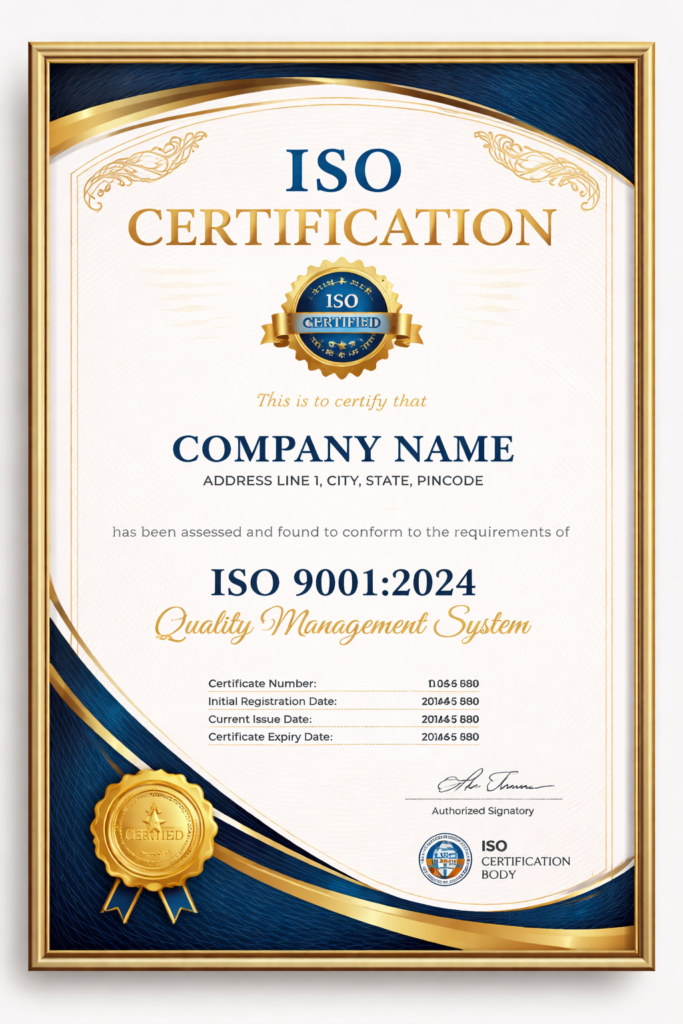
What This ISO Certificate Represents
✔ Compliance with international quality standards
✔ Strong internal processes and management systems
✔ Commitment to customer satisfaction
✔ Continuous improvement and efficiency
✔ Enhanced brand credibility and trust
Eligibility & Requirements for ISO Registration in India
Eligibility for ISO Certification
ISO certification is open to all types of organizations, regardless of size, nature, or industry. Any business aiming to improve quality, efficiency, and credibility can apply.
Businesses Eligible for ISO Certification:
Requirements for ISO Certification
To obtain ISO certification, a business must comply with certain basic requirements based on the chosen ISO standard issued by the International Organization for Standardization.
1. Defined Business Activities
The organization must clearly define its products or services and operational processes.
2. Standardized Processes
The business should implement structured processes that align with ISO standards (such as quality management, safety, or data security).
3. Documentation System
Proper documentation is required, including:
- Policies and procedures
- Work instructions
- Records of operations
4. Quality Control Measures
The organization must have systems in place to monitor and maintain quality standards.
5. Trained Staff
Employees should be aware of processes and trained to follow ISO guidelines.
6. Internal Audit
The company should conduct internal audits to ensure compliance before certification.
7. Management Responsibility
Top management must be involved in implementing and maintaining ISO standards.
8. Continuous Improvement
The business should focus on ongoing improvement in processes, quality, and performance.
Documents Required for ISO Registration
To apply for ISO certification, businesses generally need the following documents:
How We Help You Build a Strong Legal Foundation
Expert Guidance
We help you choose the right ISO standard and ensure full compliance with International Organization for Standardization guidelines.
Complete Documentation
We prepare and organize all required documents, policies, and procedures accurately.
End-to-End Support
From application to certification, we handle the entire process smoothly and quickly.
Ongoing Compliance Assistance
We guide you on audits and continuous improvements to maintain your ISO certification.
Step-by-Step Process to Register a Private Limited Company
The ISO certification process involves a series of structured steps to ensure your business complies with international standards set by the International Organization for Standardization. Here’s a slightly detailed overview:
Step 1 – Application & Requirement Analysis
You submit basic business details such as company name, nature of activities, and preferred ISO standard (e.g., ISO 9001, ISO 27001). Based on this, the scope of certification is defined.
Step 2 – Gap Analysis
Experts analyze your current business processes to identify gaps between existing practices and ISO requirements. This helps in planning necessary improvements.
Step 3 – Documentation & Process Implementation
Required documents, policies, and procedures are prepared and implemented within your organization. This may include quality manuals, SOPs, and compliance records.
Step 4 – Internal Audit & Training
An internal audit is conducted to ensure all systems are properly followed. Employees are trained to maintain ISO standards effectively.
Step 5 – External Audit by Certification Body
An authorized certification body reviews your documents and may conduct an on-site or remote audit to verify compliance.
Step 6 – Issuance of ISO Certificate
Once the audit is successfully completed, your business is awarded the ISO certificate.
Step 7 – Surveillance & Renewal
ISO certification is valid for 3 years, with periodic surveillance audits to ensure continuous compliance and improvement.
ISO Certification Validity
ISO certification is generally valid for 3 years. However, annual surveillance audits may be required to ensure compliance with ISO standards.
Why Choose Professional Assistance for ISO Certification?
Getting ISO certification requires proper documentation, process standardization, and compliance with international guidelines. Professional assistance helps businesses complete the certification smoothly and quickly.
Benefits of expert support include:
Cost of ISO Certification in India
The cost of ISO certification depends on several factors such as:
💡 Choose transparent pricing with no hidden charges.
ISO Certification for Business Growth
ISO certification is not just a compliance requirement; it is a powerful tool for business growth. It helps organizations establish structured processes, improve operational efficiency, and gain trust from customers and stakeholders.
With ISO certification, businesses can strengthen their market position and compete effectively in both national and international markets.
Advantages of ISO Certification
1. Enhanced Business Credibility
ISO certification builds trust among customers, clients, and stakeholders by showing your business follows international standards.
2. Improved Product & Service Quality
Standardized processes help maintain consistent quality and reduce errors in operations.
3. Better Customer Satisfaction
ISO focuses on meeting customer requirements, leading to improved customer experience and retention.
4. Increased Business Opportunities
ISO-certified companies get preference in government tenders, corporate contracts, and global trade.
5. Higher Operational Efficiency
Well-defined systems and procedures reduce waste, improve productivity, and optimize resources.
6. International Recognition
ISO certification is globally accepted, making it easier to expand your business into international markets.
7. Risk Management
Helps identify potential risks and implement preventive measures to avoid business disruptions.
Disadvantages of ISO Certification
1. Initial Cost Involvement
Certification, documentation, and audit costs can be slightly high for small businesses or startups.
2. Time-Consuming Process
Implementing ISO standards and preparing documentation may take time and effort.
3. Continuous Compliance Required
Businesses must maintain standards through regular audits and updates, which requires ongoing effort.
4. Requires Staff Training
Employees need proper training to understand and follow ISO processes effectively.
5. Not a Guarantee of Business Success
ISO certification improves systems and credibility, but it does not guarantee increased profits or business growth.
Apply for ISO Registration with JISTARTUP
At JISTARTUP, we simplify the ISO certification process and help businesses achieve international standards with ease. Whether you are a startup, SME, or established company, our expert team ensures a smooth, fast, and fully compliant ISO registration experience.
We understand that ISO certification is not just about getting a certificate—it’s about building a strong foundation for quality, credibility, and long-term business growth. That’s why we provide complete end-to-end support aligned with the standards of the International Organization for Standardization.
Why Choose JISTARTUP for ISO Registration?
✔ Expert Consultation
Our professionals guide you in selecting the right ISO standard based on your business type and goals.
✔ Complete Documentation Support
We handle all required documentation, including policies, procedures, and compliance records.
✔ Fast & Hassle-Free Process
Our streamlined approach ensures quick processing with minimal effort from your side.
✔ Affordable Pricing
We offer cost-effective ISO certification solutions suitable for startups and growing businesses.
✔ End-to-End Assistance
From application to final certification, we manage the entire process for you.
✔ Ongoing Compliance Support
We assist with audits, renewals, and continuous improvements to maintain your ISO certification.
Our Approach
At JISTARTUP, we follow a structured approach to ensure your business meets all ISO requirements efficiently:
With Jistartup, you can focus on building your business while we handle the legal formalities.
🚀 Start your entrepreneurial journey today with Jistartup!
See What Our Clients Are Saying
“The team at Jistartup handled our registration and compliance work very efficiently. Their clear guidance made the process quick and stress-free. A great partner for new entrepreneurs.”
“We opted for Virtual Office services from Office Space Provider along with company registration through Jistartup. The documentation was handled perfectly and got approved without any hassle. Very professional experience.”
Frequently Asked Questions (FAQs)
1. Is ISO certification mandatory for all businesses in India?
No, ISO certification is not mandatory. However, it is highly recommended as it improves credibility and helps in business growth.
2. Can a small business or startup apply for ISO certification?
Yes, startups and small businesses can easily apply. There is no restriction based on company size or turnover.
3. Do I need a physical office to get ISO certification?
No, even home-based or virtual businesses can apply, provided they have defined processes and documentation.
4. Can I apply for multiple ISO certifications at the same time?
Yes, businesses can apply for multiple ISO standards together depending on their operational needs.
5. Is ISO certification applicable to service-based businesses?
Yes, ISO certification is suitable for both product-based and service-based industries, including IT, consulting, and healthcare.
6. Will ISO certification help in getting loans or funding?
While not mandatory, ISO certification can improve your business credibility, which may positively influence lenders and investors.
7. Can ISO certification be cancelled or suspended?
Yes, if a business fails to maintain ISO standards or does not comply during audits, the certification can be suspended or cancelled.
8. Is there any government authority that issues ISO certification in India?
No, ISO certification is not issued by the government. It is provided by accredited certification bodies following standards set by the International Organization for Standardization.
9. Can I upgrade my ISO certification later?
Yes, businesses can upgrade or add new ISO standards as they grow and expand their operations.
10. What happens if my business changes its processes after certification?
You must update your documentation and inform the certification body if major changes occur to ensure continued compliance.
