
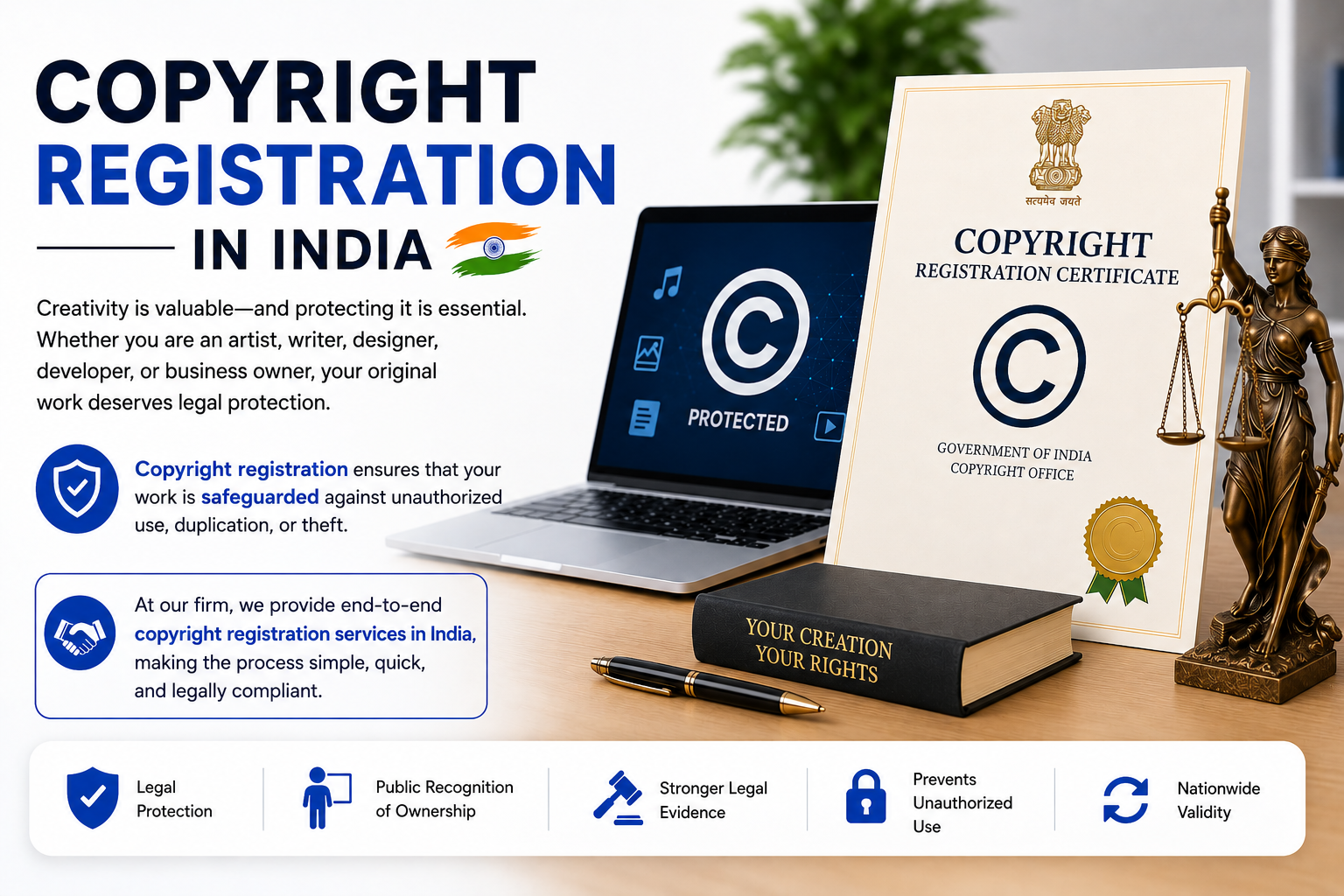
Copyright Registration in India
Creativity is valuable—and protecting it is essential. Whether you are an artist, writer, designer, developer, or business owner, your original work deserves legal protection. Copyright registration ensures that your work is safeguarded against unauthorized use, duplication, or theft.
At JiStartup, we provide end-to-end copyright registration services in India, making the process simple, quick, and legally compliant.
What is Copyright?
Copyright is a legal right granted to creators of original works, giving them exclusive rights to use, reproduce, distribute, and license their work.
It protects various types of creative works, including:
Why is Copyright Registration Important?
Although copyright exists automatically upon creation, registration provides legal proof of ownership and stronger protection.
Key Benefits:
Types of Works Protected
Under Indian copyright law, the following are protected:
1. Literary Works
Books, articles, blogs, software code
2. Artistic Works
Logos, paintings, drawings, graphics
3. Musical Works
Music compositions and lyrics
4. Cinematographic Works
Films, videos, web content
5. Sound Recordings
Audio recordings, podcasts

Copyright Registration for Social Media Creators
Influencers and creators can protect:
- Instagram posts
- YouTube videos
- Podcast recordings
- Online courses
- Photography
- Reels and promotional content
This helps prevent unauthorized reposting and commercial misuse.
Common Copyright Infringement Issues Faced by Businesses
Many creators and businesses lose revenue because their content is copied without permission. Common infringement issues include:
How Copyright Helps Startups and Digital Businesses
Modern businesses rely heavily on digital assets. Copyright registration helps startups protect:
Difference Between Copyright, Trademark & Patent
Documents Required for Copyright Registration
The documents required may vary depending on the type of creative work being registered. Below are the commonly required documents:
Basic Documents Required
1. Identity Proof of Applicant
Any one of the following:
2. Address Proof
3. Copy of Original Work
Submit the work in the appropriate format:
For Literary Work
For Artistic Work
For Software / Source Code
For Music or Audio
For Video or Film
4. Author Details
5. Applicant Details
6. No Objection Certificate (NOC)
7. Publication Details (If Published)
How We Help You Build a Strong Legal Foundation
Proper Business Registration
We handle Pvt Ltd incorporation with complete legal compliance.
Accurate Documentation
Preparation of MOA, AOA, and all required legal documents.
Compliance & Tax Support
Assistance with GST registration and regulatory filings.
End-to-End Guidance
Expert support from company setup to post-registration requirements. 🚀
Process of Copyright Registration in India
At JiStartup, we follow a smooth and transparent process:
Step 1: Consultation
We understand your work and eligibility
Step 2: Documentation
Collect necessary details and documents
Step 3: Application Filing
We file your copyright application
Step 4: Diary Number Issued
Acknowledgment from the copyright office
Step 5: Examination Period
30-day waiting period for objections
Step 6: Registration Certificate
Issued if no objections are raised
Legal Rights of a Copyright Owner
A registered copyright owner gets exclusive rights to:
Can Copyright Be Transferred or Licensed?
Yes. Copyright owners can:
Assign Copyright
Transfer ownership permanently to another person or company.
License Copyright
Allow others to use the work under agreed conditions while retaining ownership.
This is especially useful for software developers, designers, filmmakers, and content creators.
Copyright Protection for Software & Mobile Apps
Software and app developers can protect:
Copyright registration acts as strong evidence in disputes involving code duplication or unauthorized software usage.
International Protection for Copyright
India is a member of international copyright conventions such as the:
This provides broader recognition and protection for Indian creators in multiple countries.
Advantages of Copyright Registration
1. Legal Proof of Ownership
Copyright registration acts as official legal evidence that you are the rightful owner of the work. In case of disputes, the registration certificate becomes strong proof before courts and authorities.
2. Protection Against Unauthorized Use
It prevents others from copying, reproducing, publishing, or using your work without permission. This is especially important for digital creators, businesses, and software developers.
3. Right to Take Legal Action
Registered owners can file legal cases against copyright infringement and claim compensation, damages, or injunctions against unauthorized users.
4. Exclusive Rights Over the Work
The owner gets exclusive rights to:
- Reproduce the work
- Publish or distribute it
- License or sell it
- Modify or adapt the content
This gives complete control over how the work is commercially used.
5. Helps in Business Growth
Intellectual property adds value to a business. Registered copyrights improve brand credibility and can attract investors, partnerships, and licensing opportunities.
6. Revenue Generation Opportunities
Creators can earn through:
- Licensing agreements
- Royalty income
- Selling ownership rights
- Commercial partnerships
This turns creative work into a valuable business asset.
7. International Recognition
India is part of international copyright conventions, which helps creators receive recognition and protection in multiple countries.
8. Protection for Digital Content
Copyright registration protects:
- Website content
- Mobile applications
- Videos and music
- Software source code
- Social media creatives
- Online courses and eBooks
This is highly useful in the digital business environment.
9. Builds Professional Credibility
Registered intellectual property increases trust among clients, customers, publishers, and investors by showing professionalism and ownership authenticity.
10. Long-Term Protection
Copyright protection generally lasts for the lifetime of the creator plus 60 years, providing long-term security for the work and future earnings.
Disadvantages of Copyright Registration
1. Registration Process Takes Time
The copyright registration process may take several months because of examination procedures and objection waiting periods.
2. Government and Professional Fees
Although affordable, registration still involves government fees and professional service charges, especially for businesses filing multiple works.
3. Does Not Protect Ideas
Copyright protects only the expression of ideas, not the idea itself. Someone may create a similar concept differently without violating copyright law.
4. Possibility of Objections
Applications can receive objections if:
- Ownership details are unclear
- Similar work already exists
- Documents are incomplete
- Originality is questioned
Handling objections may require legal assistance.
5. Enforcement Can Be Costly
Even after registration, taking legal action against infringers may involve litigation costs, legal fees, and time-consuming court procedures.
6. Limited Protection Scope
Copyright does not protect:
- Brand names
- Business methods
- Inventions
- Functional concepts
For such protection, trademark or patent registration may also be needed.
7. Risk of Online Piracy Still Exists
Registration helps legally, but it cannot completely prevent online piracy, copying, or unauthorized sharing of digital content.
8. Requires Proper Documentation
Improper documentation or incorrect filing may lead to delays, objections, or rejection of the application.
9. Separate Registration for Different Works
Each creative work may require separate registration, which can increase time and cost for creators with multiple projects.
10. Monitoring Infringement Is Owner’s Responsibility
The copyright office does not actively monitor misuse. Owners must identify and report infringement themselves.
See What Our Clients Are Saying
“The team at Jistartup handled our registration and compliance work very efficiently. Their clear guidance made the process quick and stress-free. A great partner for new entrepreneurs.”
“We opted for Virtual Office services from Office Space Provider along with company registration through Jistartup. The documentation was handled perfectly and got approved without any hassle. Very professional experience.”
Frequently Asked Questions (FAQs) – Copyright Registration
1. Can unpublished work be registered for copyright?
Yes. Both published and unpublished original works can be registered under copyright law in India.
2. Can a website’s entire content be copyrighted?
Yes. Website content such as text, graphics, blogs, images, and design elements can be protected through copyright registration.
3. Is copyright registration available for mobile applications?
Yes. Mobile app source code, UI content, and related creative elements can be registered under copyright.
4. Can two people jointly own a copyright?
Yes. If a work is created by multiple authors, they can apply as joint copyright owners.
5. What happens if someone copies my work after registration?
You can send a legal notice, claim damages, and initiate civil or criminal action against the infringer.
6. Can I modify my work after copyright registration?
Yes. However, significant modifications or updated versions may require separate copyright registration.
7. Does copyright registration protect content on social media platforms?
Yes. Original posts, videos, photographs, reels, and digital creatives shared on social media are eligible for protection.
8. Can foreign nationals apply for copyright registration in India?
Yes. Foreign authors and businesses can apply for copyright registration in India subject to applicable laws and international conventions.
9. Is copyright registration useful for freelancers and agencies?
Absolutely. It helps freelancers and agencies legally protect client projects, designs, content, and creative deliverables.
10. Can copyright be inherited by legal heirs?
Yes. After the copyright owner’s death, the rights can pass to legal heirs or successors according to law or the owner’s will.
