

Trademark Objection in India
When applying for trademark registration, the application is carefully examined by the Trademark Registry under the Trade Marks Act, 1999. During this examination, the registrar may raise an objection if the mark does not meet certain legal requirements.
Receiving a trademark objection does not mean that your trademark application has been rejected. It simply means that the registrar requires clarification or additional justification before approving your trademark.
JiStartup provides expert assistance in drafting and filing trademark objection replies, ensuring your brand has the best chance of approval.
What is a Trademark Objection?
A trademark objection occurs when the trademark examiner raises concerns regarding the trademark application during the examination process. The objection is communicated through an Examination Report.
Applicants must respond to the objection within the prescribed time limit with a detailed explanation and supporting evidence.
If the objection is not properly answered, the trademark application may be rejected.
Common Reasons for Trademark Objection
Trademark objections can arise due to several reasons during the examination stage. Some common grounds include:
1. Similarity with Existing Trademark
If your trademark closely resembles an already registered or pending trademark, the registrar may raise an objection.
2. Lack of Distinctiveness
Trademarks that are generic, descriptive, or commonly used words may not qualify for protection.
3. Misleading or Deceptive Marks
Marks that may mislead consumers regarding the nature, quality, or origin of goods/services can be objected to.
4. Use of Prohibited Words or Symbols
Certain words, emblems, or national symbols cannot be registered under trademark law.
5. Incorrect Trademark Classification
Filing the trademark under an incorrect class can also lead to objections.

Benefits of Responding to Trademark Objection
Responding properly to a trademark objection offers several benefits:
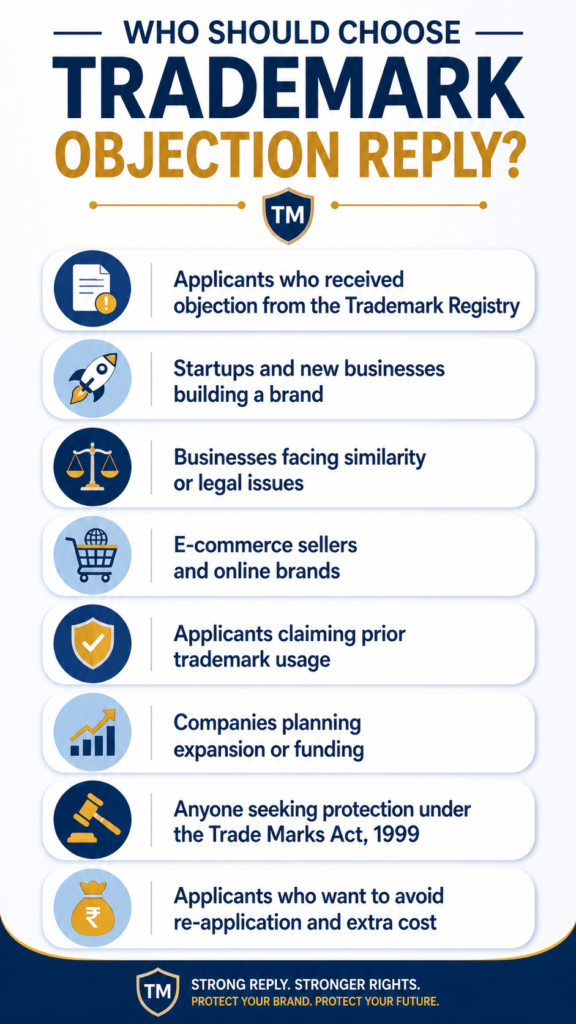
Who Should Choose Trademark Objection Reply?
- Applicants who received objection from the Trademark Registry
- Startups and new businesses building a brand
- Businesses facing similarity or legal issues
- E-commerce sellers and online brands
- Applicants claiming prior trademark usage
- Companies planning expansion or funding
- Anyone seeking protection under the Trade Marks Act, 1999
- Applicants who want to avoid re-application and extra cost
Eligibility for Trademark Objection Reply
Any applicant who has received an objection from the Trademark Registry is eligible to file a reply. The following can respond to a trademark objection:
As per the Trade Marks Act, 1999, the applicant must respond within the prescribed timeline to avoid abandonment of the application.
Requirements for Trademark Objection Reply
To successfully respond to a trademark objection, certain legal and procedural requirements must be fulfilled:
1. Examination Report
A copy of the examination report issued by the Trademark Registry highlighting the objections.
2. Proper Legal Drafting
A well-structured reply addressing each objection with legal justification and supporting arguments.
3. Supporting Evidence
Proof demonstrating the uniqueness and usage of the trademark, if applicable.
4. Timely Submission
The objection reply must be filed within 30 days from the date of issuance of the examination report.
5. Trademark Classification Accuracy
Ensure that the trademark is filed under the correct class and category of goods/services.
6. Distinctiveness Justification
Clear explanation of how the trademark is unique and not similar to existing registered marks.
Documents Required for Trademark Objection Reply
The following documents are generally required while filing a trademark objection reply:
Additional Supporting Documents (If Required)
How We Help You Build a Strong Legal Foundation
Expert Analysis of Objection
We carefully review the examination report issued by the Trademark Registry to identify the exact legal concerns.
Professional Reply Drafting
Our experts prepare a strong, legally sound response under the Trade Marks Act, 1999 to improve approval chances.
Accurate Documentation Support
We help you compile and present all required documents and evidence to strengthen your case.
End-to-End Assistance
From filing the reply to handling hearings (if required), we manage the complete process for you.
Process of Trademark Objection Reply with JiStartup
Step 1 – Share Examination Report
Send us the trademark examination report received from the registry.
Step 2 – Legal Analysis
Our experts analyze the objections and identify the best legal strategy.
Step 3 – Drafting the Reply
A detailed reply with legal arguments, case references, and evidence is prepared.
Step 4 – Filing the Response
The reply is filed with the Trademark Registry within the prescribed deadline.
Step 5 – Hearing (If Required)
If the registrar schedules a hearing, our professionals assist with representation.
What Happens If You Ignore a Trademark Objection?
Ignoring a trademark objection from the Trademark Registry can lead to serious consequences:
Key Tips to Avoid Trademark Objections
Preventing objections is always better than resolving them. Here are expert tips:
JiStartup also assists in pre-filing checks to minimize risks.
Chances of Approval After Trademark Objection
A trademark objection does not mean rejection. In fact:
With expert handling, your trademark can successfully proceed to registration.
Why Timely Legal Action Matters
Trademark objections are time-sensitive. Quick response ensures:
Delays can weaken your claim over the brand.
Advantages of Filing a Trademark Objection Reply
1. Saves Your Trademark Application
A properly drafted reply to the objection raised by the Trademark Registry can prevent your application from being rejected or abandoned. It keeps your registration process active.
2. Increases Chances of Approval
A strong legal response addressing the concerns under the Trade Marks Act, 1999 improves the likelihood of your trademark being accepted and published.
3. Protects Your Brand Identity
By successfully overcoming objections, you secure exclusive rights over your brand name, logo, or tagline, preventing misuse by competitors.
4. Establishes Legal Ownership
A successful reply strengthens your claim over the trademark and builds a solid legal foundation for future disputes or enforcement.
5. Avoids Re-application Costs
If your application is abandoned, you must reapply and pay government fees again. Responding to objections helps you avoid these additional expenses.
6. Strengthens Brand Credibility
A registered trademark enhances trust among customers, investors, and partners, making your business look more professional and reliable.
7. Opportunity to Clarify and Justify
The objection process allows you to present evidence of usage, uniqueness, and brand value, which can strengthen your overall application.
8. Enables Business Expansion
A clear trademark status is essential for expansion into marketplaces, franchising, licensing, and attracting investors.
Disadvantages of Trademark Objection Reply
1. Strict Time Limit
You must respond within 30 days, failing which the application may be marked as abandoned. This creates pressure for quick action.
2. Requires Legal Expertise
Drafting a proper reply involves legal knowledge and understanding of trademark law. Incorrect replies may lead to rejection.
3. Additional Cost Involved
Professional assistance for drafting and filing replies may involve extra costs, especially for startups or small businesses.
4. Possibility of Hearing
Even after filing a reply, the registrar may call for a hearing, which requires further preparation and representation.
5. No Guaranteed Approval
Submitting a reply does not guarantee acceptance. The final decision depends on the registrar’s evaluation.
6. Time-Consuming Process
The objection resolution process may delay the overall trademark registration timeline.
7. Documentation Burden
Applicants may need to provide extensive documents such as proof of usage, affidavits, and supporting evidence.
8. Risk of Weak Arguments
If the reply is poorly drafted or lacks strong justification, it may weaken your case and lead to rejection.
See What Our Clients Are Saying
“The team at Jistartup handled our registration and compliance work very efficiently. Their clear guidance made the process quick and stress-free. A great partner for new entrepreneurs.”
“We opted for Virtual Office services from Office Space Provider along with company registration through Jistartup. The documentation was handled perfectly and got approved without any hassle. Very professional experience.”
Frequently Asked Questions (FAQs)
1. Can I request an extension for replying to a trademark objection?
No, the Trademark Registry generally does not grant extensions for filing objection replies. You must respond within the prescribed 30 days to avoid abandonment.
2. What format should a trademark objection reply be in?
The reply must be in a formal legal format, clearly addressing each objection point with proper justification, case references (if any), and supporting documents.
3. Is it mandatory to attend a hearing after filing the objection reply?
No, a hearing is only scheduled if the registrar is not fully satisfied with your written response. If your reply is strong, the trademark may be accepted without a hearing.
4. Can I modify my trademark while replying to an objection?
Minor modifications may be allowed in certain cases, but major changes to the trademark are generally not permitted during the objection stage.
5. What happens if my trademark objection reply is rejected?
If your reply is not accepted, the application may be refused. However, you may still explore legal remedies such as appeal or re-application with better documentation.
6. Can a trademark objection be raised for already used brand names?
Yes, even if you are already using the brand, objections can still be raised based on similarity, descriptiveness, or legal restrictions under the Trade Marks Act, 1999.
7. Do I need to submit original documents for objection reply?
No, scanned copies of documents are usually sufficient for online filing. However, originals should be kept ready if required during a hearing.
8. Can I track the status after filing the objection reply?
Yes, you can track the status of your trademark application online through the official portal of the Trademark Registry using your application number.
9. Is trademark objection reply applicable for all types of trademarks?
Yes, objection replies apply to all types of trademarks including wordmarks, logos, slogans, and even sound or shape marks if objections are raised.
10. Can multiple objections be raised in a single examination report?
Yes, the examiner can raise multiple objections in one report. Your reply must address each objection separately and clearly to improve chances of approval.
