
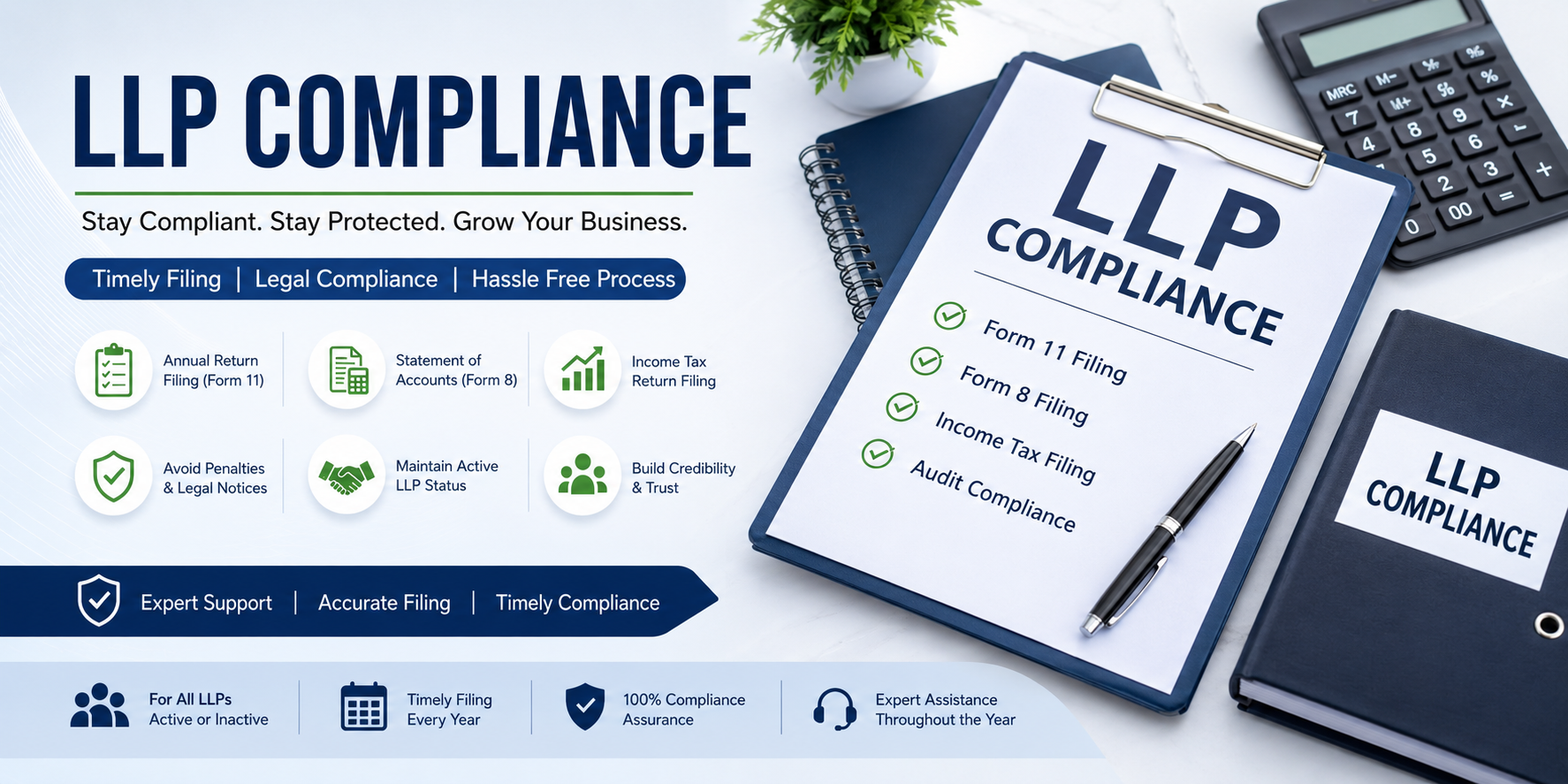
LLP Compliance Services by JiStartup
Running a Limited Liability Partnership (LLP) offers flexibility, limited liability protection, and easier business management compared to traditional partnership firms. However, every LLP registered in India must follow mandatory compliance requirements under the Limited Liability Partnership Act.
Whether your LLP is actively operating or not generating revenue, annual compliance filing is compulsory.
At JiStartup, we help businesses, startups, professionals, consultants, and entrepreneurs maintain complete LLP compliance without confusion, delays, or penalties. Our expert team ensures accurate documentation, timely filing, and smooth legal support throughout the year.
What is LLP Compliance?
LLP compliance refers to the legal procedures, annual filings, financial disclosures, and tax-related submissions that every Limited Liability Partnership must complete after registration.
The Ministry of Corporate Affairs (MCA) mandates LLPs to submit annual forms and maintain proper records regularly.
Compliance helps the government track the operational status, financial condition, and legal standing of LLP entities in India.
Why LLP Compliance is Mandatory?
Many business owners believe compliance is required only if the LLP is making profits or actively operating. However, this is incorrect.
Even dormant LLPs and LLPs with no business transactions must file annual compliance forms.
Failure to comply can result in:
Importance of LLP Compliance
Proper LLP compliance plays a major role in maintaining business legitimacy and operational continuity.
Benefits of Timely Compliance
Avoid Heavy Penalties
Late filing fees can accumulate daily without maximum limits.
Maintain Active LLP Status
Regular compliance keeps the LLP legally active under MCA records.
Easier Business Expansion
Compliant LLPs face fewer issues while opening bank accounts, applying for loans, or attracting investors.
Better Credibility
Clients, vendors, and financial institutions trust compliant businesses more.
Smooth Business Closure
An LLP with updated filings can be closed easily whenever required.
Major Annual LLP Compliance Requirements
Every LLP registered in India must complete the following compliances every financial year.
1. Form 11 – Annual Return Filing
Form 11 is an annual return that contains information about:
Due Date:
30th May every year
Mandatory For:
All LLPs registered in India, irrespective of turnover or business activity.
2. Form 8 – Statement of Accounts & Solvency
Form 8 includes:
This form confirms the financial condition of the LLP.
Due Date:
30th October every year
Mandatory For:
All LLPs.
3. Income Tax Return Filing
Every LLP must file its income tax return annually under the Income Tax Act.
Due Date:
Required Even If:
4. Audit Requirement for LLP
Audit becomes mandatory if:
Audit helps maintain transparency and financial accuracy.
Documents Required for LLP Compliance
To complete LLP annual filing, the following documents are generally required:
Consequences of Ignoring LLP Compliance
Ignoring LLP compliance may create serious problems in the future.
Risks Include:
A virtual office address is legally accepted for company registration and GST purposes.
How We Help You Build a Strong Legal Foundation
Accurate Compliance Filing
We ensure accurate and timely LLP compliance filing to help your business avoid penalties and maintain legal status without delays.
Expert MCA & Tax Guidance
Our professionals provide expert guidance on MCA regulations, ROC filings, and tax compliance requirements for LLPs across India.
Compliance Tracking & Reminders
We regularly monitor due dates and send timely reminders so you never miss important compliance deadlines.
End-to-End Legal Support
From documentation to final filing, we provide complete support for hassle-free LLP legal and compliance management.
Step-by-Step LLP Compliance Process
JiStartup follows a simple and systematic process to complete LLP compliance smoothly.
Step 1 – Initial Consultation
Our experts understand your LLP structure, compliance status, and filing requirements.
We identify:
- Pending filings
- Applicable forms
- Audit requirements
- Tax obligations
Step 2 – Document Collection
We collect all required documents and financial records from you.
Documents Required:
- PAN card of LLP
- LLP incorporation certificate
- LLP agreement
- Financial statements
- Profit & loss statement
- Balance sheet
- Bank statements
- Partner KYC documents
- DSC of designated partners
- Contribution details
Step 3 – Financial Review & Verification
Our compliance team reviews all financial records and verifies:
- Accuracy of statements
- Partner details
- Contribution structure
- Tax information
- Compliance applicability
This step helps avoid filing errors and penalties.
Step 4 – Preparation of Compliance Forms
We prepare all required forms accurately, including:
- Form 11
- Form 8
- Income Tax Return
- Audit documentation (if applicable)
Step 5 – DSC Verification & Approval
Digital Signature Certificates (DSC) of designated partners are verified for filing approval.
If DSC renewal is required, our team assists with the process.
Step 6 – Filing with MCA & Income Tax Department
After verification and approval, we file the forms with:
- Ministry of Corporate Affairs (MCA)
- Income Tax Department
We ensure timely and accurate submission before due dates.
Step 7 – Acknowledgment & Confirmation
Once filing is completed, we provide:
- Filing acknowledgment
- Challan receipts
- Compliance confirmation
- Filed form copies
Step 8 – Ongoing Compliance Support
JiStartup continues to support your LLP with:
- Due date reminders
- Compliance tracking
- Annual filing assistance
- Legal guidance
- ROC support
Late Filing Penalties for LLP
The government imposes penalties for delayed filing of LLP forms.
Penalty Structure:
For example, delayed filing of Form 8 and Form 11 for several months may result in huge penalties.
Common Mistakes Made by LLP Owners
Many LLPs become non-compliant due to:
JiStartup helps businesses avoid these mistakes through professional compliance management.
Our LLP Compliance Services
JiStartup provides complete LLP annual compliance solutions.
Our Services Include:
ROC Filing
Preparation and filing of:
- Form 8
- Form 11
Income Tax Filing
Accurate LLP income tax return filing.
Compliance Monitoring
Regular tracking of due dates and filing schedules.
DSC Assistance
Digital Signature Certificate support and renewal.
Accounting Support
Preparation of financial statements and reports.
Audit Coordination
Support for mandatory LLP audits.
Legal Consultation
Expert guidance regarding MCA and ROC compliance.
Difference Between LLP and Private Limited Company Compliance
LLPs generally have simpler compliance requirements compared to private limited companies.
LLP Advantages:
However, annual filing remains mandatory.
Advantages of LLP Compliance
Maintaining proper LLP compliance offers multiple legal, financial, and operational benefits for businesses. Timely filing and adherence to government regulations help LLPs build a strong and trustworthy business foundation.
1. Avoid Heavy Penalties
One of the biggest advantages of timely LLP compliance is avoiding late filing penalties.
The government imposes:
- ₹100 per day penalty for delayed filing
- No maximum limit on penalties
- Continuous penalties until forms are filed
Regular compliance helps businesses save significant money and avoid unnecessary legal expenses.
2. Maintains Active LLP Status
An LLP that files its annual returns and statutory forms on time remains legally active under MCA records.
Active status helps in:
- Smooth business operations
- Legal recognition
- Better credibility
- Easier government approvals
3. Builds Business Credibility
Compliant businesses gain higher trust among:
- Clients
- Investors
- Vendors
- Financial institutions
- Government authorities
A properly compliant LLP appears more professional and reliable in the market.
4. Easier Bank Loans & Funding
Banks and investors often verify compliance records before:
- Approving loans
- Providing investments
- Offering financial assistance
Timely LLP compliance improves the chances of securing funding and business expansion opportunities.
5. Simplifies Business Expansion
Compliant LLPs face fewer problems while:
- Opening bank accounts
- Applying for tenders
- Expanding operations
- Entering partnerships
- Registering on government portals
6. Better Financial Management
Regular compliance encourages businesses to maintain:
- Proper accounting records
- Accurate financial statements
- Tax documentation
- Organized bookkeeping
This improves financial transparency and business planning.
7. Smooth LLP Closure Process
If partners decide to close the LLP in the future, updated compliance records simplify the closure procedure.
Non-compliant LLPs often face:
- Delays
- Additional penalties
- Legal complications during closure
8. Reduces Legal Risks
Timely filing reduces:
- ROC notices
- Legal disputes
- Compliance-related issues
- Government scrutiny
Professional compliance management ensures safer business operations.
9. Improves Long-Term Business Stability
Consistent compliance helps businesses build:
- Strong legal standing
- Operational stability
- Better reputation
- Sustainable business growth
10. Peace of Mind for Business Owners
When compliance is managed properly, business owners can focus on:
- Growth
- Sales
- Marketing
- Customer acquisition
- Business development
Without worrying about legal filings and deadlines.
Disadvantages of LLP Compliance
Although LLP compliance provides legal and operational benefits, businesses may also face certain challenges and responsibilities while maintaining compliance.
1. Mandatory Annual Filing Requirement
Even if the LLP:
- Has no business activity
- Generates no income
- Remains inactive
Annual compliance filing is still compulsory.
This can feel unnecessary for dormant or small LLPs.
2. Late Filing Penalties are Very High
The penalty structure for LLP non-compliance is strict.
Penalty:
- ₹100 per day per form
- No upper limit
Even small delays can result in huge penalties over time.
3. Compliance Costs
LLPs may need to spend money on:
- Professional CA services
- ROC filing
- Accounting support
- Audit fees
- Tax filing
- DSC renewal
For small businesses and startups, these recurring costs may feel burdensome.
4. Documentation Burden
LLPs must maintain:
- Financial records
- Accounting statements
- Partner information
- Tax documents
- Filing acknowledgments
Improper record management may create compliance difficulties.
5. Risk of Legal Notices
Failure to comply may result in:
- MCA notices
- ROC penalties
- Legal complications
- Additional scrutiny from authorities
Ignoring compliance for long periods can create serious legal issues.
6. Audit Requirement for Growing LLPs
Once an LLP crosses:
- ₹40 lakh turnover, OR
- ₹25 lakh contribution
Audit becomes mandatory.
This increases:
- Compliance procedures
- Documentation requirements
- Professional expenses
7. Dependence on Professional Support
Most LLP owners depend on:
- Chartered Accountants
- Compliance consultants
- Tax professionals
Without expert guidance, businesses may struggle with:
- Filing accuracy
- Legal interpretation
- Deadline management
8. Time-Consuming Process
Compliance involves multiple stages:
- Documentation
- Financial review
- Form preparation
- Verification
- Filing
For busy entrepreneurs, managing compliance internally can consume valuable time.
9. DSC Renewal & Technical Issues
Digital Signature Certificates (DSC) are required for filing.
Common issues include:
- DSC expiry
- Portal errors
- Filing rejections
- Technical problems on MCA portals
These may delay filing processes.
10. Compliance Pressure on Small Businesses
Startups and small LLPs sometimes find compliance difficult due to:
- Limited resources
- Lack of accounting knowledge
- Budget constraints
- Operational workload
Professional support becomes important to handle compliance smoothly.
Why Choose JiStartup for LLP Compliance?
Experienced Team
Experts with deep knowledge of MCA compliance procedures.
Affordable Pricing
Transparent and budget-friendly compliance packages.
Complete Filing Support
End-to-end assistance for all LLP filings.
Dedicated Assistance
Continuous support throughout the process.
Timely Filing
We ensure filings are completed before deadlines.
Hassle-Free Process
Simple documentation and smooth communication.
See What Our Clients Are Saying
“The team at Jistartup handled our registration and compliance work very efficiently. Their clear guidance made the process quick and stress-free. A great partner for new entrepreneurs.”
“We opted for Virtual Office services from Office Space Provider along with company registration through Jistartup. The documentation was handled perfectly and got approved without any hassle. Very professional experience.”
Frequently Asked Questions (FAQs) – LLP Compliance
1. Is LLP compliance mandatory every year?
Yes. Every LLP registered in India must complete annual compliance filing every financial year, even if the business is inactive or has no income.
2. What are the mandatory annual compliances for an LLP?
The major annual compliances for LLP include:
- Form 11 filing
- Form 8 filing
- Income Tax Return filing
- Audit compliance (if applicable)
3. What is Form 11 in LLP compliance?
Form 11 is the Annual Return of an LLP that contains details about:
- Partners
- Management structure
- Contribution details
- Registered office information
It must be filed every year with the Ministry of Corporate Affairs (MCA).
4. What is Form 8 in LLP?
Form 8 is the Statement of Accounts and Solvency of an LLP.
It includes:
- Financial statements
- Profit & loss details
- Assets and liabilities
- Solvency declaration
5. What is the penalty for late LLP filing?
The government imposes a penalty of:
- ₹100 per day per form
- No maximum limit
The penalty continues until the pending forms are filed.
6. Is LLP compliance required if there is no business activity?
Yes. Even if the LLP:
- Has no transactions
- Earns no income
- Is inactive
Annual filing is still mandatory.
7. When is LLP audit mandatory?
Audit becomes mandatory if:
- Annual turnover exceeds ₹40 lakhs, OR
- Capital contribution exceeds ₹25 lakhs
8. Can JiStartup help with pending LLP compliance?
Yes. JiStartup assists with:
- Pending ROC filings
- Late compliance filing
- Penalty-related filings
- Annual return filing
- Income tax filing
- Compliance management
9. What documents are required for LLP compliance filing?
Generally required documents include:
- LLP PAN card
- LLP agreement
- Financial statements
- Bank statements
- Partner KYC
- DSC of partners
- Balance sheet
- Profit & loss statement
10. Why should I hire professionals for LLP compliance?
Professional compliance support helps:
- Avoid filing mistakes
- Prevent penalties
- Ensure timely filing
- Maintain legal compliance
- Reduce documentation confusion
Experts also help businesses stay updated with changing compliance rules and due dates.
