

Limited Liability Partnership (LLP) Registration in India
Starting a business requires the right balance between flexibility, legal protection, and compliance. In India, a Limited Liability Partnership (LLP) is one of the most preferred business structures for professionals, small businesses, and growing enterprises that want limited liability with simpler compliance compared to a private limited company.
At Jistartup, we make LLP registration in India simple, fast, and 100% online. From documentation and DSC to MCA approvals and incorporation, our experts manage the entire process—so you can focus on growing your business without worrying about legal formalities.
This detailed guide explains what an LLP is, why it is beneficial, who should choose it, documents required, registration process, compliance obligations, advantages, disadvantages, and FAQs—helping you make the right decision with confidence
What is a Limited Liability Partnership (LLP)?
A Limited Liability Partnership (LLP) is a hybrid business structure introduced under the Limited Liability Partnership Act, 2008, regulated by the Ministry of Corporate Affairs (MCA). It combines the operational flexibility of a partnership with the limited liability protection of a company.
Once registered, an LLP:
Key Features of an LLP
1. Limited Liability Protection
Partners are liable only to the extent of their agreed contribution. Personal assets remain protected from business losses and legal claims.
2. Separate Legal Entity
An LLP is distinct from its partners and can sue or be sued in its own name.
3. Minimum & Maximum Partners
Minimum: 2 partners
No maximum limit on partners
4. Designated Partners Requirement
Minimum 2 designated partners
At least one designated partner must be a resident of India
5. No Minimum Capital Requirement
LLP can be formed with any amount of capital, making it ideal for startups and small businesses.
6. Flexible Management
Internal operations are governed by an LLP Agreement, allowing flexibility in profit sharing and decision-making.
7. Lower Compliance Burden
Compared to private limited companies, LLPs have fewer annual compliance requirements.
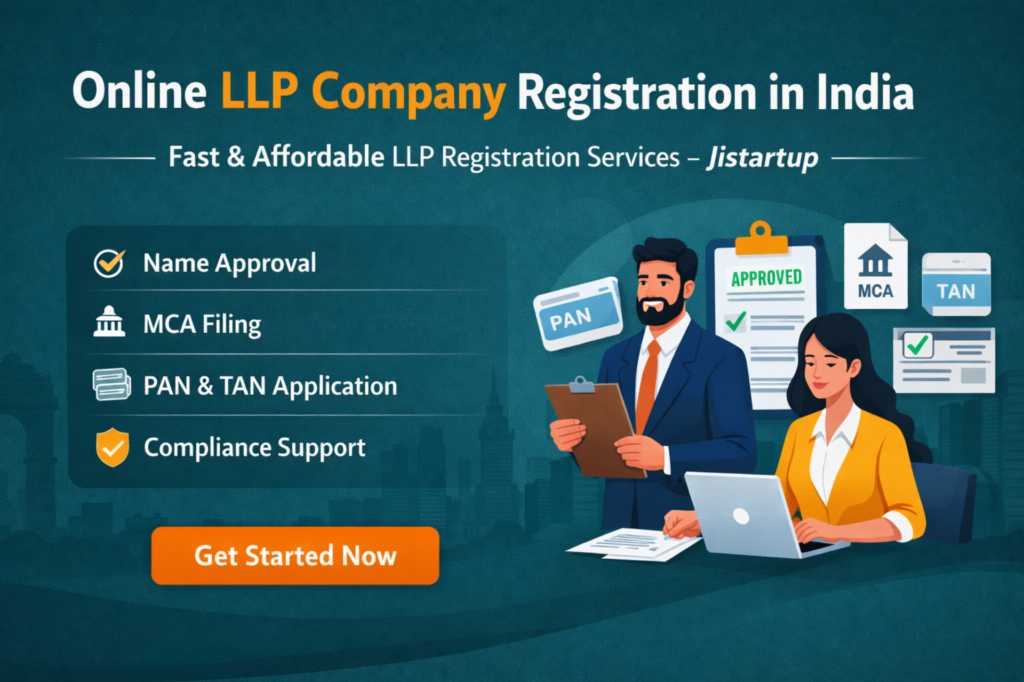
Why Register an LLP in India?
Choosing the right business structure impacts compliance costs, taxation, liability, and scalability. LLP registration offers a perfect middle ground.
1. Personal Asset Protection
Unlike traditional partnerships, partners’ personal assets are not at risk.
2. Cost-Effective & Simple
Lower registration costs and fewer annual filings compared to companies.
3. Professional Credibility
An LLP structure builds trust with clients, banks, and vendors.
4. Tax Efficiency
LLPs are taxed at a flat rate, with no dividend distribution tax.
5. Ideal for Long-Term Operations
Suitable for businesses that want stability without complex compliance.
Who Should Choose an LLP?
Professionals (CA, CS, Lawyers, Architects)
Consulting & service-based businesses
Small & medium enterprises (SMEs)
Family-run businesses
Startups not seeking external investors immediately
Businesses converting from partnership firms
Eligibility & Minimum Requirements for LLP Registration
To register an LLP in India, the following conditions must be met:
Documents Required for LLP Registration
Documents for Partners & Designated Partners
Identity Proof
Address Proof (Any One)
Other Requirements
Registered Office Address Proof
The registered office is the official communication address of the company.
Required documents:
A virtual office address is legally accepted for company registration and GST purposes.
How We Help You Build a Strong Legal Foundation
End-to-End LLP Registration
We handle everything—from DSC to Certificate of Incorporation—completely online.
Expert Consultation
Our experts guide you on whether LLP is the right structure for your business goals.
Accurate & Fast Filing
Error-free documentation ensures faster approvals and zero rejections.
Post-Incorporation Support
We assist with LLP Agreement drafting, PAN, bank account opening, and compliance.
Step-by-Step LLP Registration Process
Step 1: Digital Signature Certificate (DSC)
All designated partners must obtain DSC for MCA filings.
Step 2: DPIN Allotment
Designated Partner Identification Number (DPIN) is issued.
Step 3: Name Reservation
We apply through RUN-LLP for name approval as per MCA guidelines.
Step 4: LLP Incorporation Filing
Form FiLLiP is filed with MCA along with documents.
Step 5: Certificate of Incorporation
RoC issues the Certificate with LLP Identification Number (LLPIN).
Step 6: LLP Agreement Filing
LLP Agreement is drafted and filed within 30 days of incorporation.
Time Required for LLP Registration
7–10 working days, subject to:
Post-Registration Compliance for LLP
After incorporation, LLP must comply with:
⚠ Non-compliance attracts heavy penalties.
Cost of LLP Registration in India
The cost varies depending on:
💡 Choose transparent pricing with no hidden charges.
Certificate of Incorporation
Issued by the Registrar of Companies (RoC), it includes:
This certificate legally confirms the formation of your company in India.
Advantages of LLP
1. Limited Liability Protection
Partners’ personal assets are protected from business losses and legal liabilities.
2. Separate Legal Entity
An LLP has its own legal identity, independent of its partners.
3. No Minimum Capital Requirement
An LLP can be started with any amount of capital, making it accessible for startups and small businesses.
4. Lower Compliance Compared to Private Limited Company
LLPs require fewer ROC filings and do not require mandatory board meetings.
5. Flexible Management Structure
Operations are governed by the LLP Agreement, allowing flexibility in profit-sharing and management decisions.
6. Cost-Effective Formation & Maintenance
Registration and annual compliance costs are generally lower than a Private Limited Company.
7. Perpetual Succession
The LLP continues to exist even if partners change, resign, or pass away.
8. Ideal for Professionals & SMEs
Best suited for consultants, service providers, agencies, and small to medium enterprises.
Disadvantages of LLP
1. Cannot Raise Equity Funding
LLPs cannot issue shares, making it difficult to raise funds from venture capitalists or angel investors.
2. Not Preferred by Investors
Most investors prefer Private Limited Companies due to structured shareholding and equity options.
3. Higher Penalties for Non-Compliance
Late filing penalties can be significant and may accumulate daily.
4. Limited Scalability
Not suitable for businesses planning rapid expansion, large funding rounds, or IPO.
5. Mandatory Annual Filings Even if Inactive
Compliance is required even if the LLP does not conduct business during the year.
6. Conversion Process is Structured
Converting an LLP into a Private Limited Company is possible but involves legal procedures and documentation.
7. Audit Requirement After Threshold
Audit becomes mandatory if turnover or capital contribution crosses prescribed limits.
8. Slightly Lower Corporate Perception
The “LLP” tag may carry slightly less corporate credibility compared to “Private Limited” in certain industries.
Register Your LLP with Jistartup
Jistartup offers end-to-end Private Limited Company registration services in India at affordable pricing. Our experts manage everything—from name approval and documentation to MCA filing and incorporation.
We help you:
With Jistartup, you can focus on building your business while we handle the legal formalities.
🚀 Start your entrepreneurial journey today with Jistartup!
See What Our Clients Are Saying
“The team at Jistartup handled our registration and compliance work very efficiently. Their clear guidance made the process quick and stress-free. A great partner for new entrepreneurs.”
“We opted for Virtual Office services from Office Space Provider along with company registration through Jistartup. The documentation was handled perfectly and got approved without any hassle. Very professional experience.”
Essential LLP FAQs – Mandatory Questions Every Business Owner Should Know
1️⃣ Is it possible to start an LLP with only one person?
No. An LLP requires minimum 2 partners at all times as per the Limited Liability Partnership Act, 2008.
If the number falls below two for more than 6 months, the remaining partner may become personally liable.
2️⃣ Who can become a partner in an LLP?
Any individual or body corporate can become a partner.
However, at least two designated partners must be individuals, and at least one must be a resident of India.
3️⃣ Is it mandatory to have a registered office for LLP?
Yes. Every LLP must have a registered office address for official communication and MCA correspondence. It can be:
Owned property
Rented property
Virtual office (with proper documentation)
Registration is done through the Ministry of Corporate Affairs portal.
4️⃣ Is LLP suitable for small businesses and startups?
Yes. LLP is ideal for:
Professionals (CA, CS, consultants)
Small & medium businesses
Service-based startups
It provides limited liability with lower compliance compared to a private limited company.
5️⃣ Do LLP partners receive salary?
Partners cannot take salary like employees. They can receive:
Remuneration (if mentioned in LLP Agreement)
Profit share
Both are governed by the LLP Agreement.
6️⃣ Is GST registration mandatory for LLP?
GST registration is mandatory only if:
Turnover exceeds the prescribed threshold limit, or
The LLP engages in interstate supply, e-commerce, or specific notified businesses.
Otherwise, it is optional.
7️⃣ What happens if LLP does not file annual returns?
Heavy penalties are imposed for non-compliance.
Late filing fees under MCA are charged per day of delay, and it can lead to disqualification of designated partners.
8️⃣ Can an LLP take loans from banks?
Yes. LLPs can take business loans, OD limits, and working capital loans.
However, banks may sometimes require personal guarantees from partners.
9️⃣ Can foreign nationals become partners in an LLP?
Yes, foreign nationals or NRIs can become partners, subject to compliance with FEMA regulations and valid documentation.
🔟 Is an LLP easy to close if business stops?
LLP can be closed, but it requires:
Filing pending returns
Clearing liabilities
Applying for strike-off with MCA
Proper compliance must be completed before closure.
