

BIS Registration in India
BIS Registration is a mandatory certification for many products sold in India to ensure they meet safety, quality, and performance standards. The certification is issued by the Bureau of Indian Standards, the national standards body of India.
Manufacturers, importers, and businesses dealing with regulated products must obtain BIS certification before selling their products in the Indian market. The BIS mark assures consumers that the product meets the required Indian quality and safety standards.
If you are planning to manufacture or import regulated products, obtaining BIS Registration is essential to comply with government regulations and build trust with customers.
What is BIS Certification?
BIS Certification is a conformity assessment issued by the Bureau of Indian Standards confirming that a product meets the required Indian Standard (IS) specifications.
Products that receive BIS certification can use the ISI Mark or BIS Standard Mark, indicating that they comply with the safety and quality guidelines established by the authority.
BIS certification plays a crucial role in:
Benefits of BIS Registration
Obtaining BIS certification provides several advantages for businesses.
1. Legal Compliance
BIS registration ensures your products comply with Indian government regulations.
2. Market Access
Many products cannot be legally sold in India without BIS certification.
3. Consumer Trust
The BIS mark assures customers that the product meets quality and safety standards.
4. Improved Product Credibility
Certified products gain higher credibility in domestic and international markets.
5. Competitive Advantage
BIS certification helps businesses stand out from competitors by demonstrating product quality.

Types of BIS Registration in India
BIS offers different certification schemes depending on the product category.
1. ISI Mark Certification
The ISI Mark is mandatory for many industrial and consumer products such as cement, electrical appliances, and packaged drinking water.
Products certified under this scheme can display the ISI Mark, indicating compliance with Indian standards.
2. CRS Registration (Compulsory Registration Scheme)
Under the CRS scheme, manufacturers must register their products with the Bureau of Indian Standards before selling them in India.
Products commonly covered include:
- Electronics
- IT products
- LED lights
- Mobile phones
- Power adapters
- Batteries
3. Foreign Manufacturer Certification Scheme (FMCS)
Foreign manufacturers exporting products to India must obtain BIS certification under the FMCS scheme to ensure their products comply with Indian safety and quality standards.
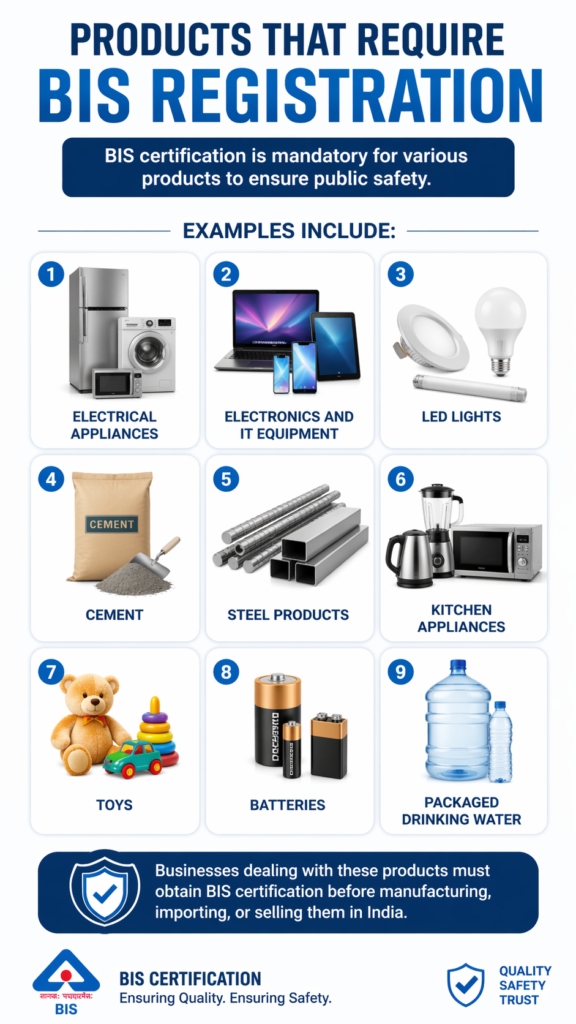
Products that Require BIS Registration
The Government of India has made BIS certification mandatory for various products to ensure public safety.
Examples include:
-
Electrical appliances
-
Electronics and IT equipment
-
LED lights
-
Cement
-
Steel products
-
Kitchen appliances
-
Toys
-
Batteries
-
Packaged drinking water
Businesses dealing with these products must obtain BIS certification before manufacturing, importing, or selling them in India.
Eligibility for BIS Registration in India
To obtain BIS Certification from the Bureau of Indian Standards, applicants must meet certain eligibility criteria depending on the type of certification scheme (ISI, CRS, or FMCS).
Who is Eligible?
1. Manufacturers (Indian & Foreign)
2. Foreign Manufacturers
3. Importers (Indirect Eligibility)
4. Business with Regulated Products
Requirements for BIS Registration
To successfully obtain certification from the Bureau of Indian Standards, businesses must fulfill the following requirements:
1. Manufacturing Unit Setup
2. Product Compliance with Indian Standards
3. Product Testing
4. Quality Control Measures
5. Marking & Labeling Compliance
6. Authorized Indian Representative (For Foreign Applicants)
Documents Required for BIS Registration
The documentation requirements vary slightly depending on the certification type, but generally include the following:
Basic Company Documents
Manufacturing Unit Documents
Product-Related Documents
Authorized Signatory Documents
Additional Documents (If Applicable)
How We Help You Build a Strong Legal Foundation
Expert Compliance Guidance
We ensure your business meets all regulations set by the Bureau of Indian Standards without confusion.
Accurate Documentation
We prepare and verify all required documents to avoid delays or rejection
End-to-End Registration Handling
From product testing to certification, we manage the complete BIS process.
Ongoing Compliance Assistance
We help you stay compliant even after certification with updates and renewals.
BIS Registration Process
The BIS registration process involves several steps to ensure product quality compliance.
Step 1: Identify Applicable Indian Standard
Determine the relevant Indian Standard (IS code) applicable to your product.
Step 2: Product Testing
The product must be tested at a BIS-recognized laboratory.
Step 3: Application Submission
Submit the BIS registration application with required documents and test reports.
Step 4: Verification by BIS
The Bureau of Indian Standards reviews the application and verifies product compliance.
Step 5: Grant of BIS Certificate
Once approved, BIS issues the registration certificate allowing the manufacturer to use the BIS standard mark.
BIS Registration Fees
The cost of BIS registration depends on several factors such as:
Who Needs BIS Registration?
BIS registration is required for:
Why Choose Professional Assistance for BIS Registration?
The BIS certification process involves technical documentation, product testing, and compliance requirements. Professional experts can help simplify the process by:
Advantages of BIS Registration
1. Legal Authorization to Sell
BIS certification from the Bureau of Indian Standards allows you to legally manufacture, import, and sell regulated products in India without compliance issues.
2. Builds Consumer Trust
The BIS Standard Mark (ISI Mark) assures customers that your product meets quality and safety standards, increasing credibility and brand reputation.
3. Wider Market Access
Many marketplaces, government tenders, and large distributors only accept BIS-certified products, helping you expand your business opportunities.
4. Quality Assurance
BIS certification ensures that your product is tested and meets Indian Standards, reducing defects and improving overall product quality.
5. Competitive Advantage
Certified products stand out in the market, giving you an edge over competitors who are not compliant.
Disadvantages of BIS Registration
1. Time-Consuming Process
The BIS registration process involves product testing, documentation, and verification, which may take time depending on the product type.
2. Initial Cost Involved
Costs include testing fees, government charges, and professional service fees, which may be high for small businesses or startups.
3. Strict Compliance Requirements
Manufacturers must continuously follow BIS standards, maintain quality, and update certifications as required.
4. Renewal & Maintenance
BIS certification is not a one-time process; it requires periodic renewal and ongoing compliance checks.
5. Limited to Manufacturer Application
Only manufacturers can apply directly, which can be challenging for importers who must depend on foreign manufacturers for certification.
Register Your BIS Registration with Jistartup
Getting certified with the Bureau of Indian Standards is more than just documentation—it requires strategy, accuracy, and ongoing compliance. Jistartup goes beyond basic registration support to give your business a strong compliance advantage.
Pre-Compliance Product Assessment
Before you even apply, we evaluate your product against BIS standards to identify gaps and reduce chances of rejection.
IS Code Identification & Risk Mapping
We help you choose the correct Indian Standard (IS code) and highlight potential compliance risks in advance.
Lab Test Report Review & Correction
Not just testing—we carefully review lab reports and suggest corrections (if needed) to ensure they meet BIS approval criteria.
Vendor & Manufacturer Coordination
We directly coordinate with your factory team or foreign manufacturer to align documentation, labeling, and compliance requirements.
Import & E-commerce Readiness Support
We guide you on how BIS certification impacts platforms like Amazon/Flipkart and customs clearance, ensuring your product is market-ready.
BIS Mark Usage & Labeling Guidance
We provide exact instructions on how to correctly use the BIS Standard Mark on your product and packaging to avoid penalties.
Renewal Alerts & Compliance Tracking
Never miss a renewal—our system tracks your certification validity and keeps you updated for timely renewal and updates.
Dedicated Case Manager
You get a single point of contact who handles your entire BIS journey, ensuring smooth communication and faster execution.
See What Our Clients Are Saying
“The team at Jistartup handled our registration and compliance work very efficiently. Their clear guidance made the process quick and stress-free. A great partner for new entrepreneurs.”
“We opted for Virtual Office services from Office Space Provider along with company registration through Jistartup. The documentation was handled perfectly and got approved without any hassle. Very professional experience.”
Frequently Asked Questions (FAQs) – BIS Registration
1. What happens if I apply under the wrong IS Code?
Applying under the wrong Indian Standard (IS Code) can lead to immediate rejection or delays. The Bureau of Indian Standards requires accurate product classification, so choosing the correct standard is critical for approval.
2. Can incomplete documentation lead to rejection?
Yes, submitting incomplete or mismatched documents is one of the most common reasons for rejection. All documents must be consistent, accurate, and properly verified before submission.
3. Is it mandatory to use BIS-approved laboratories for testing?
Yes, product testing must be conducted only in BIS-recognized laboratories. Reports from non-approved labs will not be accepted by the Bureau of Indian Standards.
4. What are the common mistakes in product labeling?
Incorrect use of the BIS Standard Mark, missing registration numbers, or improper labeling formats can lead to penalties or rejection. Proper marking guidelines must be followed strictly.
5. Is an Authorized Indian Representative (AIR) compulsory for foreign manufacturers?
Yes, foreign manufacturers must appoint an Authorized Indian Representative (AIR) to apply for BIS registration and communicate with the Bureau of Indian Standards.
6. How long does the BIS registration process take?
The process typically takes 30–60 working days, including product testing (15–25 days), documentation (3–7 days), and BIS approval (15–30 days), depending on the product category.
7. What are the penalties for selling products without BIS certification?
Non-compliance can result in product seizure, heavy fines, ban on sales, and legal action under the BIS Act. Certification is mandatory for notified products.
8. What is the validity of BIS certification, and when should it be renewed?
BIS registration is generally valid for 1–2 years, depending on the scheme. Renewal must be applied before expiry, and updated compliance or test reports may be required.
9. How can I check my BIS registration status online?
You can verify your certification by visiting the official BIS portal, entering your registration or license number, and checking product and manufacturer details.
10. Who is eligible to apply for BIS registration?
Only manufacturers can apply directly to the Bureau of Indian Standards. Traders, retailers, and importers cannot apply unless they coordinate with the manufacturer.
