
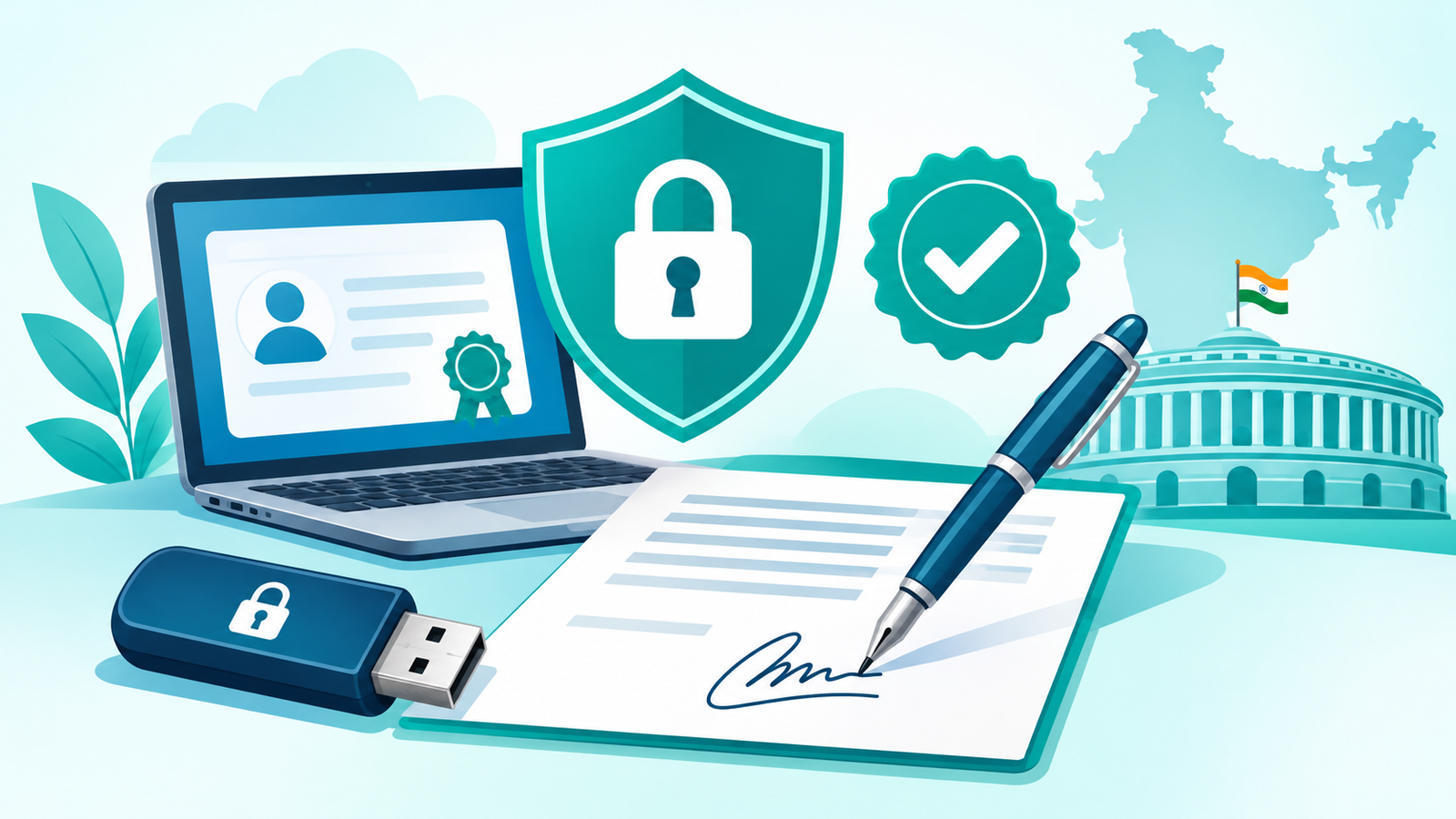
A Digital Signature Certificate (DSC) is the electronic equivalent of a signature. In India, directors, partners and taxpayers need one to sign forms for company registration, GST, income tax and e-tenders.
What is a DSC?
A DSC is issued by a government-licensed Certifying Authority after identity verification. It is stored on a secure USB token and links your identity to a document so that it cannot be altered after signing.
Classes and types
- Class 3: the class commonly required for MCA filings, e-tendering, GST and income tax e-filing.
- Signing vs encryption: a signing certificate signs documents, while an encryption certificate protects data. Some filings need both.
- Validity: usually one to three years, after which it must be renewed.
Where you need it
- Incorporation of a company or LLP on the MCA portal (see our Private Limited Company guide)
- Annual filings with the Registrar
- Income tax returns of companies and audits
- GST registration and filings for companies and LLPs
- Government e-tenders
Documents required
- PAN and Aadhaar of the applicant
- Passport-size photograph
- Email address and mobile number
- Address proof for some categories
- Organisation proof for an organisation DSC
How to apply
- Choose class, validity and signing or encryption type.
- Submit the application with documents to a Certifying Authority or its partner.
- Complete identity verification, usually by video or Aadhaar-based verification.
- Receive the DSC on a token and install the driver.
- Register the DSC on the portals where you will sign.
Safety tips
- Never share your token or PIN.
- Renew before expiry to avoid missing filing deadlines.
- Report loss immediately so the certificate can be revoked.
Get help from JiStartup
We help you obtain and register your DSC quickly. See our DSC service. Contact our team for a free consultation.
This article is general information, not legal or tax advice. Rules, fees and due dates change, so confirm current requirements on the official portal or with a professional.
