

12A & 80G Registration in India
Non-profit organizations such as trusts, societies, and Section 8 companies play an important role in social development. To encourage charitable activities, the Government of India provides special tax benefits to NGOs through 12A Registration and 80G Certification.
Obtaining 12A and 80G registration allows NGOs to receive tax exemptions on income and enables donors to claim tax deductions on their donations. These registrations help organizations attract more donors, increase credibility, and ensure compliance with tax regulations.
If you are planning to run a charitable organization or already operating one, applying for 12A and 80G registration is an essential step for financial sustainability and transparency.
What is 12A Registration?
12A Registration is a certification issued by the Income Tax Department that grants tax exemption to non-profit organizations. Without this registration, NGOs must pay income tax on their surplus income.
Once an organization obtains 12A registration, its income used for charitable purposes becomes exempt from income tax under the Income Tax Act.
Benefits of 12A Registration
What is 80G Registration?
80G Registration allows donors who contribute to an NGO to claim tax deductions on their donations under the Income Tax Act.
Organizations with 80G certification can attract more funding because donors receive tax benefits for supporting charitable causes.
Benefits of 80G Registration
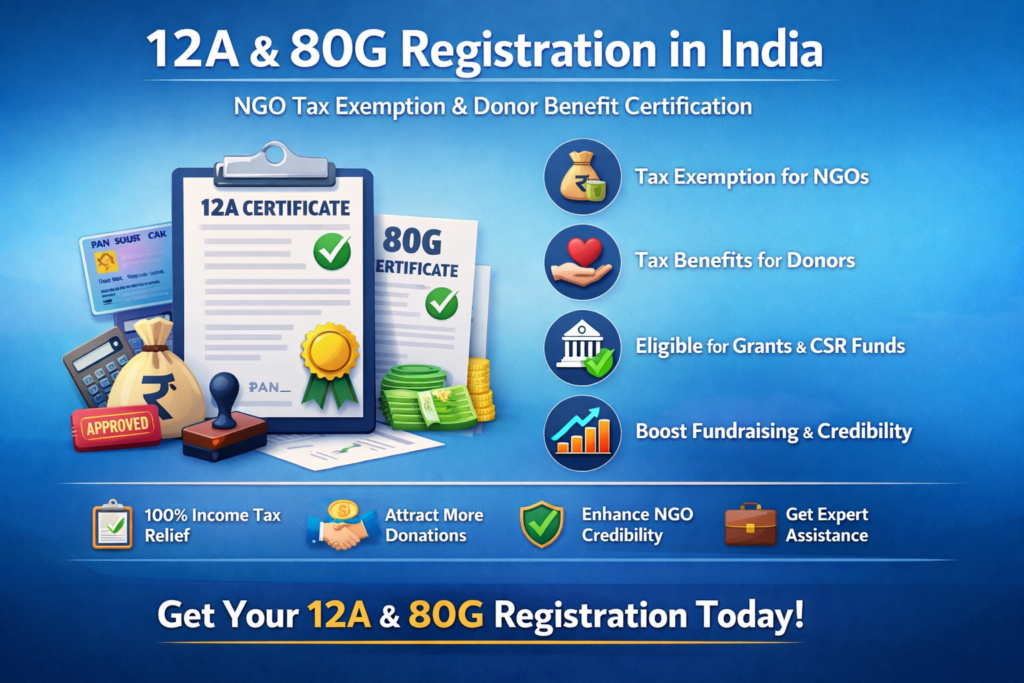
Benefits of 12A & 80G Registration
Obtaining 12A & 80G Registration is essential for NGOs to achieve financial stability, credibility, and long-term growth. These certifications not only provide tax advantages but also strengthen the organization’s ability to attract funding and operate transparently.
1. Complete Income Tax Exemption (12A Benefit)
With 12A Registration, the income of the NGO is exempt from income tax, provided it is used for charitable purposes.
This allows organizations to utilize maximum funds for social activities instead of paying taxes.
2. Tax Benefits for Donors (80G Advantage)
80G Certification allows donors to claim tax deductions on their donations.
This acts as a strong incentive, encouraging individuals and businesses to contribute more to your organization.
3. Increased Donor Trust & Credibility
NGOs with 12A & 80G Registration are considered more reliable and transparent.
Donors prefer contributing to organizations that are legally recognized and tax-compliant.
4. Easier Fundraising Opportunities
Having both registrations significantly improves your chances of receiving donations from:
• Individuals
• Corporates (CSR funding)
• International donors
It becomes easier to raise funds for expansion and social impact.
5. Eligibility for Government Grants
Many government schemes and funding programs require NGOs to have 12A & 80G Registration.
This opens doors to financial support from central and state governments.
6. Better Compliance & Legal Recognition
These registrations ensure your NGO operates within the framework of the Income Tax Act.
It reduces legal risks and enhances the organization’s official standing.
7. Boosts Corporate CSR Funding
Companies prefer NGOs with 80G certification for CSR contributions because it provides tax benefits and ensures compliance.
This increases your chances of receiving large-scale corporate funding.
8. Long-Term Financial Sustainability
Tax exemption + increased donations = stronger financial health.
This helps NGOs sustain operations and scale their impact over time.
9. Builds Strong Public Image
Registered NGOs gain a positive reputation in society.
It reflects transparency, accountability, and commitment to genuine social causes.
10. Encourages Transparent Financial Management
To maintain these registrations, NGOs must keep proper records and accounts.
This leads to better financial discipline and accountability.
11. Lifetime Validity (with Renewal Compliance)
Recent regulations provide long-term validity (subject to renewal conditions), reducing the hassle of frequent reapplications.
12. Supports Expansion & Growth
With increased funding, credibility, and compliance, NGOs can:
• Expand operations
• Launch new projects
• Reach more beneficiaries
Conclusion
12A & 80G Registration is not just a legal requirement—it is a strategic advantage for NGOs. It helps in saving taxes, attracting donors, and building a trustworthy organization that can grow and make a meaningful social impact.
Eligibility Criteria for 12A & 80G Registration (With Documents)
To obtain 12A & 80G Registration in India, an organization must satisfy specific eligibility conditions laid down under the Income Tax Act. These criteria ensure that only genuine charitable entities receive tax benefits.
Eligibility Criteria for 12A Registration
1. Must Be a Registered Non-Profit Entity
The applicant must be legally registered as one of the following:
2. Charitable Purpose Only
The organization must strictly operate for charitable purposes and not for:
3. No Cash Donations Above Prescribed Limit
To qualify for donor tax benefits:
4. Proper Maintenance of Donation Records
NGOs must maintain:
5. No Discriminatory Practices
The NGO should not work for the benefit of:
6. Compliance with Income Tax Rules
The organization must comply with:
Documents Required for 12A & 80G Registration
Basic Organizational Documents
Identity & Address Proof
Financial Documents
For existing NGOs:
Activity Proof
Additional Documents for 80G
Digital Requirements
How We Help You Build a Strong Legal Foundation
Expert Guidance
We analyze your NGO structure and suggest the right registrations for full legal compliance.
Accurate Documentation
We prepare and verify all required documents to avoid errors and rejections.
Hassle-Free Filing
We handle the complete application process for 12A & 80G registration from start to finish.
Ongoing Compliance Support
We assist with post-registration requirements to keep your NGO legally strong and audit-ready.
Step-by-Step Process for 12A & 80G Registration
Getting 12A & 80G Registration involves a structured online process through the Income Tax portal. Here’s how it works:
Step 1 – Register Your NGO
Before applying, your organization must be legally registered as:
• Trust
• Society
• Section 8 Company
Without this, you cannot proceed with 12A & 80G application.
Step 2 – Obtain PAN Card
Apply for a PAN card in the name of the NGO.
This is mandatory for filing the application with the Income Tax Department.
Step 3 – Prepare Required Documents
Collect and organize all necessary documents such as:
• Trust Deed / MOA / AOA
• Registration Certificate
• ID & Address proof of members
• NGO address proof
• Bank details & statements
• Activity proof (if available)
Proper documentation ensures faster approval.
Step 4 – Create Account on Income Tax Portal
Register your NGO on the official Income Tax e-filing portal using:
• PAN of the organization
• Email ID and mobile number
Step 5 – File Online Application (Form 10A / 10AB)
Submit the application using:
• Form 10A – For new registration
• Form 10AB – For renewal or modification
Fill in all details carefully, including:
• Organization details
• Objectives
• Activities
• Financial information
Step 6 – Upload Documents
Attach all required documents in the prescribed format on the portal.
Incomplete or incorrect uploads may delay approval.
Step 7 – Verification & Authentication
Verify the application using:
• Digital Signature Certificate (DSC) or
• Aadhaar-based OTP (for authorized signatory)
Step 8 – Review by Income Tax Department
The Income Tax Department will:
• Examine your application
• Verify documents
• May request additional clarification or information
Step 9 – Respond to Queries (If Any)
If any notice is issued, respond within the given time with proper documents and explanations.
Step 10 – Approval & Certificate Issuance
Once approved, you will receive:
• 12A Registration Certificate (Tax exemption for NGO)
• 80G Certificate (Tax benefit for donors)
These certificates are issued digitally.
Step 11 – Post-Registration Compliance
After registration, ensure:
• Proper maintenance of accounts
• Filing of income tax returns (if applicable)
• Timely renewal (as per new rules)
Importance of 12A & 80G Registration for NGOs
12A and 80G registration significantly enhance the financial and legal credibility of NGOs. These registrations help organizations attract donors, obtain funding, and operate in a transparent manner.
They also encourage individuals and businesses to contribute to social causes because donations become eligible for tax deductions.
As a result, NGOs can expand their activities and create a greater impact in society.
Advantages of 12A & 80G Registration
1. Income Tax Exemption (12A)
NGOs are exempt from paying income tax on surplus funds used for charitable purposes, allowing more funds to be utilized for social activities.
2. Tax Benefits for Donors (80G)
Donors can claim deductions on their contributions, making your NGO more attractive for fundraising.
3. Increased Credibility
Registered NGOs gain higher trust among donors, government bodies, and corporate organizations.
4. Better Fundraising Opportunities
Eligibility for CSR funding, grants, and international donations increases significantly.
5. Legal Recognition
Ensures your NGO operates under proper legal compliance, reducing risks and penalties.
6. Access to Government Grants
Many government schemes require NGOs to have 12A & 80G registration.
7. Long-Term Financial Sustainability
Tax savings combined with increased donations support long-term growth and expansion.
8. Transparency & Accountability
Encourages proper bookkeeping and financial discipline, improving operational efficiency.
Disadvantages of 12A & 80G Registration
1. Strict Compliance Requirements
NGOs must maintain proper books, file returns, and follow Income Tax rules regularly.
2. Limited Use of Funds
Funds must be used strictly for charitable purposes; misuse can lead to cancellation.
3. Regular Monitoring by Authorities
Income Tax Department may review activities, accounts, and operations periodically.
4. Renewal & Validity Conditions
Registrations are not always permanent and may require renewal under updated regulations.
5. Restrictions on Activities
Certain activities, especially profit-oriented or benefiting specific groups, may not be allowed.
6. Documentation Burden
Proper documentation, reporting, and audit requirements can be time-consuming.
7. Penalties for Non-Compliance
Failure to comply with rules may lead to penalties or cancellation of registration.
Register Your 12A & 80G Registration with Jistartup
Take the next step towards building a legally strong and financially sustainable NGO with expert support from Jistartup. We simplify the entire process of 12A & 80G Registration, ensuring accuracy, speed, and complete compliance.
Whether you are starting a new NGO or managing an existing one, our team handles everything—from documentation to final approval—so you can focus on your mission and social impact.
Get Started Today
Don’t miss out on tax benefits and donor trust. Register your NGO under 12A & 80G and unlock greater funding opportunities.
👉 Contact Jistartup now and get your registration process started quickly and smoothly.
See What Our Clients Are Saying
“The team at Jistartup handled our registration and compliance work very efficiently. Their clear guidance made the process quick and stress-free. A great partner for new entrepreneurs.”
“We opted for Virtual Office services from Office Space Provider along with company registration through Jistartup. The documentation was handled perfectly and got approved without any hassle. Very professional experience.”
Frequently Asked Questions (FAQs)
1. Can a newly formed NGO apply for 12A & 80G registration immediately?
Yes, newly registered NGOs can apply right away. They do not need to wait or show prior activity, but proper documentation and clear objectives are essential.
2. Is it mandatory to have an office space for registration?
Yes, an NGO must have a registered office address. It can be owned or rented, but valid address proof and NOC (if rented) are required.
3. Can one application cover both 12A and 80G registration?
Yes, both registrations can be applied simultaneously through the same online process, making it easier and time-saving.
4. What happens if my application gets rejected?
If rejected, you can reapply after correcting the issues or file an appeal, depending on the reason for rejection.
5. Is there any minimum donation requirement to apply for 80G?
No, there is no minimum donation requirement. Even NGOs that have not yet received donations can apply.
6. Can an NGO operate without 12A & 80G registration?
Yes, but it will not receive tax benefits, and fundraising will be more difficult due to lack of donor incentives.
7. Do foreign donations require separate registration?
Yes, to receive foreign donations, NGOs must obtain FCRA Registration, which is separate from 12A & 80G.
8. Can registration be cancelled after approval?
Yes, if the NGO violates rules, misuses funds, or fails to comply with regulations, the registration can be cancelled by authorities.
9. Is audit mandatory for NGOs with 12A registration?
Audit is required if the NGO’s income exceeds the prescribed limit under the Income Tax Act.
10. Can changes in NGO structure affect the registration?
Yes, major changes such as objectives, trustees, or structure must be updated with the Income Tax Department to avoid compliance issues.
