

Director Change in Company – Professional & Hassle-Free Service
A company’s directors play a crucial role in managing operations, making strategic decisions, and ensuring legal compliance. As businesses grow and evolve, changes in management are common. A director may resign, a new director may be appointed to bring expertise, or an existing director may be removed due to organizational restructuring.
Any change in the Board of Directors must be carried out in accordance with the Companies Act, 2013 and reported to the Ministry of Corporate Affairs (MCA) within the prescribed timelines.
JiStartup offers complete assistance for director appointment, resignation, removal, and ROC filings. Our experienced compliance professionals ensure that every step is completed accurately, efficiently, and in compliance with legal requirements.
Why Change a Company Name?
Director Change refers to any modification in the composition of a company’s Board of Directors. This includes:
Every change must be properly documented and reported to the Registrar of Companies (ROC).
Why Companies Need Director Changes
Companies may require director changes for various reasons:
Business Expansion
Growing businesses often appoint additional directors to bring new expertise and leadership.
Strategic Management Changes
Companies may restructure management to improve efficiency and decision-making.
Director Resignation
A director may voluntarily resign due to personal, professional, or health-related reasons.
Investor Requirements
Investors may require board restructuring as part of funding agreements.
Compliance Requirements
Certain companies must maintain minimum director requirements under the Companies Act.
Succession Planning
Organizations often appoint new directors to ensure business continuity.
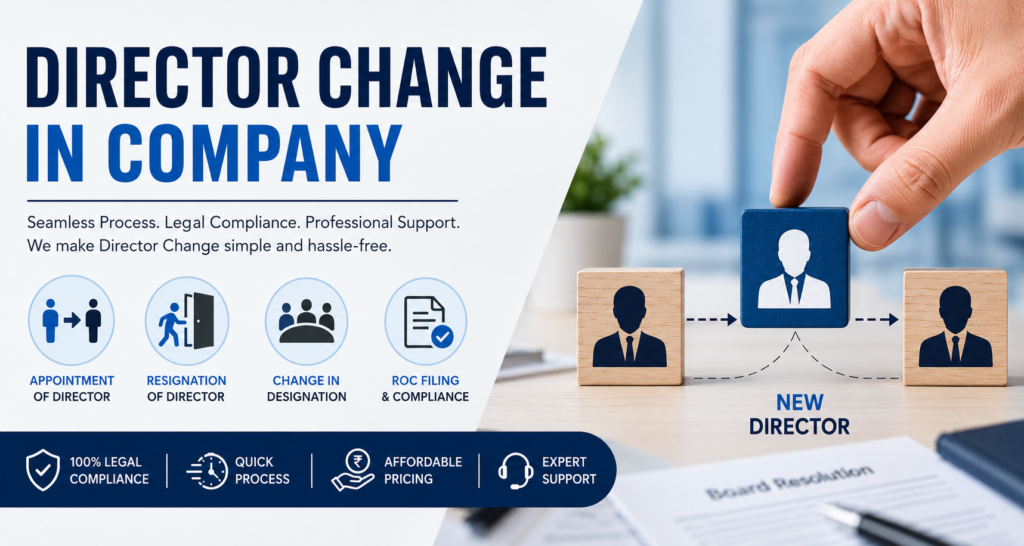
Types of Director Changes
Appointment of a New Director
A company can appoint a new director through a board resolution and shareholder approval wherever required.
Benefits include:
Resignation of Director
A director may resign by submitting a written resignation to the company.
The company must:
Removal of Director
A director may be removed by shareholders through a special procedure outlined under the Companies Act.
Reasons may include:
Appointment of Additional Director
The Board may appoint an additional director if authorized by the Articles of Association.
Such appointments are generally regularized by shareholders at the next general meeting.
Legal Requirements for Director Appointment
Before appointing a director, the following conditions must be fulfilled:
Documents Required for Director Change
For New Director Appointment
For Director Resignation
Company Documents
Documents Required for Director Change
For New Director Appointment
For Director Resignation
Company Documents
Registered Office Address Proof
The registered office is the official communication address of the company.
Required documents:
A virtual office address is legally accepted for company registration and GST purposes.
How We Help You Build a Strong Legal Foundation
✅ Accurate Documentation
Prepare and verify all required legal documents correctly.
✅ Regulatory Compliance
Ensure compliance with MCA and statutory requirements.
✅ Expert Professional Support
Guidance from experienced compliance and legal experts.
✅ Timely Filings & Updates
Complete filings on time to avoid penalties and legal issues.
Step-by-Step Process for Director Change
Step 1: Consultation and Documentation
Our experts review the company structure and collect the required documents.
Step 2: Verification of Director Eligibility
We verify DIN status, compliance requirements, and legal eligibility.
Step 3: Drafting Resolutions
Necessary Board Resolutions and shareholder resolutions are prepared.
Step 4: Board Meeting
The company conducts a Board Meeting to approve the proposed changes.
Step 5: Obtain Director Consent
The incoming director provides written consent to act as director.
Step 6: ROC Filing
Required forms are filed with the Ministry of Corporate Affairs.
Step 7: Approval and Compliance Update
Upon successful filing, company records are updated and compliance is completed.
Timeline for Director Change
Total Timeline
Generally completed within 5 to 10 working days.
Benefits of Professional Director Change Services
100% Compliance
Avoid penalties and legal issues through accurate filing.
Expert Guidance
Professional assistance at every stage.
Faster Processing
Reduced delays through proper documentation.
Error-Free Filing
Minimize rejection risks from MCA.
End-to-End Support
From documentation to final approval.
Consequences of Non-Compliance
Failure to report director changes may result in:
Timely filing is essential to maintain good corporate standing.
Advantages of Director Change in a Company
1. Fresh Leadership and Expertise
A new director can bring valuable industry experience, innovative ideas, and strategic insights that contribute to the company’s growth and competitiveness.
2. Improved Corporate Governance
Adding qualified directors strengthens decision-making, accountability, and compliance, leading to better management of business operations.
3. Supports Business Expansion
As businesses grow, appointing additional directors helps distribute responsibilities and provides specialized expertise in key areas.
4. Increased Investor and Stakeholder Confidence
A strong and experienced board enhances the company’s credibility, making it more attractive to investors, lenders, and business partners.
5. Better Compliance Management
Directors with compliance knowledge can help ensure that the company meets its legal and regulatory obligations effectively.
6. Smooth Succession Planning
Director changes allow companies to prepare future leaders and ensure continuity in management without disrupting operations.
Disadvantages of Director Change in a Company
1. Compliance and Filing Costs
Director changes involve legal documentation, ROC filings, and professional fees, which can increase administrative expenses.
2. Time-Consuming Process
The process requires board resolutions, documentation, and regulatory filings, which may take several days to complete.
3. Temporary Operational Disruptions
When a key director leaves, the company may experience a temporary gap in leadership and decision-making.
4. Adjustment Period for New Directors
Newly appointed directors often need time to understand company operations, policies, and business objectives.
5. Risk of Internal Conflicts
Differences in management styles, opinions, or strategic visions may occasionally lead to disagreements among board members.
6. Increased Compliance Responsibilities
Every director has statutory duties and liabilities, requiring ongoing attention to governance and regulatory compliance.
How JiStartup Makes Director Changes Easy
Changing directors can seem complex due to legal requirements and ROC procedures. JiStartup simplifies the entire process by managing documentation, drafting resolutions, filing forms, and coordinating compliance activities.
Our goal is to help businesses complete director changes smoothly while ensuring complete legal compliance and minimal disruption to operations.
See What Our Clients Are Saying
“The team at Jistartup handled our registration and compliance work very efficiently. Their clear guidance made the process quick and stress-free. A great partner for new entrepreneurs.”
“We opted for Virtual Office services from Office Space Provider along with company registration through Jistartup. The documentation was handled perfectly and got approved without any hassle. Very professional experience.”
❓ Smart Pvt Ltd Registration – Important Doubts Businesses Actually Have
1. Can a director be changed without changing the ownership of the company?
Yes. A director change only affects the management structure of the company. Shareholding and ownership remain unchanged unless shares are separately transferred.
2. Can a company appoint a director who lives outside India?
Yes. A foreign national or Non-Resident Indian (NRI) can be appointed as a director, subject to compliance with applicable laws and documentation requirements.
3. Is a Digital Signature Certificate (DSC) required for a new director?
Yes. A valid DSC is required for filing forms and documents electronically with the MCA portal.
4. Can an existing shareholder become a director?
Yes. A shareholder can be appointed as a director if they meet the eligibility criteria prescribed under the Companies Act, 2013.
5. Will the company's bank account be affected after a director change?
In some cases, banks may require updated board resolutions and KYC documents to revise authorized signatories. The company should inform its bank after the change.
6. Can multiple directors be appointed or resigned at the same time?
Yes. A company can appoint or accept the resignation of multiple directors simultaneously, subject to maintaining the minimum statutory number of directors.x
7. Does a director change affect existing contracts or agreements?
No. Existing contracts, licenses, and business agreements generally remain valid because the company continues as the same legal entity.
8. What happens if the company falls below the minimum required number of directors?
The company must appoint a new director as soon as possible to comply with legal requirements and avoid regulatory penalties.
9. Can a director receive remuneration after appointment?
Yes. Directors may receive remuneration, sitting fees, or other benefits as approved by the company and permitted under applicable laws.
10. Should customers, vendors, and government authorities be informed about the director change?
While not always mandatory, it is advisable to update important stakeholders, banks, government departments, and key business partners to ensure smooth operations and record accuracy.
