
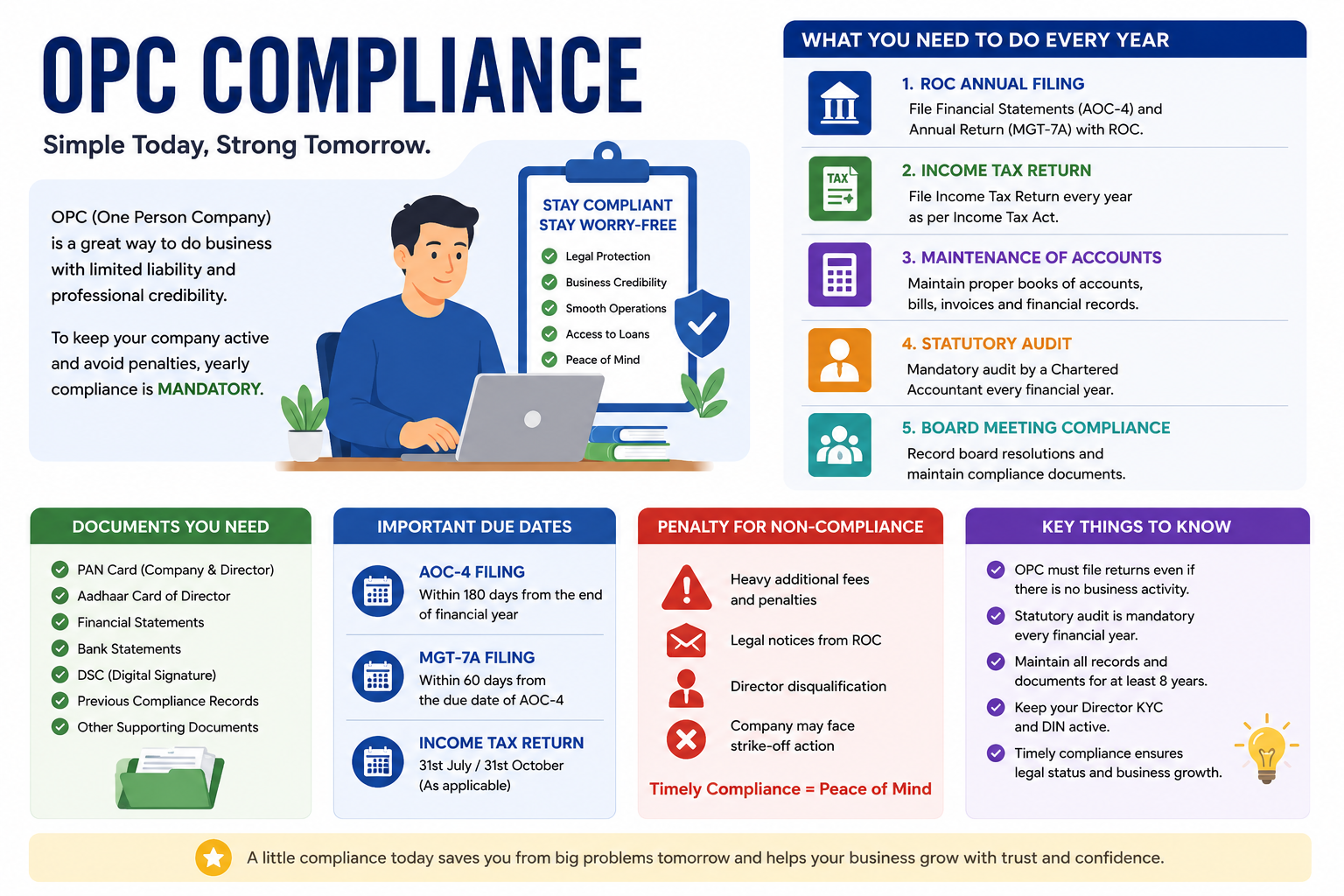
OPC Compliance Services by JiStartup
Running a One Person Company (OPC) in India comes with various legal and statutory responsibilities. Even though OPCs are designed to simplify entrepreneurship for solo business owners, annual compliance under the Ministry of Corporate Affairs is mandatory.
At JiStartup, we provide professional OPC compliance services to help businesses stay legally active, avoid penalties, and maintain smooth operations. Our experts handle everything from ROC filing to annual returns and tax compliance, ensuring complete peace of mind for entrepreneurs.
Whether you are a startup founder, freelancer, consultant, digital marketer, IT professional, trader, or service provider operating through an OPC, our compliance solutions are designed to make your business legally secure and fully compliant.
What is a One Person Company (OPC)?
A One Person Company is a business structure introduced under the Companies Act, 2013 that allows a single entrepreneur to operate a company with limited liability protection.
Unlike sole proprietorships, OPCs provide a separate legal identity, better credibility, and easier access to funding opportunities. However, every OPC must comply with mandatory annual filing and regulatory requirements.
What is OPC Compliance?
OPC compliance refers to the legal filings, financial reporting, taxation, and statutory requirements that every OPC must complete annually to remain active under the Registrar of Companies (ROC).
Compliance ensures that the company’s operations remain transparent and legally valid under Indian corporate laws.
Failure to comply may lead to:
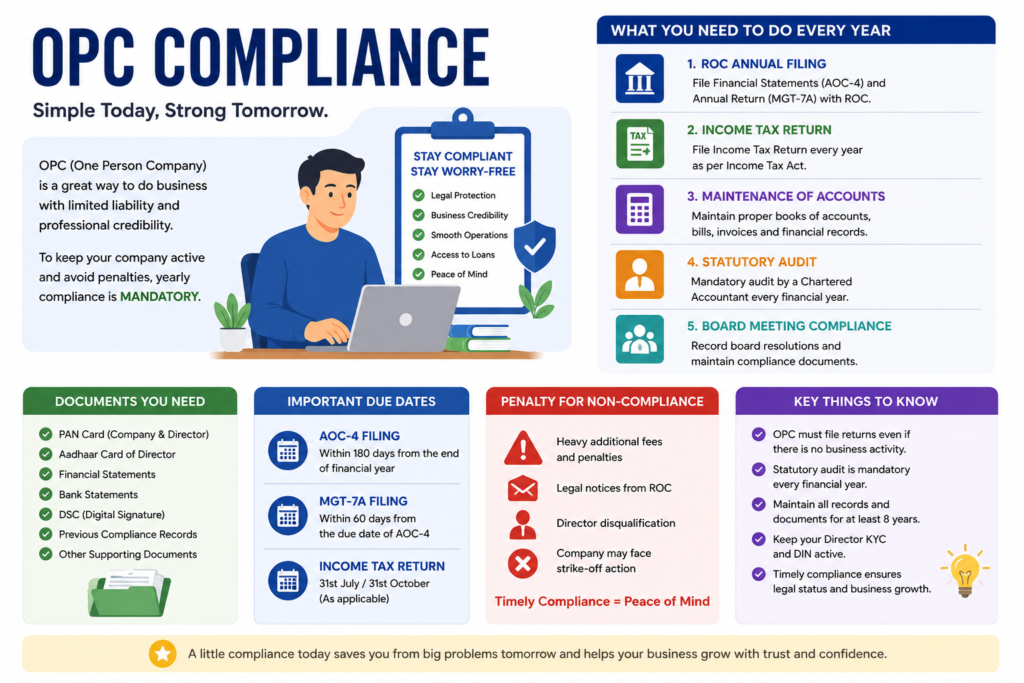
Why OPC Compliance is Important
Many business owners believe that small businesses or single-owner companies do not require extensive compliance. However, OPC compliance is compulsory irrespective of business activity.
Benefits of Proper OPC Compliance
Legal Protection
Maintains your company’s legal status and protects against penalties.
Better Business Credibility
Investors, banks, and clients trust compliant businesses more.
Easy Loan & Funding Approval
Financial institutions prefer legally compliant companies.
Smooth Business Operations
Avoid disruptions caused by government notices or legal issues.
Improved Financial Management
Regular compliance ensures accurate bookkeeping and financial records.
Business Expansion Opportunities
Compliance helps when converting OPC into Private Limited Company later.
Mandatory OPC Compliance Requirements in India
Every OPC registered in India must fulfill several statutory requirements annually.
1. ROC Annual Filing
ROC filing is one of the most important compliance requirements for OPCs.
Forms to be Filed:
Purpose:
Late filing attracts additional fees on a daily basis.
2. Income Tax Return Filing
Every OPC must file income tax returns every financial year, regardless of profit or loss.
Includes:
Proper tax filing helps avoid notices from the Income Tax Department.
3. Statutory Audit
A statutory audit is mandatory for OPCs.
Audit Includes:
The audit must be conducted by a qualified Chartered Accountant.
4. Auditor Appointment
An auditor must be appointed within the prescribed timeline after incorporation.
Purpose:
5. Maintenance of Books of Accounts
Every OPC must maintain:
Proper bookkeeping simplifies annual filing and taxation.
6. Director KYC Compliance
Directors may be required to complete KYC compliance to keep DIN active.
Failure may result in DIN deactivation.
Documents Required for OPC Compliance
To complete annual compliance smoothly, the following documents are generally required:
Company Documents
Director Documents
Financial Documents
A virtual office address is legally accepted for company registration and GST purposes.
How We Help You Build a Strong Legal Foundation
Proper Company Compliance
We ensure your OPC meets all mandatory ROC and legal compliance requirements.
Accurate Documentation
Our experts prepare and maintain error-free financial and statutory documents.
Timely Annual Filings
We help you avoid penalties with on-time ROC and tax filings.
Expert Professional Support
Get dedicated guidance from compliance professionals throughout the process.
Step-by-Step OPC Compliance Process
Step 1 – Consultation
We understand your company’s compliance status and requirements.
Step 2 – Document Collection
Required financial and company documents are collected.
Step 3 – Accounting & Review
Financial records are reviewed and prepared.
Step 4 – ROC Filing
Forms are filed with ROC accurately.
Step 5 – Tax Filing
Income tax returns are prepared and submitted.
Step 6 – Compliance Confirmation
Acknowledgement and filing confirmation are shared.
Importance of Timely OPC Compliance
Timely compliance is essential for maintaining the active status of your One Person Company. Regular filing of annual returns and financial statements not only avoids penalties but also improves the reputation and reliability of your business.
A compliant business gains more trust from:
Maintaining proper compliance also helps during:
Why Startups Prefer OPC Structure
Many solo entrepreneurs and startups choose the OPC model because it combines the advantages of a company structure with simplified ownership.
Key Reasons:
Challenges Faced by OPC Owners
While OPC offers many benefits, entrepreneurs often struggle with legal and compliance responsibilities.
Common Challenges:
JiStartup simplifies the entire process with expert compliance assistance.
Benefits of Professional OPC Compliance Services
Hiring professionals for OPC compliance helps businesses save time, reduce risks, and ensure accurate filing.
Professional Compliance Advantages:
This certificate legally confirms the formation of your company in India.
Advantages of Registering a Private Limited Company
1. Limited Liability Protection
One of the biggest advantages of OPC is limited liability protection.
In an OPC, the owner’s personal assets remain protected from business liabilities and debts. If the business faces losses or legal claims, the liability of the owner is generally limited to the amount invested in the company.
Benefits:
- Personal savings remain safer
- Reduced financial risk
- Better security for entrepreneurs
- Professional business structure
This advantage makes OPC far more secure than a sole proprietorship.
2. Separate Legal Entity
An OPC has its own legal identity separate from its owner.
This means the company can:
- Own assets
- Open bank accounts
- Enter legal contracts
- File lawsuits
- Continue operations independently
The company’s existence is not directly tied to the owner personally.
Benefits:
- Improved business credibility
- Better operational structure
- Easier legal management
- Professional identity
3. Single Owner Control
Unlike partnerships or private limited companies requiring multiple shareholders, OPC allows complete control by one individual.
The owner can make business decisions independently without conflicts or approval delays.
Benefits:
- Faster decision-making
- Full ownership rights
- Better operational flexibility
- Easy management
This is highly beneficial for startups and solo entrepreneurs.
4. Better Business Credibility
Businesses registered as OPC generally appear more professional and trustworthy compared to unregistered businesses or sole proprietorships.
Clients, vendors, banks, and investors often prefer dealing with legally registered entities.
Benefits:
- Improved market reputation
- Higher client trust
- Better vendor relationships
- Increased business opportunities
5. Easy Fundraising Opportunities
OPCs may find it easier to access:
- Bank loans
- Financial support
- Business credit facilities
Since OPCs maintain structured financial records and legal compliance, lenders often consider them more reliable.
Benefits:
- Easier loan approval
- Improved financial transparency
- Better investment opportunities
6. Continuous Business Existence
An OPC enjoys perpetual succession, meaning the company can continue even if ownership changes.
A nominee appointed during incorporation helps ensure continuity.
Benefits:
- Business stability
- Long-term operational continuity
- Reduced uncertainty
7. Easy Company Management
OPC compliance requirements are simpler compared to larger companies.
For example:
- No mandatory Annual General Meeting (AGM)
- Fewer shareholder-related formalities
- Simplified management structure
Benefits:
- Easier administration
- Lower management complexity
- Faster compliance handling
8. Tax Planning Advantages
OPCs can claim legitimate business expenses and deductions while calculating taxable income.
Benefits:
- Better financial planning
- Organized expense management
- Structured accounting
9. Suitable for Startups & Freelancers
OPC is ideal for:
- Startup founders
- Freelancers
- Consultants
- IT professionals
- Digital marketers
- Designers
- Online business owners
It provides a professional structure without requiring multiple owners.
10. Improved Brand Image
Operating as a registered company improves brand perception.
Customers often feel more confident working with registered businesses than informal entities.
Benefits:
- Better branding opportunities
- Increased customer trust
- Professional company image
Disadvantages of OPC
1. Mandatory Annual Compliance
Even though OPC is operated by a single owner, annual compliance requirements are mandatory.
Includes:
- ROC filing
- Financial statement filing
- Income tax return filing
- Audit requirements
Challenges:
- Additional professional costs
- Time-consuming procedures
- Filing deadlines
Non-compliance may result in penalties.
2. Statutory Audit Requirement
Every OPC must conduct a statutory audit regardless of turnover in many situations.
Challenges:
- Increased compliance cost
- Need for Chartered Accountant services
- Annual audit expenses
Small businesses may find this financially burdensome initially.
3. Limited Business Expansion Flexibility
OPC structure is suitable mainly for single ownership businesses.
As the company grows, conversion into a Private Limited Company may become necessary.
Challenges:
- Structural limitations
- Ownership restrictions
- Expansion complications
4. Only One Shareholder Allowed
An OPC can have only one shareholder at a time.
Challenges:
- No co-founder ownership
- No equity sharing initially
- Limited partnership flexibility
Businesses planning multiple founders may not prefer OPC.
5. Higher Compliance Cost than Proprietorship
Compared to sole proprietorship businesses, OPC compliance costs are relatively higher.
Includes:
- ROC filing fees
- Professional service charges
- Audit expenses
- Tax filing charges
This may affect very small businesses or beginners.
6. Conversion Requirements After Growth
In certain situations, OPC may require conversion into another company structure based on business growth or compliance requirements.
Challenges:
- Additional legal procedures
- Extra documentation
- Compliance transition effort
7. More Government Regulations
OPCs are regulated under corporate laws and monitored by the Registrar of Companies.
Challenges:
- Strict filing requirements
- Regulatory oversight
- Legal formalities
Business owners must stay updated with changing compliance rules.
8. Penalties for Non-Compliance
Failure to complete compliance on time may attract:
- Additional filing fees
- Government penalties
- Legal notices
- Director-related issues
Even inactive OPCs must complete annual filings.
9. Business Closure Can Be Time-Consuming
Closing an OPC legally requires formal procedures and approvals.
Challenges:
- Documentation process
- Legal formalities
- Government filing procedures
Business closure is more complex compared to proprietorships.
10. Limited Investment Flexibility
Since OPC has only one shareholder, raising equity investment may become difficult in early stages.
Challenges:
- Limited equity participation
- Investor structure limitations
- Ownership restrictions
Businesses seeking large-scale external investment may later need conversion.
Why Choose JiStartup for OPC Compliance?
Experienced Professionals
Our experts understand ROC and tax compliance thoroughly.
Affordable Pricing
Budget-friendly compliance packages for startups and small businesses.
Complete End-to-End Support
From documentation to filing, we handle everything.
Fast & Reliable Service
Timely filing to avoid penalties.
Dedicated Customer Support
Get professional guidance whenever required.
Transparent Process
No hidden charges or unnecessary complications.
See What Our Clients Are Saying
“The team at Jistartup handled our registration and compliance work very efficiently. Their clear guidance made the process quick and stress-free. A great partner for new entrepreneurs.”
“We opted for Virtual Office services from Office Space Provider along with company registration through Jistartup. The documentation was handled perfectly and got approved without any hassle. Very professional experience.”
Frequently Asked Questions (FAQs)
1. Is annual filing mandatory for OPC?
Yes, annual filing is compulsory for every OPC registered in India.
2. Is audit compulsory for OPC?
Yes, statutory audit is mandatory.
3. What happens if OPC does not file ROC returns?
Late fees, penalties, and legal action may apply.
4. Can a dormant OPC avoid compliance?
No, even dormant OPCs must complete mandatory filings.
5. Can JiStartup handle complete OPC compliance?
Yes, we provide complete end-to-end compliance support.
6. How long does OPC compliance take?
Usually depends on document availability and filing requirements.
7. Is GST filing included in OPC compliance?
GST filing can be provided separately if applicable.
8. Can OPC be converted into Private Limited Company?
Yes, conversion is possible under prescribed rules.
9. Why is bookkeeping important for OPC compliance?
Proper bookkeeping ensures accurate filing and avoids penalties.
10. How can I start OPC compliance with JiStartup?
Simply contact our team and share your business details.
